Contemplation, Sacrifice, and Service – 16th Sunday in Ordinary Time – Sermon by Father Levine
Fr. Joseph Levine; Holy Family Catholic Church and Missions; July 20, 2025
The image of Mary, the sister of Martha, sitting at the feet of Jesus, listening to him speak, has since ancient times, been seen as an image of the contemplative life and also the priority of the contemplative life, the one thing necessary. For ourselves, however active our life, we each need to have something of Mary, sitting at the feet of Jesus, in our hearts, or at least the real desire for it, otherwise we are missing the one thing necessary.
Martha, then, as she appears in this Gospel, complaining about Mary, represents not so much the active life, as the active life devoid of contemplation, the active life that is not rooted in contemplation. This easily degenerates into the spirit of “activism”, which judges all things by their earthly utility and so sees contemplation as “useless”.
Nevertheless, no matter how much serving we do, if that serving is not rooted in the love of God, it is worthless in the eyes of God. St. Paul wrote, If I give away all I have, and I deliver my body to be burned, but have not love, I am nothing. (1 Cor 13:3) We could elaborate on his words and say, If I dedicate all my waking hours to serving those in need, but have not love, I am nothing.
Truly fruitful human activity is rooted it the contemplative love of God; such activity is not the purpose of contemplation, the one thing necessary, but the overflow of contemplation. Where there is the spirit of true contemplation, there will also be truly fruitful human activity.
Concluding the parable of the vine and the branches, Jesus said, By this is my Father glorified, that you bear much fruit, and so prove to be my disciples. The much fruit refers to the works of the love of God, including the interior works of the heart, which are the root of the exterior works, and which are seen only by the Father who sees in secret. (cf. Mt 6:4,6,18)
As for the love of God, that must be rooted in the intimate knowledge of God gained through contemplation. Contemplation of God speaks of “gazing upon God,” but since we do not see God directly, we no longer even see Jesus, God made visible, directly – the closest we can come now is through the Holy Eucharist, in the Mass and Adoration – the contemplation of God, in this life, must be rooted in faith in his word and listening to his word in faith. We cannot see Jesus quite like Mary did, but we can listen to his word as Mary did. His word directs our gaze so that we can pass through what is seen, like the appearances of bread and wine, to what is not seen, the Body and Blood of Christ and the mystery of the Holy Trinity.
In this spirit of contemplation, rooted in faith in the word of God, we can now turn our attention to today’s first reading. The word describes for us a visible, historical scene, Abraham welcoming and showing hospitality to three mysterious strangers who, in the end, promise him that his wife Sarah, who is long past the age of child-bearing, will bear him a son. Abraham’s vision is fruitful, supernaturally fruitful, in the miraculous birth of Isaac, who will be offered in sacrifice like Christ and who carries the promise of the patriarchs, the promise of Christ to come, the Son of God made man, the Son of God made the son of Abraham.
Abraham “serves” the strangers, but the same word “service” (like waiting on tables) is used in languages ancient and modern for the worship of God, the divine “service”, waiting upon God.
Attend to the words: The Lord [singular] appeared to Abraham; but Abraham saw three men; yet, he addressed them as one. This interplay of the three and one led the Fathers of the Church to recognize the manifestation of the Holy Trinity to Abraham. This gave rise to an ancient saying rooted in the writings of St. Augustine, (cf. On the Trinity, Bk II.10-12) “He saw three and he adored one.”
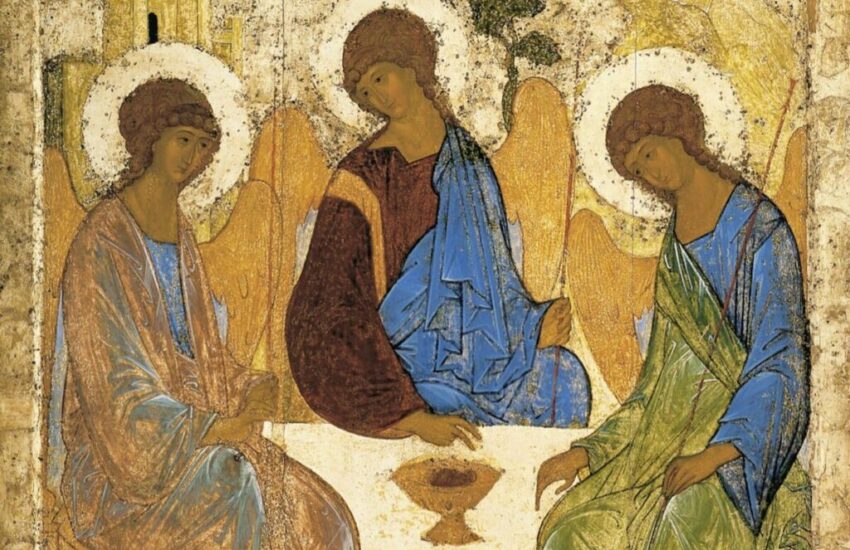
In the early 15th century, the Russian iconographer, Andrei Rublev, painted what has since become one of the most renown icons, an icon which depicts the three men, seen by Abraham. The icon depicts the men as angels with wings, but the title of the icon is “The Holy Trinity.” Faithful to the interpretation of the ancient fathers, Rublev, interprets the history as three angels, representing the persons of the Holy Trinity, appearing in human form to Abraham.
Part of the beauty of the icon is in the layers of representation: the Holy Trinity is hidden in the three angels, who are hidden in the historical vision.
The angels are seated around a table, open to the viewer, who sees from the perspective of Abraham. Without entering into too much detail, the angel on the left represents the person of the Father; the angel behind the table represents the person of the Son; the angel on the right of the viewer represents the person of the Holy Spirit. The heads of the Son and the Holy Spirit are bowed slightly in the direction of the Father, as though to acknowledge their origin.
Behind the representation of the Holy Spirit there is a mountain crag in the desert, representing the “mountain of God,” the place of prayer. The Holy Spirit leads us by means of prayer to intimate knowledge and love of the Son of God. In the words of Jesus, The Spirit of truth … will glorify me, for he will take from what is mine and declare it to you. (Jn 16:13,14) Behind the representation of the Son is the terebinth of Mamre, where the historical vision takes place, but which represents the Cross of Christ as the true tree of life. Behind the representation of the Father is the “house of the Father”. The Holy Spirit leads us through prayer to the knowledge of the Son, who leads us, through his Cross, to the supreme goal, union with God in the Father’s house. (cf. Jn 14:2,6)
The Holy Trinity, represented in this icon, is the supreme object and goal of all contemplation. While traditional iconography invites to contemplation there is perhaps no other icon that issues, so to speak, such a powerful invitation.
There is, however, one key detail that I have not yet mentioned. The icon is open to the viewer, the perspective of Abraham. All three persons look out at the viewer and there is, in their midst, an open space, and in that space a table, and on that table a meal, the tender steer offered by Abraham to his guests.
While Abraham offered and served the meal to his guests, and stood to serve them, in the icon it is as though the three invite the viewer to partake also of the meal. That indeed is the reality represented by the icon. The meal is the sacrificial banquet of Christ the Lamb of God, offered to God, the Most Holy Trinity, in the service of true worship, through which we, united to Christ, in communion with him, enter into communion with the Holy Trinity. (cf. 1 Jn 1:3) Through the sacrificial offering of the sacred humanity, the Body and Blood of Jesus Christ, the Son of God, we are united to the one God, the Father, and the Son, and the Holy Spirit.
There is more. When we contemplate the icon, we gaze on a reality that is outside ourselves as indeed God is both outside and infinitely above us. At the same time, we gaze upon a reality that has entered into us through the life of grace in the Holy Spirit. Again, the words of Jesus, If you love me, you will keep my commandments. And I will pray the Father, and he will give you another Advocate, to be with you forever, even the Spirit of truth, whom the world cannot receive, because it neither sees him nor knows him; but you know him, for he dwells in you, and will be in you … If a man loves me, he will keep my word, and my Father will love him, and we will come to him and make our home with him. (Jn 14:15-17,23-24)
Communion means mutual indwelling, our dwelling in God and his dwelling in us. And so Jesus says, he who eats my flesh and drinks my blood abides in me, and I in him. As the living Father sent me, and I live because of the Father, so he who eats me will live because of me. (Jn 6:56-57)
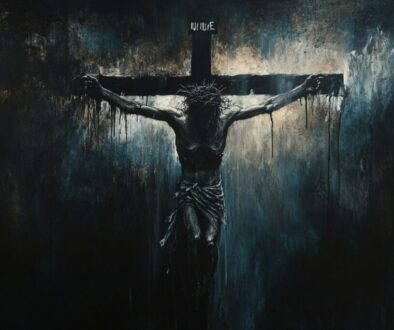
Yet, it is not insignificant that Abraham slew that steer just as Christ was slain upon the Cross; it is through the one sacrificial death of Christ, offered anew in the Holy Sacrifice of the Mass, that we enter into communion with God, that we come to dwell in him and he in us.
That brings us to today’s 2nd reading, which we could speak of as the “fruit of contemplation” that must lie at the root of all truly fruitful activity.
I rejoice in my sufferings for your sake, and in my flesh I am filling up what is lacking in the afflictions of Christ on behalf of his body, which is the Church. This is what is means to share in Christ’s love.
In the first place, if it is through the Cross of Christ that we are united to God, then the image of Christ crucified must be reproduced in us for us to be united to God. It is the Spirit himself bearing witness with our spirit that we are children of God, and if children then heirs, heirs of God and fellow heirs with Christ, provided we suffer with him in order that we may be glorified with him. (Rm 8:16-17) And, The saying is sure: If we have died with him, we shall also live with him. (2 Tim 2:11)
Yet, just as Christ’s suffering was fruitful for our salvation, fruitful bringing forth the life of grace, the life of the children of God, in us, so when our suffering is united to his, when we offer our suffering through, with, and in him, when we bring our suffering to unite to his in the holy sacrifice of the Mass, our suffering is fruitful not only for our own salvation but for others as well, even for those who are presently unknown to us, whom we will come to know only in the heavenly kingdom.
There is so much suffering in the world today. Alas, it appears that very little of it is fruitful, because very little of it is consciously and intentionally united to the suffering of Christ.
When we see someone in need, like in the Gospel of the Good Samaritan that we heard last Sunday, we should want to help and we should do what we can to help. Yet, if the truth be told, very often we are powerless to help. Very often our good deeds amount to little more than well-meaning gestures. The depths of misery found in a human soul are beyond our reach, but they are not beyond God’s reach. It is our suffering, united with Christ’s, that by the mysterious dispensation of God, allows him to reach into those depths that only his mercy can touch. He has willed to make the opening of hearts to his grace dependent on our willingness to offer our suffering in union with Christ. It is that same sharing in Christ’s suffering that also gives our good deeds, our works of mercy, our “Good Samaritan” deeds, the ability to reach beyond mere relief of pain, and serve as instruments of God’s mercy to touch and heal the soul. Then Martha, having acquired the spirit of contemplation, serves gladly and without complaint.
All this, however, comes as the fruit of true contemplation. All this comes from our repentance and acceptance of the invitation to communion represented in the icon of the Holy Trinity. God cannot be “instrumentalized,” but we can let ourselves, through contemplation, become instruments in the hands of God. That is the source of immense good.
Seek a Deeper Connection with God and Join Lay Cistercians of South Florida
Lay Cistercians of South Florida, is a community of lay people who seeks to have a deeper connection with God by living a life inspired by the monks and nuns through Lay Monasticism. Learn more about what is a Lay Cistercian on our website. Anyone who aspires to do the same as us, and is a confirmed Catholic is welcome to join us! We meet every second Saturday of the month at Emmanuel Catholic Church in Delray Beach, Florida.

This Content Has Been Reviewed For Accuracy
This content has undergone comprehensive fact-checking by our dedicated team of experts. Discover additional information about the rigorous editorial standards we adhere to on our website.