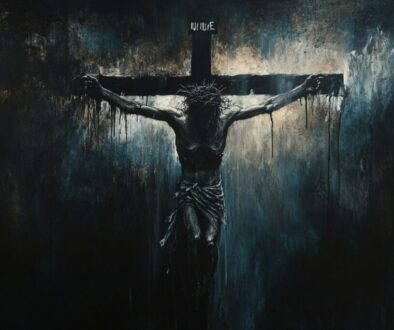
Escaping the Curse of Vanity – 18th Sunday in Ordinary Time – Sermon by Father Levine
Fr. Joseph Levine; Holy Family Catholic Church and Missions, Burns, Oregon; August 3, 2025
If today you hear his voice, harden not your hearts.
The voice of the Lord calls us to repentance. The voice of the Lord calls us to turn back to him. The voice of the Lord teaches us to number our days aright that we may gain wisdom of heart.
It is certain for each one of us that the day of death will come and, when we die, we will go before the judgment seat of Christ to render an account to him for the life he has given us and for the grace he has given us through his work of redemption. We will have to render an account to him for the work of our hands.
To number our days aright is to recognize that the number of our days is indeed limited and, whether long or short, as we regard it from our worldly perspective, that number is always short in comparison to eternity. For a few days in this world we choose for ourselves either eternal life or unending misery.
The Psalmist also prays the Lord to prosper the work of our hands. For the work of our hands truly to “prosper” then does not mean wealth and abundance in this world but means that our work in this world will be able to stand before the judgment seat of Christ.
St. Paul writes: No other foundation can any one lay than that which is laid, which is Jesus Christ. This foundation was laid in us through faith and baptism; without this foundation no human work has any worth in God’s eyes. Now if any one builds on the foundation with gold, silver, precious stones (these symbolize good works, done in Christ), wood, hay, stubble – each man’s work will become manifest; for the Day will disclose it, because it will be revealed with fire, and the fire will test what sort of work each one has done. (1 Cor 3:11-13)
In place of prosper the work of our hand, the ancient Latin Vulgate version of the Psalm puts it well, Direct the work of our hands above us. Or, guide our work and activity in this life that it might attain an eternal, supernatural goal that exceeds our mere human capacity, that it might be, in the presence of God, as gold, silver, or precious jewels.
The voice of the Lord warns us, Vanity of vanities, all things are vanity. All things are vanity that cannot stand the test of bodily death.
Money and the things that money can buy are all vanity, except insofar as they are used rightly to sustain the gift of life that God has entrusted to us and mercifully to assist those in need. The money does not withstand the test of death, but the justice and mercy do.
Praise and honor are worthless, except as a measure of virtue, but it is a merely human measure and human beings easily deceive and are easily deceived. The only praise and honor that can withstand the test of death is the praise and honor that comes from God, Well done, good and faithful servant … enter into the joy of your Master. (Mt 25:21,23)
Bodily pleasure passes with the body and serves only as rest and refreshment along the way. Alas, too often in the pilgrimage to the heavenly Jerusalem, a person pulls into the rest stop and stays there, never resuming his journey.
All the knowledge and skill we acquire in this life and all that we accomplish with it is vanity, except insofar is it helps us to grow in the knowledge and love of God or provides us means for the service of our neighbor, for love of God.
Now friendship is one thing that truly makes this life seem worthwhile. Friendship is one thing, in this life, that might give worth to any wealth, honor, pleasure, and knowledge we possess, while sustaining us in their lack. But alas, the day will come when the friend, even if faithful throughout life, will die. Finally, friendship only escapes the vanity of this world if it is friendship in Christ or leading to Christ. We need to use that measure to examine and test our friendships.
What is said of friendship applies also to marriage, which in the words of the nuptial blessing, is “the one blessing not forfeited by original sin nor washed away by the flood.” Yet, marriage needs to be sanctified by the sacrament so as to become not merely a means to temporal felicity, but a pilgrim path to the heavenly Jerusalem.
If today you hear his voice, harden not your hearts.
Today, the voice of the Lord, through the Apostle Paul, urges us: If you were raised with Christ, seek what is above, where Christ is seated at the right hand of God. Think of what is above, not of what is on earth. What is on earth is vanity; what is above is eternal. For you have died and your life is hidden with Christ in God. When Christ your life appears, then you to will appear with him in glory.
To escape the curse of vanity we must, then, seek what is above, which means seeking the life that is hidden with Christ in God. This life is hidden because it is known only to faith. It is the life of sanctifying grace, first given us in baptism, the life of the children of God, the life given us by the Holy Spirit, who leads us into the presence of the Father, who enables us, in Christ, to cry out, Abba, Father. (Rm 8,14; Gal 4:6)
See what love the Father has given us; that we should be called children of God; and so we are. The reason why the world does not know us is that it did not know him. Beloved, we are God’s children now; it does not yet appear what we shall be, but we know that when he appears we shall be like him for we shall see him as he is. And everyone who has this hope in him purifies himself as he is pure. (1 Jn 3:1-3)
Seeking what is above requires purifying ourselves, requires putting to death our earthly parts, so as to clothe ourselves with the New Man, Christ.
Putting to death our earthly parts, has also gone by the name of the “mortification of the flesh.”
The “flesh”, the “earthly parts”, is the impulse I find within myself to pursue “vanity”. Another way we could look at it is that the “flesh” inclines me to please myself, rather doing God’s will.
Jesus says, Whoever would save his life will lose it, and whoever loses his life for my sake will save it. (Mt 16:25)
We have been created for service, to live for and exist for another out of love, above all for God. All that we are and have comes from him, is his gift, and it has been given to us to serve him by serving others. We are parts of a larger whole and our true joy and happiness in this world is found in finding and fulfilling our part, playing the “role” we were meant to play. We each have a part to play in the great divine order, the grand household of God. No matter how small or how great, we must learn to play our part without complaining that it is not another part.
Yet, there is part of us that resists this, that does not want to serve, does not want to work, but wants to rest, wants to seek our own pleasure, wants to be served by others. This is the part in us that must die.
Consider a boy, sitting on the couch watching television. Mom asks him to do some small task. The boy grumbles. He grumbles for no good reason. Yes, he is absorbed by the television, but he might not even be enjoying what he is watching. Mostly, he just does not like being told what to do. Were he to let himself, he would perform the task and enjoy being of service to his mother.
Martha, when she complained to Jesus that her sister Mary was not helping her, had lost sight of what she was about. So long as she was focused on performing her task – however much work was involved – to serve Jesus, whom she loved and wanted to please, she was happy. Only when she began to look at Mary, sitting at the feet of Jesus, and thinking how much easier her work would be were Mary helping her, only then did she start to complain. (cf. Lk 10:38-42)
We can think of the fool in today’s Gospel. He was most truly a fool because he was judged so by God. Consider his folly: You have so many good things stored up for many years, rest, eat, drink, be merry. He is truly a fool because he has chosen to seek what is on earth, to seek his own pleasure. Note what is first on his list, “rest”. This is not the Sabbath of rest in God; this is not the rest of holy contemplation, enjoyed by Martha’s sister. This is the rest of “couch sitting”.
It is amazing how that desire for “rest” creeps into our activity. It crept into Martha’s service of Jesus and led to her complaining about Mary’s enjoyment of a “Sabbath rest” at Jesus’ feet.
That desire for “rest” is what led the elder brother in the parable of the prodigal son to slave for his father, rather than to live as a true son sharing in his father’s purpose and his father’s work. That is why he complained: Lo, these many years I have served you, and I never disobeyed your command; yet you never gave me a kid, that I might make merry with my friends. (Lk 15:29) That private enjoyment with his friends, apart from his father, was what he really wanted. That was the “rest” he sought.
But surely we do need some sort of rest and recreation in this life, otherwise we will just “burn out.” God did not make us to be “workaholics”. Indeed, but the rest stop is not the goal of the journey.
Consider climbing a mountain. If you are going to make it to the top you must keep pushing forward. You might need to stop for a rest, but only to renew your strength to continue the climb. At times the path might be less steep or even go downhill for awhile – that also gives you a breather – but you will need to start climbing again. You must keep going upwards, do not give up, do not let yourself grow discouraged, or you will never reach the top.
The journey of life is a mountain climb; God himself is the mountaintop, raised high up above the whole of creation and above every passing vanity.
For such a climb, we need strength, we need food. The food that is given us is nothing less than the Body and Blood of Jesus Christ in the Holy Eucharist; this is the food that nourishes the life that is hidden with Christ in God; this is the food that nourishes that life until he appears and we appear with him in glory.
Amen, amen, I say to you, unless you eat the flesh of the Son of Man and drink his blood, you have no life in you; he who eats my flesh and drinks my blood has eternal life, and I will raise him up on the last day. (Jn 6:53-54)
Remember the fool’s “rest, eat, drink, and be merry?” Well, there is also a wise man’s “rest, eat, drink, and be merry.” Rest in Christ, eat and drink his Body and Blood, and rejoice in the life of grace, the life that is hidden with Christ in God. There is no vanity in this.
Seek a Deeper Connection with God and Join Lay Cistercians of South Florida
Lay Cistercians of South Florida, is a community of lay people who seeks to have a deeper connection with God by living a life inspired by the monks and nuns through Lay Monasticism. Learn more about what is a Lay Cistercian on our website. Anyone who aspires to do the same as us, and is a confirmed Catholic is welcome to join us! We meet every second Saturday of the month at Emmanuel Catholic Church in Delray Beach, Florida.

This Content Has Been Reviewed For Accuracy
This content has undergone comprehensive fact-checking by our dedicated team of experts. Discover additional information about the rigorous editorial standards we adhere to on our website.