A Tale of Two Trees – Sermon by Father Levine
Fr. Joseph Levine; Holy Family Catholic Church and Missions, Burns, Oregon; February 22, 2026
We might think of Lent as a time of self-denial and trial, in which we must face many temptations, and that is true, but it is important to realize that the discipline and trial of Lent are means to an end, overcoming the inheritance and effects in us of Adam’s sin so as to share ever more fully in the promise of Christ.
Today’s 2nd reading sets before our eyes the contrast between Adam and Jesus Christ. Through our human birth, we belong to Adam; through our baptism, we now belong to Christ, but must not give way to the inheritance of Adam that we find in ourselves and that wars against the grace of Christ. If we are to overcome the inheritance of Adam, it is important that we recognize the greatness of Christ, the Son of God, and his abundant gift.
If by the transgression of one, the many died, how much more did the grace of God and the gracious gift of the one man Jesus Christ overflow for the many. … If by the transgression of the one, death came to reign through that one, how much more will those who receive the abundance of grace and the gift of justification come to reign in life through the one Jesus Christ.
Through faith and baptism, we have already received the abundance of grace and the gift of justification, but the reign of life, delivered from every threat of death, washed from every stain of sin, and freed from all bodily decay, corruption, and weakness, is promised us in the kingdom of heaven. To attain that promise, however, we must separate ourselves from the disobedience of Adam and join ourselves to the obedience of Christ.
Adam and Christ. We find Adam in the 1st reading, and we find Christ in the Gospel.
Adam is not found alone, but together with his wife Eve, who seems to play the greater role in the sin. Still, the word of God is clear, Adam’s sin was decisive. Christ’s obedience is not contrasted with Eve’s disobedience, but with Adam’s. The one man, Jesus Christ, is not contrasted with Eve, but with the one man, Adam.
Nevertheless, Eve does have a counterpart, the Virgin Mary. Quoting St. Irenaeus (2nd century), St. Epiphanius (4th century), and St. Jerome (4th-5th century), the Catechism of the Catholic Church tells us:
“As St. Irenaeus says, ‘Being obedient she became the cause of salvation for herself and for the whole human race.’ Hence, not a few of the early Fathers gladly assert: ‘The knot of Eve’s disobedience was untied by Mary’s obedience: what the virgin Eve bound through her disbelief, Mary loosened by her faith.’ Comparing her with Eve, they call Mary ‘the Mother of the living’ and frequently claim: ‘Death through Eve, life through Mary.’” (CCC 494)
So, just as Eve cooperated with Adam, her husband, in leading us to sin, the Virgin Mary cooperated with Christ, her Son, in leading us to redemption.
In any case, looking at the 1st reading, it is good for us to focus on the choice that was set before our first parents and what was chosen. Satan approaches all of us, male and female, with manifold deceits, following pretty much the same root that he approached Eve, sowing doubt in our minds regarding God’s goodness.
Last Sunday, we heard Sirach tell us, Before man are life and death, good and evil, whichever he chooses will be given him. (Sir 15:17) The tree of life and the tree of knowledge of good and evil represent this choice, in primordial fashion, set before Adam. The fundamental choice is to obey God or to disobey him. To obey God is the way to life; to disobey is the way of death.
Yet, we are left wondering, “Why should knowledge be the way of death? Did not God give us minds that we might learn and know?” Of course, it is not merely the tree of knowledge that is forbidden, but the “tree of knowledge of good and evil”. Yet that makes the question even more difficult; of all the things that we need to know in life, isn’t the most important the knowledge of right and wrong, good and evil?
To resolve this knotty question, let us consider how knowledge can be a bad thing. We can start with the words of St. Paul, Knowledge puffs up, but charity builds up. (1 Cor 8:1)
The knowledge that puffs up is knowledge of “things” that can be used, at least used for the purpose of self-exaltation, as might be the case with a proud and arrogant university professor, who cares little for truth, but greatly for the praise of men. Or it can be the knowledge of “things” that can be used in order to control the lives of others. The pursuit of knowledge for controlling power (which means finally controlling people) has driven our technological society. Indeed, AI, face-recognition technology, data collection, and video cameras are all employed for purposes of control and manipulation. Nor is there any great reason to trust in the benevolence of the controlling powers.
Really, it is this knowledge equated with power that was forbidden in the prohibition against the tree of the knowledge of good and evil. It is not a knowledge of wisdom and understanding, but a knowledge of mastery and control, separated from charity, ironically separated from right and wrong. Instead, it sets itself up, in godlike fashion, as the supreme judge of right and wrong. That is the reason the tree is given its ironic name.
One way we can see, in our world today, the pervasiveness of this knowledge without charity, is the incessant attempt to “solve problems”, human problems, by changing things, as in changing laws and institutions, policies and procedures.
Now, a country can have the best jet fighter plane money can buy, but if it does have anyone capable of flying it, it is nothing more than an expensive piece of junk. Well, the capacity to “fly” any human institution, a government, a corporation, even a parish, even if all the laws and structures were perfect, requires not just “know-how” but good people, people of honesty, integrity, and true charity.
Charity or Christian love is deeply social; it always connects us with others, with God first and then with our brothers and sisters. Charity always looks to serve the good of persons and sets us in a right relationship with them; it therefore sets persons, who are to be loved, over things, that are to be used in the service of persons. The Church as the Body of Christ is the great society of charity, in which we are to grow up in every way into him who is the head, into Christ, from whom the whole body, joined and knit together by every joint with which it is supplied, when each part is working properly, makes bodily growth and upbuilds itself in love. (Eph 4:15-16)
True knowledge of God, true knowledge of his plan of salvation, and true knowledge of right and wrong are indeed needed to serve this upbuilding of the Body of Christ in charity. Such knowledge, joined to charity, does not “puff up”. Nor does any other knowledge that is placed at the service of building up the Body of Christ in charity “puff up”. That service of charity leads to the greatest knowledge, beyond the reach of all human striving, that comes as a pure gift of God, given to those who love him, the vision of his face, the vision that makes one blessed. (cf. 1 Cor 13:12)
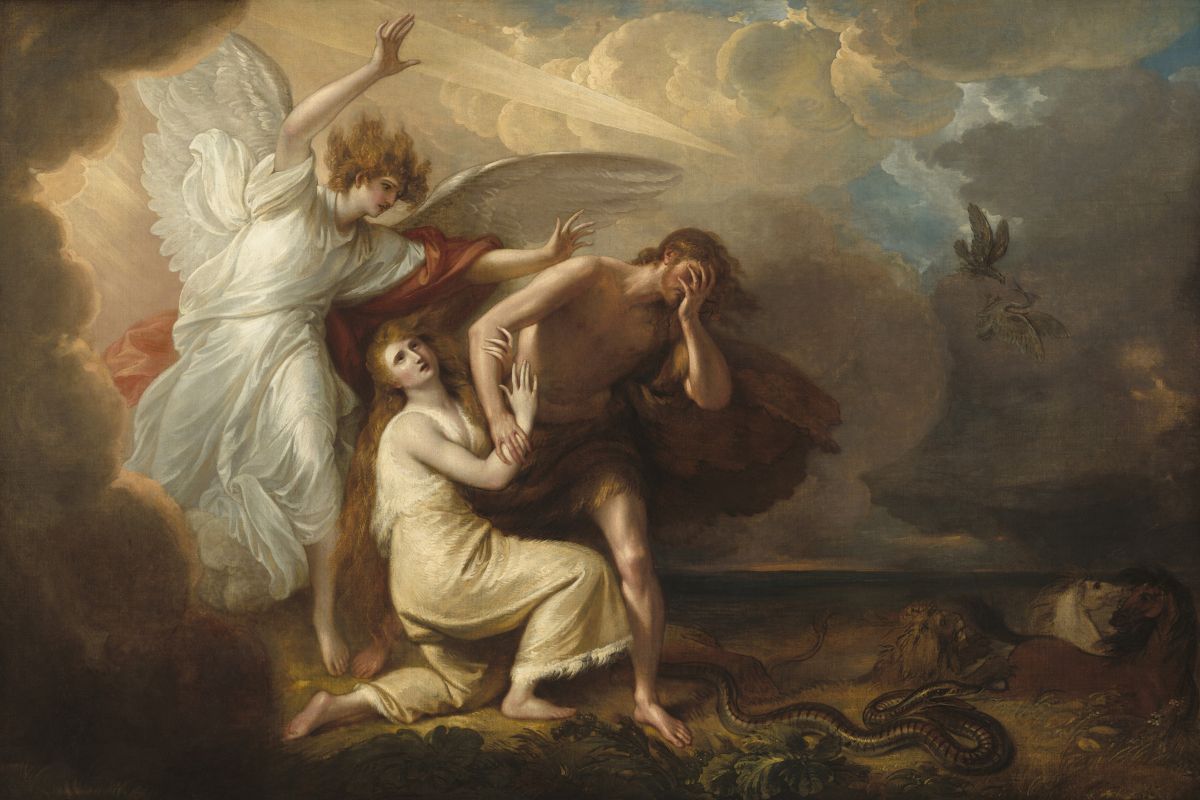
Returning to Adam and Eve. Adam’s choice was decisive, but we are not told why he chose to eat of the fruit of the tree. Whatever his motive, he chose to disobey God, knowing full well the evil of what he was doing. St. Paul tells us that he was not deceived, though Eve was. (Cf. 1 Tim 2:14) Eve was deceived from the moment when she heard the serpent challenge God and answered defensively. Her very attempt to answer the serpent revealed the beginning of her distrust in God, her beginning to doubt God’s goodness, God’s motivation. As a result, she believed the serpent’s outright lie when he declared that God was trying to keep man from a knowledge that would enable him to rival God. Under that spell of rivaling God, the tree seemed desirable for gaining wisdom. And so she ate, and Adam ate, and we have all inherited the difficulty of trusting the goodness and wisdom of God.
Sin does not lead to life, but corrupts the heart, separating us from God, and instead of fulfilling the promise of joy, produces sorrow and shame, as Adam and Eve discovered when their eyes were opened. We can be so slow to learn the lesson; we can be like Charlie Brown, always ready to try again when Lucy invites him to kick the football.
We must pray with the Psalmist: Create a clean heart in me, O God … cast me not out from your presence, and your Holy Spirit take not from me. Give me back the joy of your salvation.
It is Jesus Christ, the Son of God made man, who died on the Cross for our salvation, who by the power of his Precious Blood, cleanses our hearts, bestows on us the gift of his Holy Spirit, and the joy of salvation.
We must then follow him, learn from him to trust in God, and overcome temptation, that we might depart from the way of Adam’s disobedience and be joined to God by the way of Christ’s obedience, even in the midst of suffering and temptation.
Adam disobeyed in the garden; Christ resisted temptation in the desert; Adam lost his trust in God when everything was going well; we need to learn to trust in God and overcome temptation even in the desert of affliction.
Satan proposed material bread to Christ; Often we are ready to settle for just that. We say, “Just give me what I need in order to live, here and now.”
Christ responded by pointing us to the bread that comes forth from the mouth of God. He is himself, the Word made flesh, that comes forth from the mouth of God, and, by his word, “This is my Body”, gives himself to us as the Bread of Life, that bread that nourishes in us a life that does not die. But to be nourished by that Bread, we must believe in Jesus, trust in him, and desire truly to live from his life.
Not understanding with whom he is dealing, Satan then challenges Jesus with a temptation that easily throws us for a loop. For us, the temptation goes like this: “I believe in Jesus, therefore I should be able to do x,y, and z; why don’t I see the results? Why doesn’t God help me and answer my prayer?” Or just, “Why does God let me suffer these things? Where is he?” Then we want to act, to take things into our own hands, to try to force God’s hand.
Jesus says, You shall not put the Lord your God to the test.
In one word: Trust! To trust in God means to obey him, to do his will, to follow his way, without demanding things for ourselves, much less “results” here and now, on our terms. Trust in God requires patience on our part, waiting for God’s time, believing that he does indeed know best, believing that in everything God works for the good of those who love him. (Rm 8:28)
Finally, Satan unmasks himself and declares what he really has to offer, for a price – “success”. It can be something simple, like a promotion at work, but it comes with a cost: disobeying God, compromising with evil, doing something corrupt, or turning a blind eye to the corruption. Just a little thing it seems, like a pinch of incense burned to Caesar, as to God, the worship of raw power.
The voice of divine authority speaks, hidden in the man Jesus Christ: Begone Satan. It is written, ‘The Lord your God, shall you worship and him alone shall you serve.
That is what Eve should have said the moment the serpent questioned God.
God alone is absolute; He cannot rightly be called into question. It is alright to ask him a question, as did the Blessed Virgin Mary, seeking greater understanding of what he wants. (Cf. Lk 1:34) It is not alright to challenge him with a question that calls his power, his wisdom, or his goodness into doubt, without which we would not even exist.
Adam ate the fruit of the forbidden tree, and we died. Jesus died on the Cross, making it to become the true tree of life, giving himself to us as the life-giving fruit, by his word, “This is my Body.” When we eat in faith and trust, obeying his commandments, we live.
Seek a Deeper Connection with God and Join Lay Cistercians of South Florida
Lay Cistercians of South Florida, is a community of lay people who seeks to have a deeper connection with God by living a life inspired by the monks and nuns through Lay Monasticism. Learn more about what is a Lay Cistercian on our website. Anyone who aspires to do the same as us, and is a confirmed Catholic is welcome to join us! We meet every second Saturday of the month at Emmanuel Catholic Church in Delray Beach, Florida.

This Content Has Been Reviewed For Accuracy
This content has undergone comprehensive fact-checking by our dedicated team of experts. Discover additional information about the rigorous editorial standards we adhere to on our website.