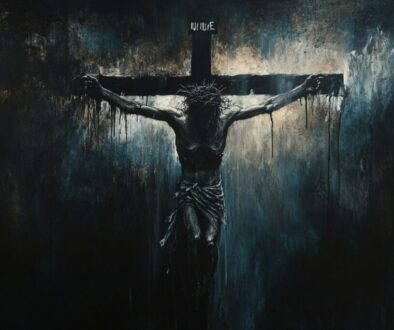
The Fire of Divine Love and the Idolatry of Human Plans – 20th Sunday in Ordinary Time – Sermon by Father Levine
Fr. Joseph Levine; Holy Family Catholic Church and Missions, Burns, Oregon; August 17, 2025
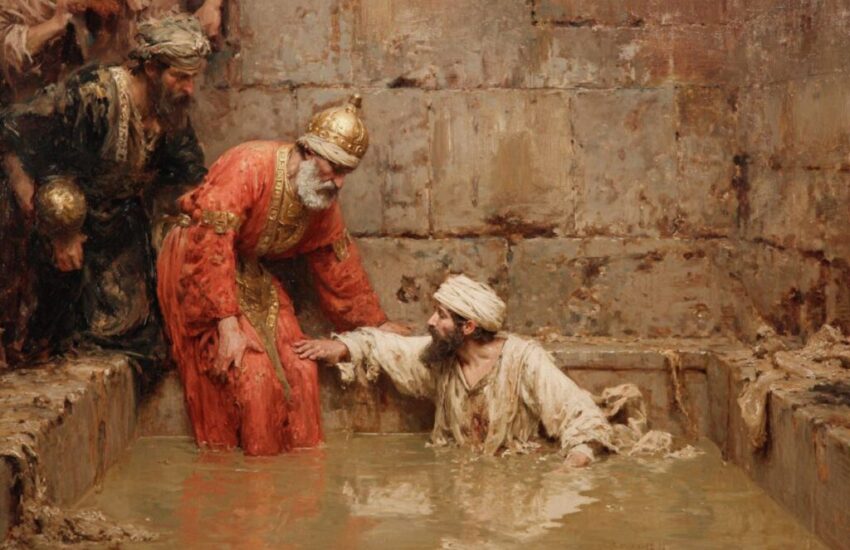
The princes of Judah accused the prophet Jeremiah of demoralizing the people. Now, when we read this, we think, “Jeremiah was a prophet of God, therefore the princes were wrong.
Indeed, but if we consider the actual event, the princes at the time, by accusing Jeremiah of demoralizing the people were effectively accusing him of being a false prophet. There were, at the same time, those whom the princes approved as being prophets. Further, if we consider the reason for their accusation, it might seem well-founded.
The city of Jerusalem was besieged by the Babylonian army and Jeremiah was declaring that God was punishing the king, the princes, and people for their idolatry and their sins. Consequently, if the people kept fighting, the Babylonians would conquer and destroy the city and the temple. If, however, they surrendered to the Babylonians and submitted to their rule as penance for their sins, the city and temple would have been spared. (cf. Jer 32:28-35; 33:3-5; 34:1-3; 38:17-18) Not a very “patriotic” message to say the least. Indeed, for those set on a fight to the finish, it was a message that was downright treasonous. The prophets approved by the princes, supported the plans of the princes.
If we want to get an idea of how Jeremiah appeared to the princes of Judah, just imagine what someone like Zelensky might think of a supposed Ukrainian “prophet” who was counseling surrender to Putin.
Of course, Jeremiah was a true prophet and was doing no more than proclaiming the word of God. It was God himself who was opposed to the plans of the princes of Judah. Jeremiah’s message was undermining their plans because they were leading the people astray, going against God.
If we consider well the conflict, the princes were concerned about the greatness of Judah, its independence from foreign rule, its political power and prosperity; God was concerned rather about the fidelity of princes and people to his covenant and his law. That is a very different set of priorities.
In this regard I want to make a reference to contemporary affairs, the modern State of Israel and modern Zionism, because there are some basic facts here that are little known. I will simply quote Fr. David Neuhaus, an Israeli citizen, a convert to the Catholic faith, and a Jesuit priest, writing in the Vatican newspaper. The quote regards David Ben-Gurion, the first Prime Minister of modern Israel.
“Ben-Gurion was not a religious Jew, and his faith in God was overshadowed by his belief in the ‘Jewish’ nation, a concept derived from his avid reading of the Bible. He also explicitly rejected the religious traditions of the Jewish people, which had developed over the centuries in the rabbinic writings collected in the Talmud … Ben-Gurion’s biblicism (a secular reading of the Bible used as a treasure trove of nationalist terminology and mythology) was instrumental in the early history of Zionist activity in Palestine. Although harshly criticized by religious Jewish intellectuals in Israel such as Martin Buber and Yeshayahu Leibowitz—both deeply aware of the troubling moral questions raised by Israel’s military conquests, the ethnic cleansing from Israeli territories of Palestinians, and the entrenched discrimination against Arab citizens in the State of Israel—Ben-Gurion’s version of Zionism dominated.” (cf. https://www.catholicculture.org/news/headlines/index.cfm?storyid=66558)
Returning to the subject, though, we want to consider more in depth the contrast between God’s plans and human plans (whether of nations, communities, or individuals) for worldly goals and achievements. We can consider the words of Jesus, seek first the kingdom of God and its justice, then all these things [that you need] shall be yours as well. (Mt 6:33) Yet, so often we do things in the exact opposite manner, we seek the things we need or think we need and then ask God’s help, without ever really asking him what he wants of us, without ever simply placing ourselves at his disposal, without reserve or condition.
We turn then to today’s Gospel, Jesus says, I have come to set the earth on fire, and how I wish that it were already blazing. Might these words not be considered just as “demoralizing” as the message of the prophet Jeremiah? Indeed, the human earth of which Jesus speaks is capable of refusing and rejecting the fire. Jesus himself sees his message as “polarizing” or “divisive” to the point that he warns, Do you think that I have come to establish peace on the earth? No, I tell you, but rather division.
He has not come to establish the sort of peace desired by the princes of Judah in the time of Jeremiah, or any of those who today are imbued with the same spirit of worldly power and ambition. That is because the fire that Jesus wants to cast upon the earth so as to set it ablaze is the fire of the Holy Spirit, the fire of divine love, which separates from every earthly desire and worldly ambition. It is the fire that leads us, as we heard two Sundays ago, to put to death the parts [in us] that are earthly: fornication, impurity, passion, evil desire, and the greed that is idolatry, so that we can cloth ourselves with the New Man, Jesus Christ. (Col 3:5)
Jesus speaks about this same fire and this same sword of division when he says, He who loves father or mother more than me is not worthy of my; he who loves son or daughter more than me is not worthy of me; and he who does not take up his cross and follow me is not worthy of me. (Mt 10:37-38) We could even add, “He who loves his nation and people more than me, is not worthy of me.”
Indeed, when the High Priest, Caiaphas, counseled putting Jesus to death, his argument was that Jesus was putting the well-being of the nation in danger, for the Sanhedrin was afraid that if people listened to and believed in Jesus, the Romans would come and destroy the city and the temple. (cf. 11:45-53)
The love of God is absolute; every human love, no matter how noble, must be subordinate to the love of God. Those who remain attached to their human loves, will find the words of Jesus “demoralizing”.
If we have the love of God in us, we can suffer the loss of all things; if we do not have the love of God in us, nothing else will be of any good to us, unless it somehow leads us to repentance and the love of God.
In the words of St. Augustine:
“Two cities have been formed by two loves: the earthly by the love of self, even to the contempt of God; the heavenly by the love of God, even to the contempt of self. The former, in a word, glories in itself, the latter in the Lord. For the one seeks glory from men; but the greatest glory of the other is God, the witness of conscience. … In the one, the princes and the nations it subdues are ruled by the love of ruling; in the other, the princes and the subjects serve one another in love, the latter obeying, while the former take thought for all. The one delights in its own strength, represented in the persons of its rulers; the other says to its God, ‘I will love Thee, O Lord, my strength.’ (Ps 18[17]:1) And therefore the wise men of the one city, living according to man, have sought for profit to their own bodies or souls, or both, and those who have known God ‘glorified Him not as God, neither were thankful, but became vain in their imaginations, and their foolish heart was darkened; professing themselves to be wise,’–that is, glorying in their own wisdom, and being possessed by pride,– ‘they became fools, and changed the glory of the incorruptible God into an image made like to corruptible man, and to birds, and four-footed beasts, and creeping things.’ (Rm 1:21-23) For they were either leaders or followers of the people in adoring images, ‘and worshipped and served the creature more than the Creator, who is blessed for ever.’ (Rm 1:25) But in the other city there is no human wisdom, but only godliness, which offers due worship to the true God, and looks for its reward in the society of the saints, of holy angels as well as holy men, ‘that God may be all in all.’” (City of God, Bk XIV, Ch 8)
In this world, the boundary line between the heavenly and earthly city is represented sacramentally by the boundaries of the visible Church, but the invisible reality cuts right through our hearts. The battle between the two loves is found in each one of us.
Yet, there is now a great cloud of witnesses, who following Jesus Christ in this world, who fought the good fight, finished the race, kept the faith, even to death, often to the shedding of their blood, now reign with Christ in heaven. (cf. 2 Tim 4:6-8) The cloud of witnesses, the saints in heaven, pray for us and urge us on. Looking to Christ and the saints, then, we must not lose heart or grow weary, for in the struggle against sin we have not yet resisted to the point of shedding blood. This is the battle, this is the combat, that really matters.
The more people are willing to shed their own blood for love of Christ, the less will they be willing to shed the blood of their fellow men. The more people are willing to shed their blood for the love of Christ, the more will the heavenly city become manifest even in this world and with it the peace of Christ will appear.
At the heart of the visible Church, crowning the façade of St. Peter’s Basilica in Rome, this reality is represented by a statue of Christ, carrying his Cross, in the middle, ready as it were to go up to heaven, calling out, Come, follow me. Then on either side, not only over the façade of the basilica, but also over the colonnades embracing St. Peter’s Square, are statues of saints, the cloud of witnesses, those who heard the call, and followed Christ to the end.
Seek a Deeper Connection with God and Join Lay Cistercians of South Florida
Lay Cistercians of South Florida, is a community of lay people who seeks to have a deeper connection with God by living a life inspired by the monks and nuns through Lay Monasticism. Learn more about what is a Lay Cistercian on our website. Anyone who aspires to do the same as us, and is a confirmed Catholic is welcome to join us! We meet every second Saturday of the month at Emmanuel Catholic Church in Delray Beach, Florida.

This Content Has Been Reviewed For Accuracy
This content has undergone comprehensive fact-checking by our dedicated team of experts. Discover additional information about the rigorous editorial standards we adhere to on our website.