The Wisdom of the Cross – 23rd Sunday in Ordinary Time – Sermon by Father Levine

Fr. Joseph Levine; Holy Family Catholic Church and Missions, Burns, Oregon; September 7, 2025
The daily news and commentaries are filled with the timid deliberations of mortals. The daily news and commentaries do not view human events from the perspective of God’s counsel or intention, but rather from the perspective of human minds, burdened with mortality and weighed down by many concerns. The daily news and commentaries are presented to us for the most part by men who guess at the things on earth and neglect altogether to consider the things of heaven. Their perspectives are often driven by human power conflicts and their presentations have more the character of propaganda than the love of truth. Some few, at least in Catholic or other Christian media, might attempt to view things from a standpoint of faith, but are any of them true prophets possessing divine insight?
There is nothing new under the sun. (Ecc 1:9) Long before the time of Christ, the Greek philosopher Plato presented an image of men chained in a cave, with a fire behind them, casting shadows on a wall in front of them. The men argued about the shadows on the wall, far removed from reality, such as God sees it. That is the character of the daily news and commentaries.
Yet, for those who seek it, God does send wisdom from on high, he does give the gift and guidance of the Holy Spirit, to guide our steps in this world aright.
This first lesson of divine wisdom is to teach us to number our days aright, that is to recognize the shortness of our days in this world in comparison with eternity. This lesson of wisdom then prepares us to receive divine wisdom itself that comes to us in the person of Jesus Christ. Unless we recognize the shortness of our days and recognize further that at the end of our days we will have to give an account to God for the life he has lent to us, then we will scarcely be ready to believe in Jesus Christ, the Son of God made man – at least not in a practical and life-changing manner – we will scarcely be able to receive his teaching, and to let ourselves be governed by his teaching.
In today’s Gospel, Jesus presents to us, in rather stark terms, the uncompromising and absolute character of his person and his teaching. He uses the language of holy hatred in regard to what is naturally most dear to us. The language should shock us; the language should shake us up and waken us from our lethargy.
Does a father or mother, wife or child, brother or sister, make a demand upon us, a claim upon our loyalty, love, and devotion? Do we feel the pull and power of that demand? Do we feel that would be failing in our duty should fail to meet that demand? Well and good.
Then, let us ask another question, “Would that demand in any way oppose Christ and his teaching?” If the answer is “yes” then all the pull of loyalty, love, and devotion to our family member must become as nothing. It can no more compare to Christ’s demand than time can compare to eternity. And should the family member, in face of our refusal, say, “Why do you hate me?”, we must reply, I don’t hate you, but I love Jesus Christ above all things.
Indeed, it is not just a matter of our family member, but our very life. Is there something I want very dearly in life, something perhaps that I think I could not live without? Let it be something good and noble. But, if Christ himself asks me to give that up?
And what might that lead to? Jesus himself warns his Apostles that they will be persecuted to the point of death and hated by all because of his name. (Mt 10:22)
To follow Christ we must be prepared, as it were, to build a spiritual tower that will cost us everything that we have to give. To follow Christ, we must be willing to accept the terms of peace that he the King of kings, the Almighty, who will come in glory to judge the living and the dead, offers us. They are terms of true peace, but they require on our part an unconditional surrender to him.
Yes, there is a reward, but before we get to that, let us consider what is not the reward. In line with today’s Gospel, we can use the prayer that accompanies the St. Benedict’s Medal, as a light of discernment: “Let the Holy Cross be my light; Let not the dragon be my guide.”
There is a website that purports to be Catholic – and I use this as an example, a symptom of cultural disease – that invites people to reclaim the vibrant life for which they were created, to achieve high performance personal development, and to reclaim their health. The website does speak of “supernatural fruitfulness” and God’s providence, but please pay attention, it does not speak of the Cross or of eternal salvation.
This is not uncommon. It is a variation on the “prosperity Gospel”. But Christ does not promise happiness or prosperity in this life. Prosper the work of our hands means that our good works will be able to stand before the judgment seat of Christ.
Yes, sometimes Christ does work miraculous healings, even today, as an answer to prayers, as during his earthly life; these remind us of his reality, his power, and his concern for even the littlest things, but evidently he does not always work miracles to solve our earthly problems. If he did, people would not be distressed by the perennial question of why God allows evil and suffering.
Worse, when supernatural fruitfulness and providence are correlated with vibrancy, health, and high performance in this life, those who do not enjoy such things are then tempted to think that God has abandoned them, that they are unworthy, that they are failures as Christians – woe is me, God did not answer my prayer and give me the cure I asked for – when the contrary may well be true.
Consider the words of St. Rose of Lima: “Hear, O people; hear, O nations. I am warning you about the commandment of Christ by using words that came from his own lips: We cannot obtain grace unless we suffer afflictions. We must heap trouble upon trouble to attain a deep participation in the divine nature, the glory of the sons of God and perfect happiness of soul.” (Liturgy of the Hours, Vol. III, pg. 1342)
Then there is St. Pio of Pietrelcina (Padre Pio) who bore the stigmata, the marks of Christ’s wounds, in his body for 50 years, and, yes, they hurt. Writing words of encouragement to a nun, in the midst of her sufferings, he talks about how we are to be fashioned as living stones to be fit into an eternal heavenly temple and for that purpose we must be willing to suffer the blows of hammer and chisel. He writes, “The soul destined to reign with Christ in glory must be stripped by the blows of hammer and chisel, which the divine artist makes use of to shape the stones, that is to say his chosen souls.” (Liturgy of the Hours, Memorial of St. Pio of Pietrelcina, Office of Readings) These blows include shadows, fears, temptations, sorrows of spirit, as well as bodily sickness and weakness. What is important is that in the midst of this the soul not offend God by sin but rather loves God in all she does.
That is the wisdom that comes from on high. All the sound and fury of the daily news and commentaries signifies very little, except to remind us that this world is passing, and that what matters is that we seek to pass through it, doing the will of God, gladly, with love, accepting the suffering and affliction he sends us. This is what enables us to follow St. Pio’s famous counsel, “Pray, hope, and don’t worry.”
This does indeed transform our life in this world, as St. Paul indicates in a simple but profound passage in today’s 2nd reading when says to Philemon that he is receiving back his slave as more than a slave, a brother, beloved … to you, as a man, and in the Lord.
We need to consider well the power of these words. The great evil of slavery is not that one man is in a position of superiority over another, or that he commands his activity, but rather that one man holds another as property, like a head of cattle, and indeed treats him as such.
Think of a cattle auction or bull sale; think of the way the calves and bulls are advertised, the qualities that are listed for the sake of attaining a higher price, or even the defects that need to be noted for the sake of honesty. That is exactly how black slaves were sold and traded in the pre-Civil War south.
A good master might treat a slave well, but as property, not as a person, not as a brother, beloved … as a man, and in the Lord.
We do not actually know how Philemon treated Onesimus after receiving this letter, but we do know something about the life of St. Martin of Tours, in the 4th century, when he was a soldier in the imperial guard. He was assigned an imperial slave. He treated him as a brother, sharing his meal with him, and even serving him at table. St. Martin treated his slave as a brother, and as a man, and in the Lord.
Contrariwise, whenever someone fails to recognize the humanity of another person, whatever his status, he considers that person as a though he were a mere slave. So it is that an employer might treat his employee as no more than a slave.
The Christian treats others as human beings, created in the image of God, and in the Lord, as brothers in Christ, or at least as capable of becoming a brother in Christ.
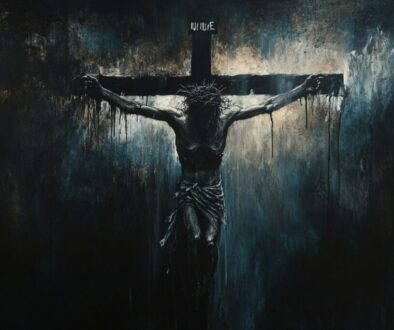
We only acquire that vision in the measure that we follow Christ, embrace his Cross, and let him purify us of our egoism. This is the wisdom from on high that is more sure than the daily news and commentaries.
Where does that lead us in the end? To what eye has not seen, nor ear heard, nor has it entered into the heart of man, what God has prepared for those who love him. (1 Cor 2:9) This is the vision of God, the Most Holy Trinity, the Father, and the Son, and the Holy Spirit, the eternal communion of divine love. St. John writes, Everyone who thus hopes in him purifies himself as he is pure. It is through the Cross of Christ that we are purified for the vision of God.
Seek a Deeper Connection with God and Join Lay Cistercians of South Florida
Lay Cistercians of South Florida, is a community of lay people who seeks to have a deeper connection with God by living a life inspired by the monks and nuns through Lay Monasticism. Learn more about what is a Lay Cistercian on our website. Anyone who aspires to do the same as us, and is a confirmed Catholic is welcome to join us! We meet every second Saturday of the month at Emmanuel Catholic Church in Delray Beach, Florida.

This Content Has Been Reviewed For Accuracy
This content has undergone comprehensive fact-checking by our dedicated team of experts. Discover additional information about the rigorous editorial standards we adhere to on our website.