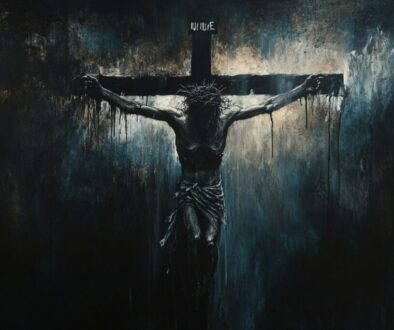
I Am Lazarus – 26th Sunday In Ordinary Time – Sermon by Father Levine
Fr. Joseph Levine; Holy Family Catholic Church and Missions, Burns, Oregon; September 28, 2025
We have heard today the famous story of Lazarus and the Rich Man. The standard contemporary message drawn from this story is that we should help the poor, in particular we should vote for candidates who will support government funded, that is taxpayer funded, welfare programs; but please note that taxes are not charitable donations, but coercive measures. Justice might be involved here, but charity is not. Of course, these days, anything government funded is, by definition, not religious, even stripped of all religion. Well, somehow, I do not think that is the message that Jesus had in mind.
So, let’s begin at the end of the story: If they will not listen to Moses and the prophets, neither will they be persuaded if someone should rise from the dead.
“They” literally refers to the rich man’s brothers, and by implication indicts the rich man himself for having failed to listen to the Moses and the prophets, and finally the indictment would have extended to the Jewish people, contemporary with Jesus, insofar as they had failed to listen to Moses and the prophets. Having failed to listen to Moses and the prophets, they failed also to believe in Jesus Christ, even after he rose from the dead. In short, they are without excuse. (cf. Jn 5:43-47)
“Moses and the prophets” is shorthand for the whole of the word of God proclaimed to the Jewish people in the time of the Old Testament. Now, through Jesus Christ, the Word made flesh, crucified and risen from the dead, through his Apostles, and through his Church, the word of God has been proclaimed in all the world. So, we could extend the words of Jesus to our own time saying, “If they do not listen to Jesus and the Apostles, if they do not listen to the Church, they will not believe, no matter how manner miracles are wrought, no matter how great the signs and wonders they see.” In short, there is no excuse before God for a lack of faith, not just faith believed, but faith put into practice.
Next, moving back in the story, we learn that what is at stake is eternal life and eternal condemnation. The chasm between the two is so great that, once established, no one could switch sides even if they wanted to. Further, the “good things” enjoyed in this life do not help towards eternal salvation; if anything, they are a hindrance rather than a help. Contrariwise, those who suffer grievously in this life might, by that very suffering, be better prepared for eternal salvation.
We can think of the words of Jesus, Blessed are you poor, for yours is the kingdom of God; Blessed are you who hunger now, for you shall be satisfied … Woe to you that are rich, for you have received your consolation; Woe to you who are full now, for you shall hunger. (Lk 6:20-21,24-25)
This is not something automatic, as though mere material poverty merits the kingdom of God, or mere material riches excludes from the kingdom of God; rather, it is a matter of whether one seeks his “consolation” in this world and the things of this world, or seeks his fulfillment and happiness in eternal life.
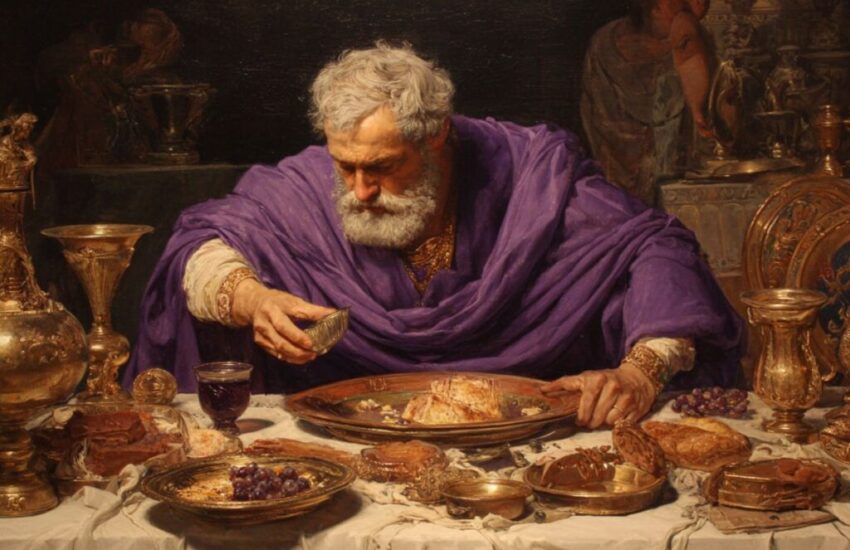
Finally, we come to the contrast between the rich man himself, in this life, dressed in purple and fine linen, who dined sumptuously each day, and Lazarus, the poor man, lying at the rich man’s door, covered with sores, who would gladly have eaten his fill of the scraps that fell from the rich man’s table.
What the rich man does and fails to do leads to his eternal condemnation, his torment that is compared to suffering in a burning fire, longing in vain for the relief of even a touch of water on his tongue.
No, the rich man was not condemned for his failure to vote for candidates who would support government funded welfare programs. It is all much more personal than that. Indeed, note that rich man has no personal name, while Lazarus does. It is a though the rich man can only gain a real name, gain the dignity that belongs to him as a person, by the way he treats another person in need.
His first sin, then, is his self-absorption that blinds him to others. St. Paul writes of those who live as enemies of the Cross of Christ, whose end is destruction, whose god is their belly, and who glory in their shame, with minds set on earthly things. (Ph 3:18-19) That describes the rich man, who dines sumptuously each day, worshipping the god of his belly – the belly god is a powerful image for egoism at its worst, for concern for nothing but one’s own selfish satisfaction, whether sought in the pleasure of eating, or in any other form of self-indulgence. Such a one must oppose also the Cross of Christ, who calls us to die to ourselves, take up our Cross and follow him. (cf. Mt 16:24; Lk 9:23) That is why rich has no name; through his self-seeking he has lost himself, in accord with the Lords’ words, Whoever would save his life will lose it. (Lk 9:24, cf. Mt 16:25)
Because the rich man can see only himself, indeed, he cannot even see past his own belly-god, he cannot see Lazarus. Even when he is in torment, he only speaks to Abraham seeking relief from his pain and only sees Lazarus as a potential servant of that relief. Since in this life he failed to see Lazarus as a true human being, he was also blind to his need.
This hatred of the Cross of Christ leads to such complete apathy and indifference that one no longer even asks the questions that can lead to faith.
We can see this apathy and blindness, afflicting the society in which we live, in the August 22nd stabbing of the Ukrainian refugee, Iryna Zarutska, on public transport in Charlotte, North Carolina. No one rushed to help her, but people did stand by, with their cell phones out, filming her bleeding to death. These same people may well have cast their ballots for government programs to help the poor.
So the rich man stands as a warning against following the path of self-seeking and egoism that becomes blind to others and their needs and which, rather than bringing fulfillment to one’s own person, leads to the dissolution and destruction of the personality, represented by the rich man’s namelessness. Contrariwise, we are urged to be attentive to others and their needs – not distant others, but those who cross our paths, especially those whose names we can and should know.
In this regard we can take to heart the words of St. Paul, But you, man of God, pursue righteousness, devotion, faith, love, patience, and gentleness. Compete well for the faith. Lay hold of eternal life, to which you have been called when you made the noble profession in the presence of many witnesses. The noble profession speaks of our baptismal vows, which we renew every year, on Easter Sunday, with the whole congregation, including the angels and saints in heaven, present.
Yet, there is a deeper message to be found here because we have not yet spoken of Lazarus himself, Lazarus who is the poor and hungry man who is blessed, Lazarus who is consoled in the bosom of Abraham; it seems as though Jesus speaks of the reality of the other world as it was before his own death and resurrection, because now he has prepared for us a place not in the bosom of father Abraham, but together with himself in the bosom of the heavenly Father. (cf. Jn 1:18, 14:2, 17:24)
You see, it is not enough that we be generous with the good things that God has given to us; it is not enough that we help others in their need. It is even more important that we recognize that we now lie before the gates of our heavenly Father just as Lazarus lay before the gates of the earthly rich man.
We are poor and hungry, because in ourselves and from ourselves we lack the resources to fulfill our purpose in life, to achieve our destiny, to attain eternal life; for this we need the help of God’s grace, not just the gift of sanctifying grace that we received in baptism, but the actual grace, the help we need each day to live in fidelity to the gift received. For this we must pray, we must beg God, saying, Give us this day our daily bread. For this, we must beg the intercession of the Blessed Virgin Mary, Pray for us sinners, now, and at the hour of our death.
Further, we are covered with sores, because even if we avoid falling into sin, or at least mortal sin, we know well the temptations to which we are exposed, that rise up from within, from our own flesh, as pus from sores. We must let the dogs, that is, the preachers of the word of God, lick our sores with their words, words that reveal the reality of our sores, but give us hope of healing at the same time, hope of the forgiveness of sins.
If we present ourselves before the gates of our heavenly Father, as Lazarus lay at the gates of the rich man, we can trust that, unlike the rich man, our heavenly Father sees us and has mercy on us and will not forget us. Indeed, he sends for our relief, not Lazarus, but his very Son, Jesus Christ, not just for our relief, through the forgiveness of sins, but for our nourishment, in the Holy Eucharist.
Finally, we can say that in the degree that we recognize the truth of who we are, as wretched Lazarus in the presence of our heavenly Father, in that degree we will also truly see and recognize our brother “Lazarus” in his need. The name “Lazarus” means the one whom God has helped; this is the name of redeemed humanity, whom Christ has called forth from the tomb.
He has filled the hungry with good things; he has sent the rich empty away.
Seek a Deeper Connection with God and Join Lay Cistercians of South Florida
Lay Cistercians of South Florida, is a community of lay people who seeks to have a deeper connection with God by living a life inspired by the monks and nuns through Lay Monasticism. Learn more about what is a Lay Cistercian on our website. Anyone who aspires to do the same as us, and is a confirmed Catholic is welcome to join us! We meet every second Saturday of the month at Emmanuel Catholic Church in Delray Beach, Florida.

This Content Has Been Reviewed For Accuracy
This content has undergone comprehensive fact-checking by our dedicated team of experts. Discover additional information about the rigorous editorial standards we adhere to on our website.