The Violence of the Culture of Death and the Heart of Jesus – 27th Sunday In Ordinary Time – Sermon by Father Levine
Fr. Joseph Levine; Holy Catholic Church and Missions, Burns, Oregon; October 5, 2025
How long, O Lord? I cry to help but you do not listen! I cry out ‘Violence’!’ and you do not intervene.
We know well that we live in a violent world; the daily violence in the news seems to increase now at such a rate that it is hard to keep up. Yet the violence in the headlines emerges from levels of institutionalized violence that are so pervasive that we hardly even recognize it anymore, at least not in its full gravity and scope.
Here we can speak about the “culture of death”. The thing about a culture is that so forms people that certain thoughts and actions begin to seem natural and obvious (whether they are or not) while others become nearly unthinkable. The culture of death, then, so radically mixes up right and wrong that many people are now acting more from the darkness of ignorance, confusion, and distress than from malice.
Let us examine a little the scope of the culture of death, starting with the most obvious, abortion. In a 1992 Supreme Court decision upholding Roe v. Wade and the supposed right of abortion, it was observed that “for two decades of economic and social developments, people have organized intimate relationships and made choices that define their views of themselves and their places in society, in reliance on the availability of abortion in the event that contraception should fail.” (Planned Parenthood v. Casey) In other words, the allowance of abortion led to the reality of abortion being woven into the fabric of the economic and social life of the nation. People came to depend upon the availability of abortion not only in the way they led their lives, but also in the way they shaped their very identity. What was true in 1992 is even more true today, even though Roe v. Wade has now been overturned.
Take note, though, of what lies behind abortion, contraception. The Supreme Court ruling acknowledged that abortion is “needed” in case contraception fails, and it does.
Contraception says, “We want to do the things that produce children, without having children.” It contains within itself a deep hostility towards children, except perhaps “on my own terms”. So, it can hardly be surprising that if the prevention of children fails, then the next step will be to destroy the child, perceived now not as innocent life, not as a gift, but as a threat to the self-will of adults.
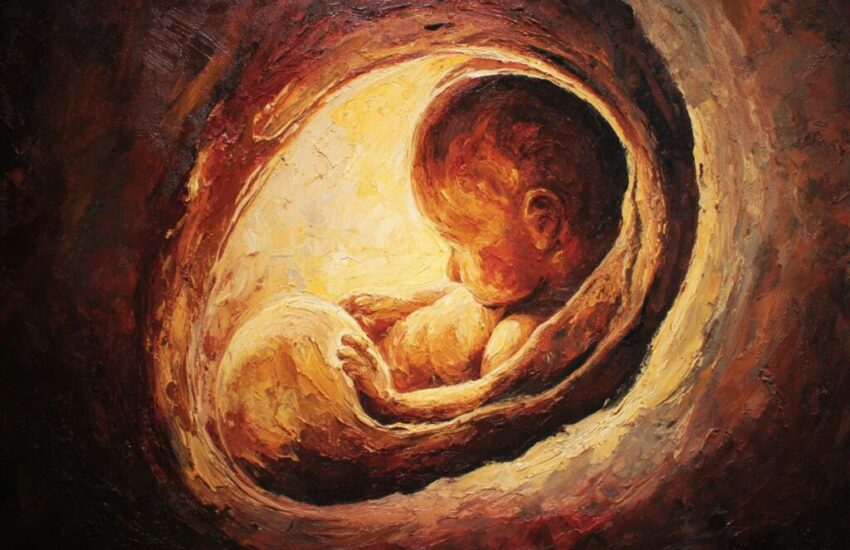
What a joy it is for a woman who wants to have a child when she becomes pregnant; what a joy to feel the life-giving power of her body. When, however, a woman has a miscarriage, apart from the particular sorrow of losing this baby of hers and her husband’s, there is the underlying pain in the woman’s experience of her body, made to produce life, gearing up to produce life, beginning to produce life, then failing to the point that instead of life, death comes.
Contrary to all this, contraception, sees the wonderful life-giving power of the woman’s body as an enemy; abortion turns the mother against her offspring. Both involve a radical violence directed at the very sources of human life. That violence is now not just an isolated occurrence in rare, desperate circumstances, but has become embedded in the fabric of our society. People have come to rely and depend on such violence, which should be nearly unthinkable, as being an allowable escape hatch. The violence has become embedded in law, especially here in Oregon, health-care, and the economy.
Ironically, contraception, which separates the reproductive acts from reproduction, has opened the door for IVF, which separates reproduction from the reproductive acts. Further, while the goal of IVF is new human life, wrongly conceived as a laboratory product, the method involves the destruction of unwanted embryos and so turns out even more destructive than abortion. For each life given, there are multiple lives destroyed.
The separation of the reproductive acts from reproduction and vice-versa, resulting from the human attempt to wrest control of the sources of God-given life, has led to the violence of the lying language of “reproductive health,” which has little to do with health and generally sees reproduction as the enemy. It has also led to the utter confusion about sexuality that pervades our society, and so also the evils of “gender-ideology” – if being a man or woman is not first and foremost about the life-giving capacity to become a father or mother, then what is it? – which even though it does not directly destroy life, is a sterile, lifeless fruit of the culture of death.
The propaganda of the culture of death has been driven by stoking fears of overpopulation, to which have been added the sort of environmentalism that sees human beings themselves as a sort of disease upon the earth. This propaganda has succeeded so well that by the middle to the end of this century, the world population will most likely start declining, and there will be no way to control that decline. Already, alarms have been sounding about declining fertility rates, but the propaganda has succeeded so well that, as things now stand, it will be hard to persuade women to start having more children.
From the beginning of life, we then move to the violence that has been brought to bear on the natural end of life. The matters at the end of life have been rendered complicated by medical advances and the need to distinguish between “ordinary care” and “extraordinary care”. I did hear one Catholic expert in this field say that you will not be able to get it right unless you pray and seek the will of God.
There is a world of difference between refusing extraordinary care, thereby allowing an illness to take its course, and seeking to dispose of a life, whether one’s own or that of another, that is seen as burdensome or no longer having any value. The latter course then masks itself with deceptive expressions such as “euthanasia” meaning “good death”, or “death with dignity.” Alas, here again, Oregon “proudly” – as in the capital sin – leads the way. The Cross of Christ teaches us that human life has meaning and value, even in the midst of the greatest sufferings, but once faith is lost and suffering is viewed as a pure “negative”, once life itself is perceived as a burden, then the pressure is on to begin disposing of the life of others, and the pressure is on those who are perceived as “burdensome” to bow out so as to free others from the burden that is themselves. What begins as voluntary “assisted suicide” ends as hastening burdensome others on their way.
Contrast this with bear one another’s burdens and so fulfill the law of Christ. (Gal 6:2) The life that might seem burdensome is a call to love; to reject the burden is to reject love.
In the meantime, when the beginning and end of life has become marked by such violence and deception, why should we be surprised at the ever increasing and open violence on the streets of our cities? Then there is that expression that has been gaining in currency, “the forever wars”. When our domestic life is marked by such incredible violence, how can we expect to find peace abroad?
How long, O Lord? I cry to help but you do not listen! I cry out ‘Violence’!’ and you do not intervene. … Then the Lord answered me and said, ‘Write down the vision clearly upon tablets, so that one can read it readily. For the vision still has its time, presses on to fulfillment and will not disappoint; if it delays, wait for it, it will surely come, it will not be late. The rash one has no integrity, but the just one, because of his faith, shall live.
The rash one has no integrity. The rash one, in the face of violence and injustice, reacts with anger, hatred, and vengeance, seeking to take matters into his own hands; the rash one seeks, by means of violence, to conquer violence. The rash one does not understand that the culture of death is deeply rooted in the demonic and, for that reason, can only be vanquished by supernatural means. It has been given to the Blessed Virgin Mary to crush the head of the serpent. (cf. Gen 3:15) The rosary is more powerful than the persuasive force of a Charlie Kirk.
So what does it mean, in this context, that the just man shall live by faith? It is an answer that, to human thinking, seems weak and even useless. We need to take heed to the words of St. Paul: the weakness of God is stronger than men. (1 Cor 1:25) It means recognizing that while God allows the violence, the violence is caused by men, who at root are rebelling against God. It means then that our first and most important response must be to live by faith, according to the will of God, revealed to us by Jesus Christ, Son of God and Savior. As St. Paul wrote to Timothy: Take as your norm the sound words that you heard from me, in faith and in love that are in Christ Jesus. Guard this rich trust with the help of the Holy Spirit that dwells within us.
It means, then, opposing evil with good. It means learning to suffer in patience, in union with the Cross of Christ. It means realizing that what is important is not that we solve the problems of the world, but that in the midst of the problems of the world, we are called to live each day in the presence of God, seeking to please him, as Jesus sought always to please his Father. (cf. Jn 8:29) It means doing what we can within the scope of our very limited power, while believing that indeed God is in charge and that his providence is at work in his world and that his greatest, most powerful work is most often hidden from the eyes of men, but yet connected mysteriously with our daily fidelity, self-denial, and prayer.
Erika Kirk gave us a great example of what this means when, in the name of Jesus Christ, she publicly forgave the man who assassinated her husband. She also showed us what that does not mean, by leaving the man’s fate to the judicial process.
This also speaks to the difference between violence and the use of force. Violence could be defined as the unjust use of force, which means that a just use of force would not be violent. Punishment, making use of force, can be justly applied. This is not violence. There is a human aspect involved in judicial processes, but we know quite well, from the judicial processes that led to the condemnation of Christ, that a mere judicial verdict does not guarantee justice. The human judicial process needs to recognize the supreme law of God in theory and in fact. Since that recognition is almost universally lacking, violence has become deeply embedded even in the legitimate judicial order.
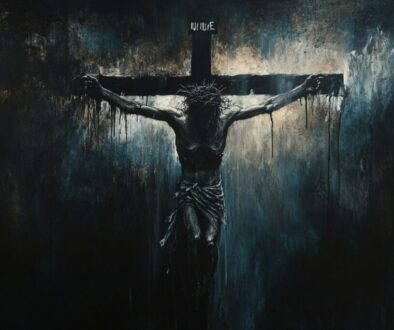
I cry out ‘Violence’! The anguished cry of the prophet contains the question: “Why does God allow this?” Why did the Son of God become man and freely hand himself over to the greatest violence of his crucifixion? Because God freely loves us and would have us freely return his love.
When a man and a woman stand before the altar and the minister of Christ and exchange their wedding vows, it is as though the man takes his beating heart out of his chest, hands it to his bride, and says, “I give this to you. Please take good care of it.” And the woman takes her beating heart out of her chest, hands it to the groom, and says, “I give this to you. Please take good care of it.” Such mutual vulnerability. How easily each one is able to betray that trust and hurt the one they love the most.
Well, out of love, God entrusted himself to our power, in the person of his Son, Jesus Christ. Out of love, he continues to entrust himself to our power in the Holy Eucharist. Violence, at its deepest root, is the result of our free rejection of his love. That is why the most important response to violence is to recognize the love of the Heart of Jesus, to seek to respond to his love with love, with a love that seeks to make reparation, to seek to enter into and share the sorrow of the Heart of Jesus, after the example of the Blessed Virgin Mary at the foot of the Cross.
Jesus wept. (Jn 11:35; cf. Lk 19:41-44)
Seek a Deeper Connection with God and Join Lay Cistercians of South Florida
Lay Cistercians of South Florida, is a community of lay people who seeks to have a deeper connection with God by living a life inspired by the monks and nuns through Lay Monasticism. Learn more about what is a Lay Cistercian on our website. Anyone who aspires to do the same as us, and is a confirmed Catholic is welcome to join us! We meet every second Saturday of the month at Emmanuel Catholic Church in Delray Beach, Florida.

This Content Has Been Reviewed For Accuracy
This content has undergone comprehensive fact-checking by our dedicated team of experts. Discover additional information about the rigorous editorial standards we adhere to on our website.