Earthly Warfare and Christian Warfare – 29th Sunday In Ordinary Time – Sermon by Father Levine
Fr. Joseph Levine; Holy Family Catholic Church and Missions, Burns, Oregon; October 19, 2025
Joshua mowed down Amalek and his people with the edge of the sword. These words are rather disturbing to our modern mentality. This was a real historical battle. Joshua and the Israelite army destroyed the Amalekite army and the blood of the slain flowed upon the ground. More disturbing is that the victory in battle was granted by God himself as a result of Moses’ prayer on the mountaintop.
Such passages as this need to be understood properly in their Old Testament context and then we need to understand well what was involved in the transition from the old to the new, in order to apply the Old Testament to the reality of the New Testament, which defines the times in which we live today. We do not want to develop a concept of Christian “jihad” dividing the nations of the world into a “house of war” and a “house of peace.”
To understand the Old Testament rightly we must grasp that before the time of Christ, after the sin of Adam, in a world that labored beneath the darkness and ignorance of sin, without the light of Christ, a world in which the nations were plunged into idolatry, God set apart the people of Israel to instruct them in knowledge of himself and prepare them for the coming of Christ, who would be the Savior of all mankind, in whom, according to his promise to Abraham, all the nations of the earth would be blessed. (cf. Gen 12:3, 22:18) It is important that even when he separated the people of Israel from the rest of the nations, God already had in view the salvation of all.
As for the remaining nations, first we must remember that good is always more pervasive than evil, so that some underlying natural goodness, some confused knowledge of God remained among them, and certain individuals among them might even have been touched and guided by the grace of God. Nevertheless, the Psalmist declared, All the gods of the nations are idols, or according to a version that speaks to the reality behind the idols, all the gods of the nations are demons. (Ps 96[95]:5)
The selection of Israel, then, set up on the earthly, temporal level, a very fundamental division between the people of God and the rest of the nations, a division that in accord with the times needed to be asserted and defended by the force of arms. Consequently, as a general rule, until the time of Christ, we could say that Israel, an earthly nation, was identified with the kingdom of God and set in opposition to the remaining nations, the Gentiles.
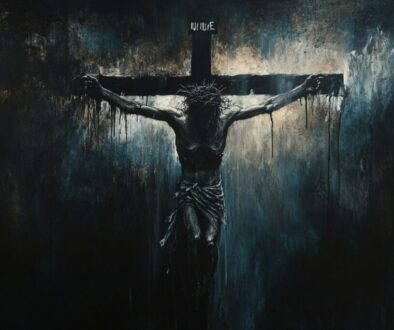
Through his death and resurrection, Jesus Christ, the Son of God made man, the anointed Savior of mankind, the fulfillment of all the promises made to the patriarchs and prophets, changed all of that. Jesus Christ brought the old covenant to fulfillment; we could say that the old covenant died with Jesus on the Cross, as he inaugurated the new and eternal covenant in his own Blood. (cf. Rm 7:1-6; Col 2:13-14; He 9:15-16)
Before the death and resurrection of Christ, on account of the sin of Adam, mankind as a whole was at enmity with God, (cf. Eph 2:1-3) with only a partial exception being made for the people of Israel. Even the people of Israel, however, did not have in reality, but only in a multitude of figures, the sacrifice that takes away sins and reconciles man to God. (cf. He 10:1-4) Without that sacrifice mankind was at enmity with God and necessarily among themselves as well, for there cannot be peace among men if there is no peace with God. Before Christ, warfare among the nations was the “de facto” rule.
Through the death and resurrection of Christ, God reconciled to himself all things, whether in heaven or on earth, making peace by the blood of the Cross. (Col 1:20) And Jesus himself, has made us both (Gentile and Jew) one, and has broken down the dividing wall of hostility … that he might create in himself one new man in place of the two, so making peace, and might reconcile us both to God in one body through the Cross, thereby bringing the hostility to an end. (Eph 2:14-16). He is the Lamb who was slain and who by his Blood redeemed men for God from every tribe and tongue and people and nation, and has made them a kingdom and priests to our God. (Rev 5:9-10)
Consequently, for those who are baptized in Christ, every human difference takes second place to the unity in Christ, for there is neither Jew nor Greek, there is neither slave nor free, there is neither male nor female; for you are all one in Christ Jesus. (Gal 3:28)
Yet, even after the death and resurrection of Christ not all have faith (2 Th 3:2) and, even among the baptized, the mystery of iniquity continues to work until the final harvest of judgment day, like the weeds sown among the wheat. (cf. 2 Th 2:7; Mt 13:24-30;36-43)
There have in past times been Christian nations that rightly employed armies and navies to protect a Christian political and social order. On their behalf, prayer was offered in some way as in the warfare of Israel against Amalek; even so, no Christian nation could ever be identified with the kingdom of God, as was Israel before the time of Christ. If once there may have been a place for the use of earthly arms in a sort of Christian warfare, two things have now changed: In our own time, there is no Christian political order to defend and warfare has become destructive to an extent that previous centuries could scarcely have imagined. This makes prayer for peace to be a priority.
Yet, while relation between prayer and earthly battles has undergone a fundamental transformation with the death and resurrection of Christ, there remains the spiritual battle of Christian warfare for which prayer is essential.
Whether we want or not, we are all caught up in the midst of an intense, invisible spiritual warfare. St. Paul writes, Put on the whole armor of God, that you may be able to stand against the wiles of the devil. For you are not contending against flesh and blood, but against the principalities, against the powers, against the spiritual host of wickedness in the heavenly places. Therefore, take the whole armor of God, that you may be able to withstand in the evil day, and having done all, to stand. (Eph 6:11-13) The weapons of this warfare are truth, righteousness, faith, prayer, the sword of God’s word, and zeal to spread the Gospel. (cf. Eph 6:14-18)
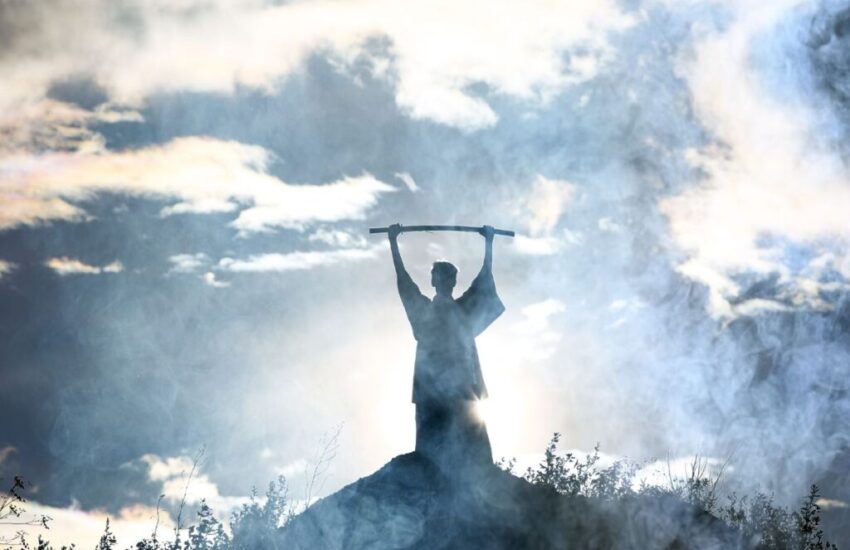
With that in mind we can turn back to our first reading. On the mountaintop Moses, with his arms extended, stands for Christ crucified, whose supreme and victorious prayer is now contained above all in the holy sacrifice of the Mass. The rock on which he sits represents the divine nature from which he drew the strength that enabled him to undergo the horrific sufferings of the Cross.
But why should Christ need help and support to persevere in prayer? On the Cross, he alone wrought our salvation; he did all that was necessary to reconcile man to God. Nevertheless, according to the dispensation of God’s providence, the effect of Christ’s prayer in the world today requires our cooperation as members of his Body; this cooperation is represented by Aaron, the priest, and Hur, the prince, the chief among the laity. (cf. Col 1:24)
We must all, clergy and laity, do our part, praying without ceasing, praying without growing weary, like the widow in the Gospel, that the kingdom of God in this world might prevail over its enemies, as Israel prevailed over Amalek. (cf. Ps 74[73]:8; 83[82]:4)
Amalek and the other historical enemies of ancient Israel, whose gods were demons, have become prophetic symbols of all the demonic enemies of the Church. We trust in the the promise of Christ, the gates of hell shall not prevail. (Mt 16:18)
Just as in ancient times those demonic enemies employed different nations as their instruments, today we could say that the demonic enemies employ a variety of ideologies as their instruments. These ideologies, in turn, often come to dominate the lives of particular nations. So the Nazi ideology dominated Germany during the Hitler years. So the Marxist ideology of atheistic communism dominated the old Soviet Union and continues to dominate the People’s Republic of China and North Korea.
Spiritual warfare, however, must be directed first of all against the reign of sin in ourselves and then against the ideologies and the demonic powers behind those ideologies, not against the people who have fallen prey to the ideologies. People are complex; we must thus distinguish between when a person is thinking and acting simply as a tool of an ideology, and when the person, even if influenced by the ideology, is thinking and acting as a human being, with his personal experience, desires, hopes, and aspirations. The ideology needs to be defeated and destroyed; the person needs to be freed from his slavery so that he might come to know Christ and attain to eternal salvation.
This is true also of the ideology that pervades the western world today and is identified by the letters “LGBT”. Now many people, who do not really share the ideology, employ the language of the ideology because they think it is the compassionate thing to do. The demons, however, are masters of manipulating compassion through sloppy thinking. There are also many troubled and unfortunate souls have been caught up and have come to identify with the alphabetical rainbow ideology. They are not the enemy, the ideology is. Their salvation requires that they be delivered from slavery to the ideology.
The Psalmist prays that the enemies of the people of God be put to shame and dismayed for ever and that they perish in disgrace. (Ps 83[82]:17) This applies first of all to the demons behind the ideology. In the second place, it applies to those who harden themselves and willingly give themselves to the ideology, persevering to the end, without repentance. For the others, the Psalmist prays, Fill their faces with shame that they may seek thy name, O Lord. (Ps 83[82]:16) This is the salutary shame that leads to repentance and conversion, opening the soul to receive the mercy and grace of God.
The battle of prayer is the chief battle that we must fight, every single day, as Christians. We must fight that battle first of all for ourselves, because unless we live in the grace of God we are of no service for the kingdom of God. So we must continually beg God for the help we need (the actual grace) to live in his grace (sanctifying grace) and serve his kingdom in this world and attain our eternal salvation in the next.
St. Augustine tells us that continual prayer is the continual exercise of our desire for the good things that God has prepared for us; if we truly love our neighbor then we will desire those same good things for him. That continual exercise of our desire enlarges our hearts to receive ever more what God in his infinite goodness wants to bestow on us in time and above all in eternity. Words are, from time to time, necessary to stir up and nourish this continual desire, rooted in faith, hope, and charity. (St. Augustine, Letter to Proba, 9)
Our prayer for ourselves and for the kingdom of God supports “Joshua” and his army on the battlefield. The soldiers on that battlefield are all those who by their temporal activity in this world, in the family, in the marketplace, in business, in politics, in recreation (no realm of human life is excluded) seek to build up the kingdom of God, not by means of guns, missiles, and drones, but by the exercise of truth and righteousness in charity. Every confirmed Catholic must be in some measure both praying on the mountain top and fighting on the battlefield. Some will be more occupied with one, some with the other, but regardless of the amount of time spent in one or the other, prayer must always be primary; it is prayer that wins the victory.
Joshua mowed down Amalek and his people with the edge of the sword. By the sword of the word of God the demons are driven back and the human enemies of Christ are defeated by being slain to sin so as to be made alive in Christ. For Christian warfare, then, we need not only prayer, but the word of God, preached and lived, so as to be equipped for every good work, living always in the presence of Jesus Christ, who will come to judge the living and the dead. That is when he will vindicate forever his faithful who cry out to him day and night.
Seek a Deeper Connection with God and Join Lay Cistercians of South Florida
Lay Cistercians of South Florida, is a community of lay people who seeks to have a deeper connection with God by living a life inspired by the monks and nuns through Lay Monasticism. Learn more about what is a Lay Cistercian on our website. Anyone who aspires to do the same as us, and is a confirmed Catholic is welcome to join us! We meet every second Saturday of the month at Emmanuel Catholic Church in Delray Beach, Florida.

This Content Has Been Reviewed For Accuracy
This content has undergone comprehensive fact-checking by our dedicated team of experts. Discover additional information about the rigorous editorial standards we adhere to on our website.