Finding Our True Orientation – 33rd Sunday in Ordinary Time – Sermon by Father Levine
Fr. Joseph Levine; Holy Family Catholic Church and Missions, Burns, Oregon; November 16, 2025
This 33rd Sunday in Ordinary Time could be called “Apocalypse Sunday.” Indeed, the liturgical year ends, where it begins on the 1st Sunday of Advent, Christ, the Alpha and the Omega, the Beginning and the End, coming in glory.
“Apocalypse” is a scary word. Other words employed for the same reality are “the end times”, “the eschaton”, and the “parousia”. The first is more popular, the last two are more scholarly, fancy Greek words. “Eschaton” means “end”, “parousia” “arrival”; the Latin equivalent is “advent”. The scary word “apocalypse” simply means “revelation” or “unveiling”, as in there is nothing covered that will not be revealed. (Mt 10:26) The last book of the Bible is named “Apocalypse” or “Revelation”.
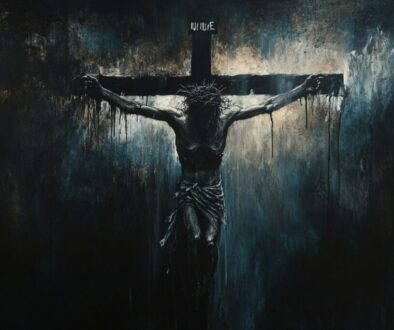
Really, we could say that there are two great apocalypses: the first is Christ’s incarnation, life, death, and resurrection; the second is his return in glory.
As for the first. In many and various ways God spoke of old to our fathers by the prophets; but in these last days he has spoke to us by a Son, whom he made heir of all things, through whom he also created the world. (He 1:1) And, No one has ever seen God, the only Son, who is in the bosom of the Father, he has made him known. (Jn 1:18)
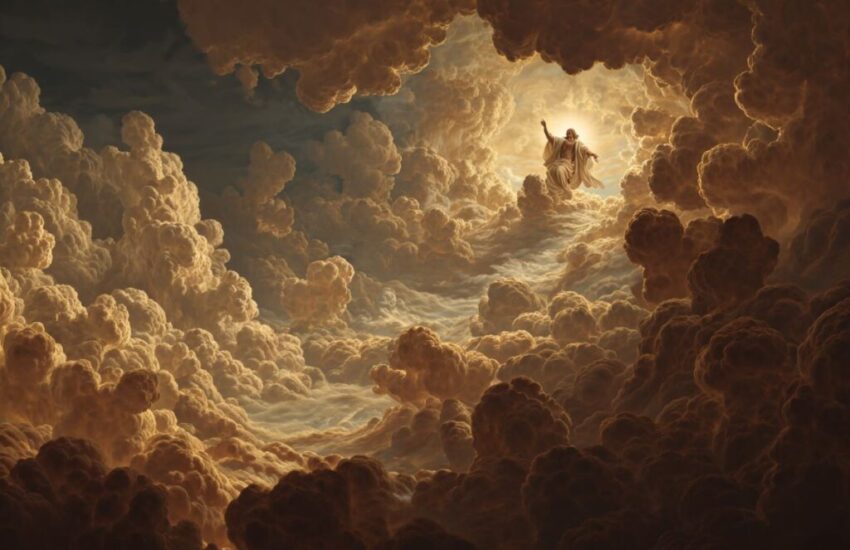
And the second: Behold, he is coming with the clouds, and every eye will see him, every one who pierced him; and all the tribes of the earth will wail on account of him. (Rev 1:7)
What is revealed? In the first place, Jesus Christ himself, the Son of God made man, and through him God, the Holy Trinity. In the first apocalypse, he is revealed in humility, patience, and mercy; in the second apocalypse he is revealed in glory, power, and justice.
In the second place, the secrets of hearts are revealed. From the first coming of Christ, through course of history until his return, those secrets are revealed in the way people respond to Christ and the proclamation of the Gospel. (cf. Lk 2:35) They are revealed most of all to each person himself, which revelation will be completed when the person departs from this world and goes before the judgment seat of Christ. When Christ returns in glory, those secrets will be proclaimed to the universe, after the resurrection of the dead, at the Last Judgment.
In today’s Gospel, Jesus, in response to the disciples’ admiration of the splendor of the ancient temple in Jerusalem, responds, All that you see here – the days are coming when there will not be left a stone upon another stone that will not be thrown down.
That prophecy was literally fulfilled in 70AD, less than 40 years after the Crucifixion. The people of Judea had rebelled against Roman rule; the Romans came besieged and destroyed Jerusalem and the Temple. The very thing that the Sanhedrin had feared would happen, were people to believe in Jesus, came to pass. What are we to do? For this man performs many signs. If we let him go on thus, every one will believe in him, and the Romans will come and destroy both our holy place and our nation. (Jn 11:47) That led to Caiaphas counseling them to put Jesus to death. (cf. Jn 11:49-50) Jesus allowed them to carry out their plan.
The destruction of the Temple in 70AD is key to understanding all the apocalyptic passages of the New Testament, for they all contain a dual reference, to the first apocalypse, which was in a way completed with that destruction, and the second apocalypse, when Christ returns in glory, which is prefigured by the destruction of the Temple.
If you were a first-century Jew, especially in Judea or Galilee, the Temple in Jerusalem was the center of the world. The destruction of the Temple was comparable to the end of the world. Indeed, it was the end of the religion of the Old Testament.
The end began when Jesus died on the Cross and the Holy of Holies in the Temple was violently unveiled. (cf. Lk 23:45) The veil was torn in two and the Holy of Holies was exposed, revealing that the purpose of the Temple had been fulfilled now that Christ, by his death, had opened the way into the true sanctuary, the heavenly sanctuary, giving us confidence to enter by the new and living way which he opened for us through the veil, that is, through his flesh, the same flesh that is offered always new and living in the Holy Eucharist. (He 10:20, cf. He 9:11-12; 9:24)
I once read an article by a Jewish biblical scholar who observed that two religions emerged from the destruction of the Temple in 70AD: Rabbinic Judaism and Christianity.
You see Judaism as it exists today, Rabbinic Judaism, is not simply the same as the Old Testament religion. The Old Testament religion was centered on the Temple worship. The Rabbi, Yohannan ben Zakkai, a Pharisee, escaped the besieged city, gave his support to the Romans, and was allowed to settle in Jamnia (modern Yavne, just south of present-day Tel-Aviv), where he established a rabbinic school that effectively took the place of the Sanhedrin. This rabbinic school laid the foundations of rabbinic Judaism as it exists to this day, Judaism after the “end of the world”, Judaism without a Temple. Since then, the basic Jewish argument against Christianity is that there is no peace in the world and therefore the Messiah has not come.
Of course, the Church was born earlier from the side of Christ on the Cross and first revealed to the world on the day of Pentecost, but only after the destruction of the Temple did it become manifest, even to outsiders, that the Church was a “new thing”, not just another Jewish sect. The basic Christian answer to the Jews is that the nations of the world have believed in the God of Israel, therefore the Messiah has come; perfect peace will come only when he returns in glory and the world is transformed by the resurrection.
I once heard an Israeli philosophy professor say to a group of Catholic seminarians, who were asking about the possible rebuilding of the Temple, that the Temple no longer played a central role in Judaism, that indeed, Temple worship had passed to the Catholic Church and was continued in the Mass.
In sum, in 70AD an old world was destroyed and a new world was born, the world of the Church, in which time is given for the Gospel to be preached throughout the world, offering men the opportunity to believe and be saved.
So, St. Peter, commenting on what to some people seemed already a delay in the fulfillment of the Lord’s promise, wrote, Do not ignore this one fact, beloved, that with the Lord one day is as a thousand years, and a thousand years as one day. The Lord is not slow about his promise as some count slowness, but is forbearing toward you, not wishing that any should perish, but that all should reach repentance. (2 Pe 3:9-10) Forbearing toward you… We so often ask why God doesn’t do something about all the evil in the world; well, he is allowing you and me and everyone else a time for repentance. As for the fulfillment of justice: According to his promise we wait for a new heaven and a new earth in which justice dwells. (2 Pe 3:9-10, 13)
Yet, if the old world came to an end with the destruction of the Jerusalem Temple, that suggests that the new world will come to an end with destruction of the new Temple, the Church.
Indeed, the Catechism of the Catholic Church hints at this: “The Church will enter the glory of the kingdom only through this final Passover, when she will follow her Lord in his death and Resurrection.” (CCC 677)
Another way of looking at this is to see that since the death and resurrection of Christ, as the “mystery of iniquity” continues its work in the world, (cf. 2 Th 2:7) the world has forever sought the destruction of the Church.
Should the world ever succeed such that there was no longer a stone upon another stone, that is no longer any living believer in this world built upon the foundation stone of Jesus Christ, then the rejection of Christ would be so complete that the only thing left for the world would be the judgment of God.
Or, perhaps, so long as the Blood of Christ is offered in Holy Sacrifice of the Mass, that outweighs all the wickedness, crimes, and sins of men. Should the Temple be destroyed and the Sacrifice cease, then there would be nothing left for the world but the judgment of God.
When will that be? We do not know the day nor the hour. (cf. Mk 13:32) Today’s Gospel gives us “signs” but the signs are always present, wars and insurrections, earthquakes, famines, plagues, persecutions of the Church, and even mighty signs from the sky. The signs that continue in every time remind us that the world in its present form is passing; Christ is coming. (cf. 1 Cor 7:31)
What is important is that we be vigilant, heed the Lord’s warning, see that you be not deceived. Do not be deceived by “new things” or by the revelation of secrets supposedly never before known or by those who claim to have the solution to the problems of the world or the church.
Rather, we must contend for the faith which was once for all delivered to the Church. (Jd 3) We must, in the fullest sense, work quietly, peacefully doing the will of God in all things, feeding upon the Bread of Life, the Body of Christ in the Holy Eucharist. By your perseverance – to the end – you shall secure your souls. (cf. Mt 24:13)
Lo, the day is coming, blazing like an oven. The coming of Christ, the final apocalypse, brings judgment upon the proud and evildoers, but to those who fear his name he is the sun of justice with its healing rays.
There is nothing covered that will not be revealed. (Mt 10:26) As the blazing sun of this world dispels the darkness and makes all things visible, so it will be with Christ at his coming.
The sun of justice will rise – the sun rises in the east and God created the world intending that the rising sun would be a sign of Christ coming in glory. The Latin word for “rising” is “oriens”, from which we get both “the orient” as in the east, and “orientation”, knowing where you are.
Jewish prayer is oriented on Jerusalem; when Jews get together to pray, they face Jerusalem. Muslims orient themselves on Mecca. The ancient Christian tradition of prayer is to face the east in expectation of Christ’s coming. Churches used to be built facing the east, with the altar on the east side of the Church and priest and people facing the same direction, to the east, to the coming of Christ. In the west today, we have lost our “orientation”. It is nice to be able see – though at present we walk by faith not by sight (cf. 2 Cor 5:7) – it is nice to be able to see, but when prayer is in a circle either it signifies nothing, unless maybe the desire to see, or it speaks of a community no longer open to the horizon of Christ’s coming but closed in on itself.
Perhaps, remembering that the world in its present form is passing, we need to regain our true orientation towards Christ, towards his coming, towards eternity. Then we will be ready for the apocalypse, the great and final revelation of God.
Seek a Deeper Connection with God and Join Lay Cistercians of South Florida
Lay Cistercians of South Florida, is a community of lay people who seeks to have a deeper connection with God by living a life inspired by the monks and nuns through Lay Monasticism. Learn more about what is a Lay Cistercian on our website. Anyone who aspires to do the same as us, and is a confirmed Catholic is welcome to join us! We meet every second Saturday of the month at Emmanuel Catholic Church in Delray Beach, Florida.

This Content Has Been Reviewed For Accuracy
This content has undergone comprehensive fact-checking by our dedicated team of experts. Discover additional information about the rigorous editorial standards we adhere to on our website.