Come After Me, And I Will Make You Fishers Of Men – Sermon by Father Levine
Fr. Joseph Levine; Holy Family Catholic Church and Missions, Burns, Oregon; January 25, 2026
Last Sunday I spoke about the universal call to holiness, the common vocation of all the baptized. Today – as the Diocese of Baker introduces “Called by Name Sunday” – I will speak about the specific vocation to the priesthood. Much of what I say could also be applied to the vocation to the religious life. What I have to say is important not just for young men who might have a vocation to the priesthood, but for parents, who must guide their children, and for all Catholics, who should understand how God calls people and should pray for many to hear and answer the call.
The priesthood is reserved to men; the religious life is open to all; a dual vocation to both priesthood and religious life is possible and common. The Apostles embodied both vocations.
In today’s Gospel, we heard Jesus call four men to follow him as Apostles: Come after me, and I will make you fishers of men.
When Jesus called Peter and Andrew, James and John, this was not just the general call to holiness – though we are all called to follow Jesus – but a specific call to follow him precisely as fishers of men, to leave everything and dedicate their lives to the service of the kingdom of God, to share in Jesus’ own work. (cf. Mt 19:27) This is a call to share in the apostolic life, a work shared by those in holy orders, the priesthood, in a public and official capacity.
St. Paul wrote, No one takes the honor on himself, but the one who is called by God. (He 5:4)
How does that work?
With the four Apostles in today’s Gospel, they literally heard God, the Son of God, speaking to them in a human voice, calling them to follow him.
Well, sometimes a man has a special, distinct experience, maybe even hearing words spoken as by God, but that is relatively rare and – guess what – not sufficient, because finally the call needs to be recognized by the Church.
Well, speaking of the Church, the Bishop wants the priests to say something of their own vocation story today, so maybe my own story will help illustrate how God can work.
I will start with the words of the Psalm: What return shall I make to the Lord for all that he has given to me? I will lift up the chalice of salvation and call upon the name of the Lord … I will offer you the sacrifice of praise and call on the name of the Lord. (Ps 116[115]:12-13,17)
Now, if you are young Catholic man of sound mind and able body, not yet committed in marriage, mindful of all that God has given to you, you could do nothing better with your life than offer yourself to serve God as a priest.
Well, my own story?
When Snoopy would play at being a great novelist, he would sit at his typewriter and type the most hackneyed phrase: “It was a dark and stormy night.”
Well, sometimes it really was a dark and stormy night. Indeed, that was the weather on a cold January day some 44 years ago as I stood at a bus stop in downtown Oakland, California. The dark, the storm, and the cold outside, however, were no match for the darkness of ignorance and sin, the confusion of mind and emotion, and the chilly lack of charity in my soul, as I stood at the bus stop, at the absolute low point of my life.
At that point, the light of grace shone upon my mind. Though at the time I did not know it for what it was, I did accept it and acted upon it. There was in itself nothing extraordinary in what happened. All I did was to make a choice, but given the state of my soul, it was a most unlikely choice, rooted in a most unlikely insight. In a word, I chose to turn away from the downward path of sin; I determined that it would be better to suffer evil than to do evil; I therefore chose to turn away from evil and seek the path of good. (cf. Is 1:16-17) I even chose concrete means to remove myself from the evil of my circumstances.
Christ himself did not yet appear clearly in my decision, except perhaps in the background. I was not yet at the point of saying, Jesus is Lord, but I knew that is what was said about him. (1 Cor 12:3) Yet, though I did not know it, in a remote way I was beginning to hear the call, Come, follow me.
Each step away from evil and towards the good is a step towards Christ; every such step prepares us to hear his voice. I would suggest then that any special call emerges from our response to the universal call to holiness and that we first begin to respond to the universal call to holiness, in whatever the circumstances of our life, when we determine to turn away from evil and seek the path of good. This is how both St. John the Baptist and Jesus Christ would have us begin, when they begin their preaching with the words, Repent, for the kingdom of heaven is at hand. (cf. Mt 3:2, Lk 3:10-14)
By June of that year, my repentance and faith had become quite definite as I was baptized into the Catholic Church on Pentecost Sunday. At that point, I was indeed asking the question posed by the Psalmist: What return shall I make to the Lord for all that he has given to me? I had now recognized that God had given me everything (and indeed had even restored it to me after, like the prodigal son, I had thrown it away) and was asking how I could give myself back to him, completely.
From there, I spent four years in the US Coast Guard, and I can highlight a few things during that time that began to make my vocation clear.
First, I discovered the meaning of the sacrifice of the Mass and the practice of Eucharistic adoration. Next, two different priests were involved, may they rest in peace. The first was a Coast Guard chaplain, Fr. Richard Powers, who suggested that I consider the priesthood. The other, Msgr. Alvin Wagner, a parish priest, inspired me by his appearance; I saw him praying and thought, “I want to be like that.” Then, I heard a recording of a talk given by Archbishop Fulton Sheen to priests, speaking about Christ as both priest and victim and the priest as sharing in the twofold role of Christ.
I spoke to Msgr. Wagner telling him that I thought I had a vocation. He welcomed my interest and suggested some people to speak to, but he advised me that the vocation comes from the Church, and so I would not truly have a “vocation” until it was approved by the Church on the day of my ordination. We could put it this way: a young man offers himself to the Church, saying, I think Christ is calling me to the priesthood; the Church responds and says, “Let’s see if that is so or not.”
In any case, from the time I spoke to Msgr. Wagner, it took a long time (26 years), through various detours and obstacles, before I was ordained to the priesthood. The typical seminary formation is about 8 years total. Yet, during that entire time, I was directing my steps towards the goal of ordination.
The call “come, follow me” does not usually involve anything miraculous or extraordinary, but comes through the circumstances of life. What is important is to seek the will of God, day by day, trying to do what is good and right, while asking God in prayer, “What do you want of me?” At the same time, the person should consider the words of the Psalmist, What return shall I make to the Lord for all that he has given to me?
A Catholic man can do nothing better than offer his service as a priest, or as a religious, or both; a Catholic woman can do nothing better than give herself wholly to Christ as a religious.
Sts. Louis and Zelie Martin were the first married couple ever to be canonized together. They had each attempted to pursue a religious vocation but discovered that God had other plans; that is actually a good way for young Catholics to discover marriage as a vocation. They had nine children, four of whom, including their two boys, did not survive childhood. The remaining five girls all became nuns, the youngest being St. Therese of the Child Jesus and the Holy Face, “The Little Flower”.
I should also say something about what it means to be a priest, but first, a word about celibacy, which for many is the big obstacle. For a diocesan priest, especially in the Diocese of Baker, the biggest difficulty of celibacy is living alone in a rectory, without a family. This is not actually the ideal for priestly life; nor is it a problem for a priest in a religious order or in places where multiple priests serve in one parish. It is, however, a problem where there is a shortage of priests. If, during the next ten years, many young men in the Diocese of Baker respond to God’s call and are ordained to the priesthood, then in ten to twenty years, the situation of priestly life could be very different.
Yet, I tell people that I do not actually live alone; I live with the Father, and the Son, and the Holy Spirit; I live with the Blessed Virgin Mary and St. Joseph, my guardian angel, and indeed all the angels and saints – it can get quite crowded. Of course, these are all very real, but invisible companions; living with them requires living a life of faith and prayer.
But why celibacy? To put it simply, an earthly father serves the physical propagation of the human race, descended from Adam. On account of Adam’s sin, spiritual generation was separated from physical generation. Spiritual generation takes its origin from Christ, and the priest serves Christ’s work of spiritual regeneration. That is why priests are called “father,” and that is one big reason why priests must be men. For that reason, also, it is most fitting that the priesthood be separated from the work of physical generation.
But what does it mean to be a priest?
I will answer by speaking about the two most central acts of priestly life, hearing confessions and celebrating Mass.
There is not much I can say about hearing confessions, but it is perhaps the hardest and most rewarding part of priestly ministry. In hearing confessions, it is given to the priest to see the depths of human misery through the eyes of God’s mercy; it is given to the priest to stand at the “switching station” of divine grace and witness the transformation of the repentant soul.
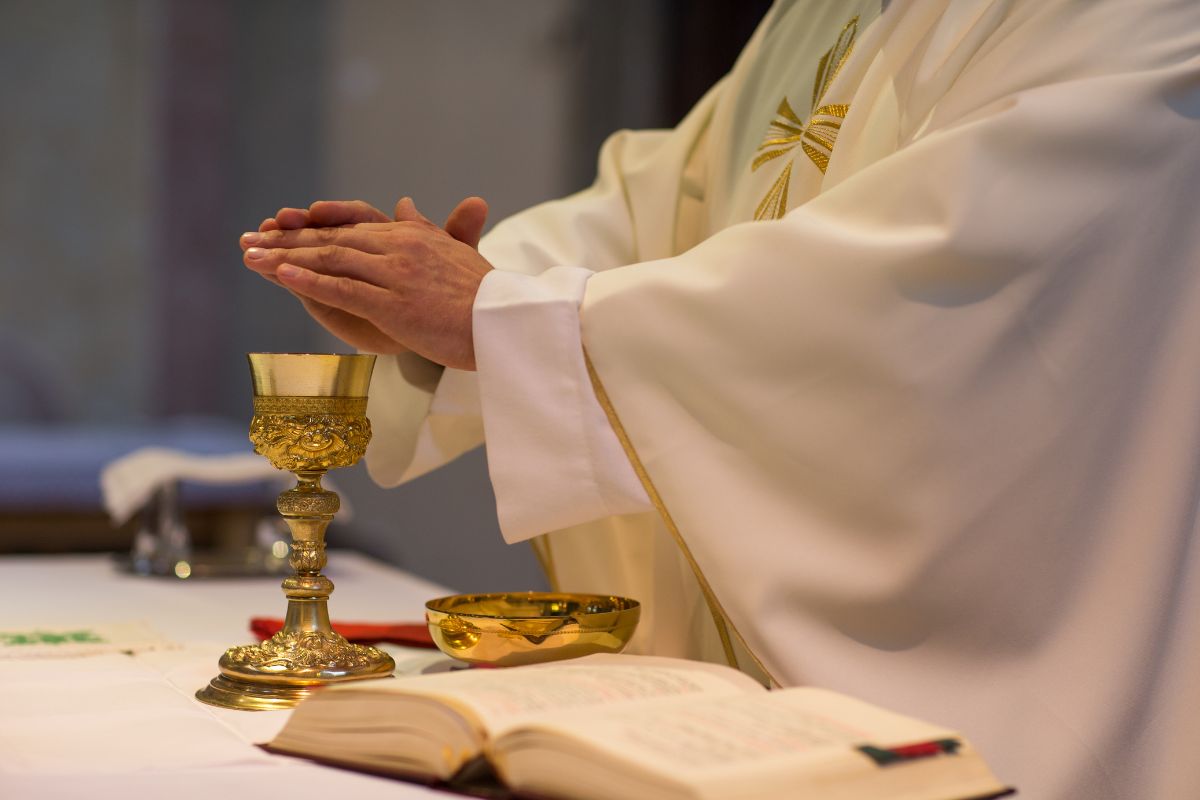
And Mass? How is it that a man can stand at the altar, holding a small piece of bread or chalice of wine, and say, “This is my Body”, “This is the chalice of my Blood”, speaking in the person of Jesus Christ, the Son of God, the Lamb of God, and have through the instrumentality of his owns words, which are Christ’s words spoken through him, the bread and wine become the Body and Blood of Christ, the true and perfect sacrifice offered to God?
In a way it is much easier for me to believe all that the Holy Catholic Church holds and teaches, the whole doctrine of the Holy Trinity, the whole doctrine of the Incarnation and Redemption, everything about the Church and the sacraments, the whole moral teaching of the Church, than to believe that I, Joseph Levine, who once stood at that bus stop in Oakland on a cold, rainy, January night, now stand at the altar offering to the Father the Body and Blood of Jesus Christ.
What return shall I make to the Lord for all that he has given to me? I will lift up the chalice of salvation and call upon the name of the Lord … I will offer you the sacrifice of praise and call on the name of the Lord.
Seek a Deeper Connection with God and Join Lay Cistercians of South Florida
Lay Cistercians of South Florida, is a community of lay people who seeks to have a deeper connection with God by living a life inspired by the monks and nuns through Lay Monasticism. Learn more about what is a Lay Cistercian on our website. Anyone who aspires to do the same as us, and is a confirmed Catholic is welcome to join us! We meet every second Saturday of the month at Emmanuel Catholic Church in Delray Beach, Florida.
This Content Has Been Reviewed For Accuracy
This content has undergone comprehensive fact-checking by our dedicated team of experts. Discover additional information about the rigorous editorial standards we adhere to on our website.