The Gospel of Peace and Salvation – Sermon by Father Levine
Fr. Joseph Levine; Holy Family Catholic Church and Missions, Burns, Oregon; December 25, 2025
How beautiful on the mountains are the feet of the one who brings glad tidings, announcing peace, bearing good news, announcing salvation, and saying to Zion, ‘Your God is King!’
The angel announced to the shepherds, I proclaim to you good news of great joy that will be for all the people. (Lk 2:19) “Glad tidings”, “Good news”, the same Hebrew word is translated into Greek and Latin as “Evangelion/Evangelium” and into English as “Gospel”.
Gospel is perhaps more apt than simply “good news” or “glad tidings”. “Good news” can be an ordinary message that brings a moment of passing joy to a single person. “Gospel” indicates something great. The prophet conveys that “greatness” by way of emphatic repetition.
There are not many people left who can really remember the end of World War II, but the news of the end of the war, brought to a victorious conclusion, after almost four years of American involvement, a war effort that engaged the united nation, with countless men in arms overseas, 400,000 Americans lost in battle, and the news that we had won, that Japan had surrendered and that the troops were coming home. That was experienced not just by one person, or one family, or one city, but by the whole nation as “good news”, great news, the celebration of a hard fought victory, the end of the war, the beginning of peace. That, however, still pales in comparison to what is conveyed by the single word “Gospel”.
The Gospel announcing “peace”, not the end of an earthly war, but the peace that comes from the reconciliation of man with God; the Gospel announcing “salvation” – the Hebrew word could be rendered as “Jesus” – the forgiveness of sins, the life of grace, and the promise of eternal life; the Gospel announcing “God is King” or, what is the same, “Christ is King!” The Gospel is the good news that proclaims the greatest victory, won on behalf of the entire human race, for all time, the victory of Jesus Christ, the Son of God made man, over sin, death, and the devil, bringing peace, salvation, and eternal life to all who believe.
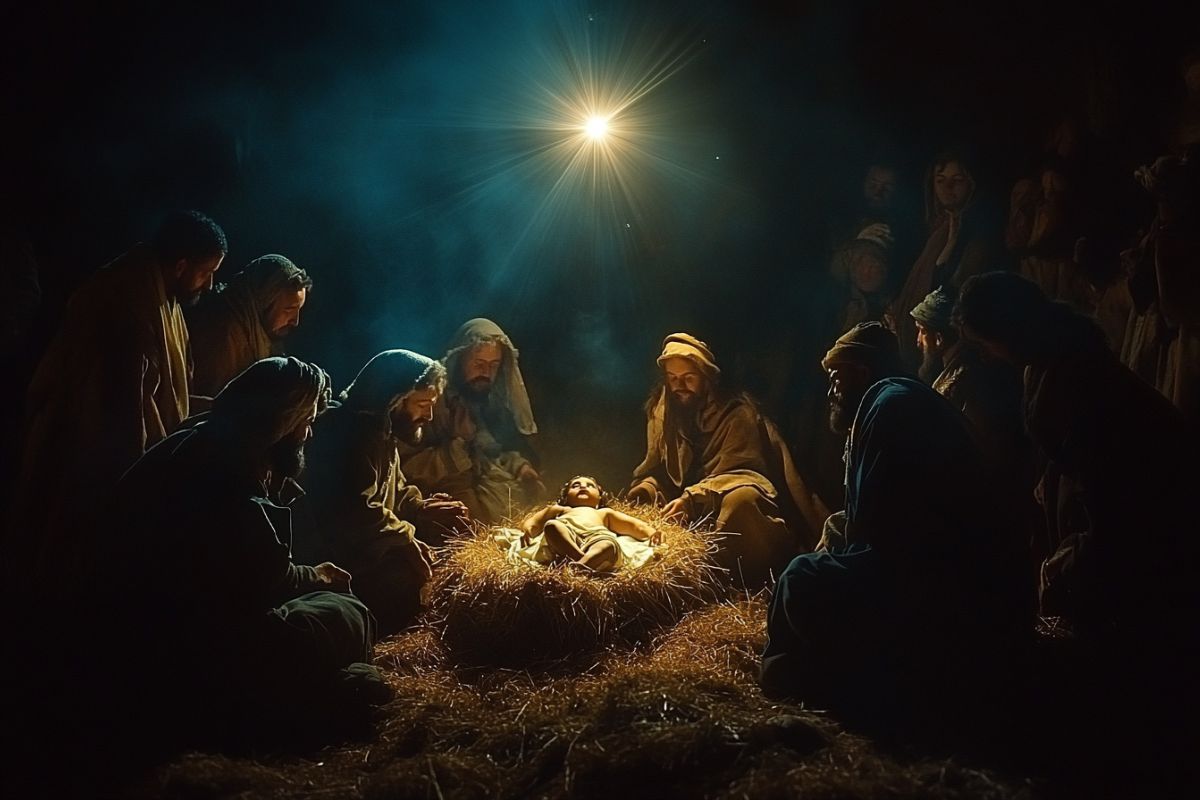
Of course, the birth of Jesus Christ in Bethlehem is but the beginning of the Gospel. The great warrior, our great champion, has arrived on the battlefield, and makes ready for the contest. He arrives on the battlefield as the light that shines in the darkness, the light that the darkness will never be able to overcome, the light that vanquishes the darkness.
He does not arrive unannounced nor without preparation. Rather, he is what the prophets had long foretold in many and various ways; he is the Word who was in the beginning with God, the Word who was God, the Word whom God now speaks to us, through becoming flesh and being born of the Virgin Mary; he is the one Son through whom now God speaks all that he had foretold by way of the prophets, and much more; he is the One who was promised and the One who fulfills the promise far beyond all expectations and all hopes.
Now, all the ends of the earth have seen the salvation of God. That word “salvation” again – in Hebrew it is “Jesus” – which was made known to the shepherds in Bethlehem is now believed in every corner of the earth. Jesus the Savior brings the Gospel of peace.
The key to “peace on earth”; the key to the way we treat each other in justice and charity; the key is to recognize the common poverty of our human nature, made even more destitute by sin, in the poverty of the child in the manger, born to be the Lamb of God, the victim for our sins, and the common gift that is given to all who will receive it.
Our common poverty: each one hear could consider the sort of person or group that he is inclined to despise or look down upon, whether on account of a physical defect, material lack, or moral failure. Next consider that man sees only the appearance, but God sees the heart. (cf. 1 Sam 16:7) Next, look into your own heart and ask, “Who am I without Christ? What would I be without Christ?” Whatever it is that repels you in others, your own soul, without Christ would be much more wretched and deformed. There is only one thing that a human being can truly take credit for as his own, sin. All good comes from God and the most we can do is cooperate with his work and without Christ, we would do nothing but make a mess of the good that he has bestowed upon us. That is our common poverty, our common destitution.
No human inequality, just or unjust has significance in comparison; no human excellence, however great, whether a natural endowment or acquired by hard work, has significance in comparison; no human weakness, has significance in comparison.
And the gift received? To those who did accept him he gave the power to become children of God, to those who believe in his name.
In the words of the Catechism of the Catholic Church:
“The Word became flesh to make us ‘partakers of the divine nature’ [2 Pe 1:4]: ‘For this is why the Word became man, and the Son of God became the Son of man: so that man, by entering into communion with the Word and thus receiving divine sonship, might become a son of God.’ [St. Ireneaus] ‘For the Son of God became man so that we might become God.’ [St. Athanasius] ‘The only-begotten Son of God, wanting to make us sharers in his divinity, assumed our nature, so that he, made man, might make men gods.’ [St. Thomas Aquinas]” (CCC 460)
How great is this gift? In the words of St. Paul, I count everything as loss because of the surpassing worth of knowing Christ Jesus my Lord. (Ph 3:8)
In Bethlehem God fulfills his promise. The fulfillment is great beyond all expectations. Only the poverty of Bethlehem can reveal the glory that infinitely exceeds all the glory that human beings can conceive or fashion. The silence of the Infant, who is the eternal Word of God, proclaims better than all human words, the wisdom of God that infinitely exceeds all human wisdom. The promise is fulfilled beyond all expectation because the Savior who is born to us is the very Son of God, who brings to us a truly divine salvation.
Perhaps that seems long ago and far away. The prophet tells us: The Lord’s acts of mercy are not exhausted, his compassion is not spent. (Lam 3:22)
The birth of Jesus Christ in Bethlehem is proof that God is faithful, God is true. He promises and he fulfills. The birth of Jesus Christ in Bethlehem is a down-payment, as it were, on what is yet to come.
What has been given to us in the birth of Christ is already great beyond our conception; what is given to us in the birth of Jesus Christ is not just long ago and far away but is given to us in a very real and concrete fashion, here and now, in holy communion. Taste and see that the Lord is good! (Ps 34[33]:8)
Yet, what is given to us is itself a promise of what is much greater, what no eye has seen, nor ear has heard, nor heart of man conceived, what God has prepared for those who love him. (1 Cor 2:9) Nothing less than to behold the very face of God. (cf. 1 Cor 13:12, 1 Jn 3:2) The Son of God, without leaving his Father’s side, came down from heaven, where he is one God with the Father, and then, standing upon the earth, making ready to return to the Father, he prayed that where he is, we may also be, so as to behold the glory given him by the Father before the foundation of the world. (cf. Jn 17:24)
Before the foundation of the world, when the Word was with God, when the Word was God, when there was nothing but God and his Word and his Holy Spirit, when nothing of what seems so real to us, including our own life, existed, or had any need to exist, except that in his sheer goodness and generosity, God, the Holy Trinity, had chosen to create the universe. To behold that glory without which nothing would exist, that is what is promised.
God has promised; he is faithful; he will fulfill his promise, if only we will consent to live in faith, hope, and charity.
Seek a Deeper Connection with God and Join Lay Cistercians of South Florida
Lay Cistercians of South Florida, is a community of lay people who seeks to have a deeper connection with God by living a life inspired by the monks and nuns through Lay Monasticism. Learn more about what is a Lay Cistercian on our website. Anyone who aspires to do the same as us, and is a confirmed Catholic is welcome to join us! We meet every second Saturday of the month at Emmanuel Catholic Church in Delray Beach, Florida.

This Content Has Been Reviewed For Accuracy
This content has undergone comprehensive fact-checking by our dedicated team of experts. Discover additional information about the rigorous editorial standards we adhere to on our website.