Priest in the Order of Melchizedek – Corpus Christi – Sermon by Father Levine
Fr. Joseph Levine; Holy Family Catholic Church and Missions, Burns, Oregon; June 22, 2025
“The New Testament lies hidden in the Old and the Old Testament is unveiled in the New.” (CCC 129, citing St. Augustine) Yes, I cited that last Sunday to introduce the highest mystery, that of the Holy Trinity, and I cite it again today to introduce the lowliest mystery, that of the Body and Blood of Jesus Christ, hidden beneath the appearances of bread and wine: sacrament, sacrifice, and presence.
In this case, the mystery of the Holy Eucharist, which is foreshadowed in many and various ways in the Old Testament, such as the manna in the desert, the bread of presence in the temple, the little cake that gave the prophet Elijah the strength to make the journey to the mountain of God, is hidden today in the curious and mysterious figure of Melchizedek.
Today’s 1st reading gives us the whole of the recorded history of Melchizedek as revealed to us by the word of God. Were that all there was to it, this would seem to be nothing more than a curious side-story in the history of Abraham.
But then we also have the Psalm of David and what a Psalm!
Jesus refers to the first line, the Lord said to my Lord, “Sit at my right hand,” to suggest to the Pharisees that the Messiah must be something more than the son of David, since David refers to him as Lord. (cf. Mt 22:41-46) To this same “Lord” of David, God says, before the daystar, like the dew, I have begotten you, hinting at the divine origin of the Son of God. Yet, to this same figure, royal and divine, it is said, as to a man, a priest, The Lord has sworn, and he will not repent: ‘You are a priest forever, according to the order of Melchizedek.
Suddenly, the cryptic figure of ancient Melchizedek is transformed into one of the most powerful prophetic symbols of the whole Old Testament, bringing together the royal Messiah, the Son of David and the Son of God, with the priesthood, which among the people of Israel, was a hereditary office quite apart from the line of David.
All this that is hidden in the Old Testament in unveiled in the New Testament through the Letter to the Hebrews. The theme of the Letter is that Jesus Christ, the Son of God made man, descended from David, of the tribe of Judah, Crucified, ascended into heaven, having made expiation for sins, where he sits at the right hand of God, is a priest forever, after the order of Melchizedek.
The reality of the priesthood of Jesus Christ is shown in various ways in the New Testament, but it is only the Letter to the Hebrews that explicitly identifies him as a priest and explains his work of redemption as a priestly work and it does so through the figure of Melchizedek who is used as the “lens” with which to view the priesthood of Christ. The very scarcity of information regarding the historical Melchizedek makes him suitable to serve as a prophetic symbol of Christ’s priesthood.
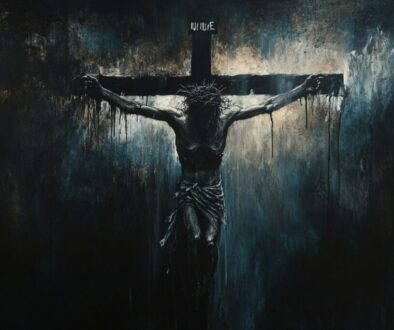
The priest is defined by the Letter to Hebrews as one chosen, by God, from among men, to act on behalf of men in relation to God, to offer gifts and sacrifices for sins. (He 5:1, cf. He 5:4) Jesus was constituted a priest through the very fact of the Son of God becoming man (cf. He 5:5) and fulfilled his priestly work through his obedient suffering, completed upon the Cross. (cf. He 5:8)
Elsewhere in the New Testament, the baptized faithful are referred to as a holy priesthood that offers spiritual sacrifices acceptable to God through Christ. (cf. 1 Pe 2:4-5) And that by freeing us from our sins in his blood (a reference to sacrifice without using the word) Jesus has made us a kingdom, priests to his God and Father. (Rev 1:6)
How does this priesthood of the baptized, established by Christ through his sacrifice, and the priesthood of Christ, symbolized by Melchizedek fit together?
Reliance on Scripture alone cannot really answer the question. Indeed, the way in which the Scripture sets forth these matters in different manners and different places should make it evident that the Bible is not a manual for starting a church, nor a manual for living a Christian life, in isolation, but rather presupposes, as a point of reference, the already existing reality of Israel in the Old Testament and the Church of the New Testament.
In light of that reality, we can begin to see how the prophetic symbol of Melchizedek integrates many more aspects than might appear at first glance.
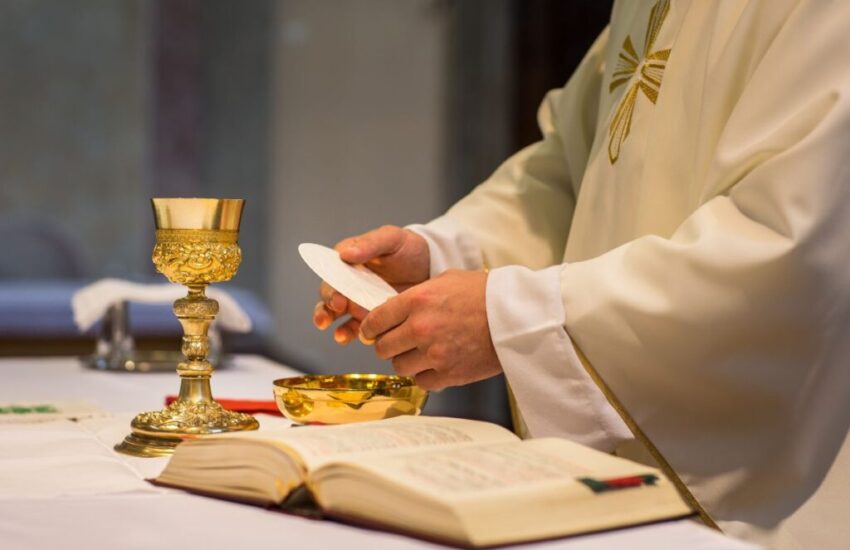
In the Letter to the Hebrews, St. Paul makes mention of Christ offering his Body and Blood, but he makes no mention of Melchizedek offering bread and wine. (cf. He 9:14, 10:10) Nevertheless, his original audience would have been very familiar with that little detail and would have readily connected it with the bread and wine used at the Mass, used in the sacrament of Christ’s Body and Blood. Christ offers his sacrifice on the Cross, but the figure of Melchizedek connects the Cross and the Holy Eucharist, in which Christ offers his same sacrifice, his same Body and Blood, through his priestly ministers. The sacrifice which he offered in a bloody fashion upon the Cross, he offers in an unbloody fashion in the Mass. (cf. Council of Trent, 22nd Session, On the Sacrifice of the Mass)
On the Cross, Christ, in truth was a priest offering himself in sacrifice, giving perfect worship to his Father, but none of that was apparent. The reality of priest and sacrifice was there, in the most perfect fashion, but the visible ritual and symbol of priest and sacrifice was not there.
Through the living symbol of Melchizedek, the inner reality of Christ’s sacrifice is connected to the ritual and symbol of the Mass. This tells us also that the whole ritual order of the Old Testament not only finds its fulfillment in Christ’s self-offering on the Cross, but also finds that fulfillment continued in the ritual and liturgy of the Church. Melchizedek was the living prophetic symbol of Christ the priest, yet to come; the sacrament of holy orders in the Church is the visible sacrament of Christ the priest, who has already completed his priestly work and now, like Melchizedek, brings what looks like bread and wine.
Pope St. Clement I was the third successor of St. Peter and before the end of the 1st century he wrote a letter to the Church in Corinth. St. Paul had written two canonical letters to the Corinthians and St. Clement is familiar with them; indeed he makes reference to how St. Paul helped heal the divisions in the Christian community in Corinth. In St. Clement’s time, new divisions had arisen; these new divisions appear to have had their source in a rebellion against the priestly authority established in Corinth. St. Clement was also deeply familiar with the Letter to the Hebrews and, in writing to the Corinthians, makes frequent reference to that Letter.
At the heart of his Letter he gives us an extensive teaching about the hierarchical, priestly order of the Church, following from the Apostles and bringing to fulfillment the priestly order of ancient Israel. Among other things he writes, “[Jesus Christ, the high priest of our offerings (c. 36)] has ordered the sacrifices to be offered and the services to be held, and this not in a random and irregular fashion, but at definite times and seasons. He has, moreover, himself, by his sovereign will determined where and by whom he wants them to be carried out. Thus all things are done religiously, acceptable to his good pleasure, dependent on his will. Those, therefore, that make their offerings at the prescribed times are acceptable and blessed; for, since they comply with the ordinances of the Master, they do not sin. Special functions are assigned to the high priest; a special office is imposed upon the priests; and special ministrations fall to the Levites. The layman is bound by rules laid down for the laity.” (c. 40)
The spiritual offering of the faithful, then, is brought into the “order of Melchizedek” and joined to the sacrifice of Christ, precisely through participation in the holy sacrifice of the Mass.
All this has great practical importance for our life and attitude as Christians.
There is a temptation to “spiritualize” (maybe “vaporize” would be a better word) completely the priestly aspect of the Christian life, such that all that really counts is the interior reality of the individual Christian’s self-offering to God. This fits very well with the “Jesus, my personal Savior” approach to the faith, or the “me and Jesus” approach to the faith. Any sort of worship in common then becomes at best, a nice “add-on”, optional, maybe even good and desirable, but certainly not necessary and essential.
This Christian individualism, which makes common worship and so also Christian community optional, seems a bit strange when you think that at the heart of the Gospel is Jesus’ own commandment, As I have loved you, so must you love one another. (Jn 13:34) Nor is it any accident that Jesus gave us his new commandment at the Last Supper, when he also gave us the sacrament of his Body and Blood and the sacrament of Holy Orders.
As in the Old Testament, there was a people, bound together in a covenant with God, joined in a common sacrificial worship, so in the New Testament, there is a people, the Church, bound together in a covenant with God, joined in a common sacrificial worship.
We cannot love another as Christians without sharing in our common worship, given to us by Christ; we cannot love one another as Christians, without belonging to his Church, which is the mystical Body of Christ, offering the true Body of Christ, and nourished by the same Body of Christ.
Shortly after the time of St. Clement, St. Ignatius of Antioch wrote to the Church in Ephesus, “Make an effort to meet more frequently to celebrate God’s Eucharist and to offer praise. For, when you meet frequently in the same place, the forces of Satan are overthrown, and his baneful influence is neutralized by the unanimity of your faith. Peace is a precious thing: it puts and end to every war waged by heavenly or earthly enemies.” (c. 13)
The Holy Eucharist, the Body and Blood of Christ, priest according to the order of Melchizedek, is the sacrifice and communion of peace where truly all can eat and be satisfied.
Seek a Deeper Connection with God and Join Lay Cistercians of South Florida
Lay Cistercians of South Florida, is a community of lay people who seeks to have a deeper connection with God by living a life inspired by the monks and nuns through Lay Monasticism. Learn more about what is a Lay Cistercian on our website. Anyone who aspires to do the same as us, and is a confirmed Catholic is welcome to join us! We meet every second Saturday of the month at Emmanuel Catholic Church in Delray Beach, Florida.

This Content Has Been Reviewed For Accuracy
This content has undergone comprehensive fact-checking by our dedicated team of experts. Discover additional information about the rigorous editorial standards we adhere to on our website.