Divine Mercy Leading to Life in the Church, Leading to the Eternal Inheritance – Sermon by Father Levine
Fr. Joseph Levine; Holy Family Catholic Church and Missions, Burns, Oregon; April 12, 2026
On this Divine Mercy Sunday, let us begin with the reality of Jesus Christ, risen from the dead, our Lord and God, who made himself known most surely to Doubting Thomas. Everything starts from there. He made himself known most surely to Doubting Thomas in order to heal the wounds of our unbelief. Without faith, we cannot open ourselves to the Divine Mercy.
He healed the wounds of Thomas’s unbelief by showing him his own wounds, transformed and glorious after his resurrection. He thereby reveals his wounds as the fountain of mercy, a fountain that comes to us through the sacraments of the Church, represented by the Blood and Water coming from his wounded side on the Cross.
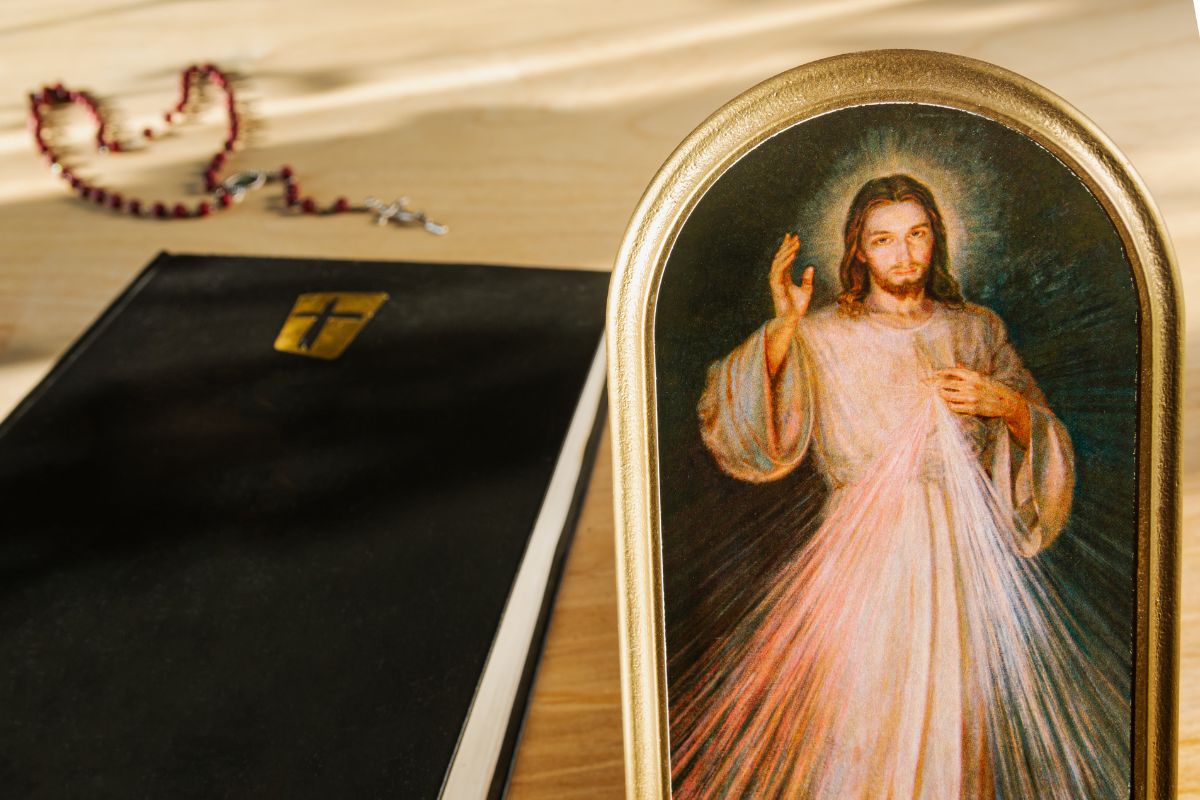
Having completed his redemptive and salvific work through his sacrificial death on the Cross as the Lamb of God, Jesus, in his resurrection, bestows upon his Church, in the person of the Apostles, the power to forgive sins. The forgiveness of sins goes hand in hand with the gift of the Holy Spirit and the new life of grace communicated to the soul by the Holy Spirit. So, in the image of Divine Mercy, the flow of Blood and Water from the wounded side of Christ is transformed into rays of light, representing the grace of the Holy Spirit, coming now from Christ’s glorified wounds. The peace of Christ is received in the forgiveness of sins and the new life of grace.
Jesus Christ merited for us the forgiveness of sins by his death on the Cross; the merit of his most Precious Blood is continually offered to the Father, in the Holy Sacrifice of the Mass, for the forgiveness of sins. That forgiveness touches a soul in her first conversion through the sacrament of Baptism, wiping away all the guilt of sin and all “temporal punishment”, which is the obligation before God to make up for the damage to the moral order done by sin; forgiveness comes to the soul after baptism most powerfully in the sacrament of penance, which is needed in the case of mortal sin, and which wipes away all the guilt of sin but not the whole “temporal punishment”, leaving the soul with an obligation to work to restore the damage she did to the moral order. The Church assists us in this work through the granting of indulgences, attached to specific acts of piety, applying to them the merits of Jesus Christ, the Blessed Virgin Mary, and the saints.
The fountain of Divine Mercy comes to us through the Church and her sacraments. The sacraments, which communicate to us the forgiveness of sins and the grace of the Holy Spirit, were entrusted to the Church by Jesus Christ, and the grace that flows from the sacraments builds up at the same time the souls of the faithful and Christ’s Church.
The Catechism of the Catholic Church tells us:
“The Church is born primarily of Christ’s total self-giving for our salvation, anticipated in the institution of the Eucharist and fulfilled on the cross. ‘The origin and growth of the Church are symbolized by the blood and water which flowed from the open side of the crucified Jesus.’ ‘For it was from the side of Christ as he slept the sleep of death upon the cross that there came forth the «wondrous sacrament of the whole Church.»’ As Eve was formed from the sleeping Adam’s side, so the Church was born from the pierced heart of Christ hanging dead on the cross.” (CCC 766)
Having received the mercy of God, we must seek to live the life of grace in the Church.
Today’s 1st reading speaks to us of the life of the newborn Church, the community of salvation, the community of Divine Mercy, the community of those who have been forgiven, in the wake of the first outpouring of the Holy Spirit on the day of Pentecost. From that seed, small as a grain of mustard seed, the Catholic Church has spread throughout the whole world. Though her life has also been marked by the inheritance of sin, as the weeds planted in the midst of the wheat, (cf. Mt 13:24-30, 36-43) nevertheless life together in the Church is the first fruit of the Divine Mercy.
First of all, there is the authority of the Apostles and their teaching, which is continued in the Pope and the bishops, which also guarantees our faith and governs the administration of the sacraments, which revolve around the Holy Eucharist, called in the ancient Church the breaking of the bread.
The affirmation that all who believed were together and had all things in common calls from some commentary. This pertains to the reality of the Church, but also requires a great deal on our part that it might be realized fully as it should be in the life of the Church.
The most fundamental way in which believers are “together” is through being together in participating in the Holy Sacrifice of the Mass, being in one place at Sunday Mass in particular. To neglect Sunday Mass is to neglect the fundamental “togetherness” of the faithful.
St. Paul writes, The love of Christ impels us, because we are convinced that one has died for all; therefore all have died. And he died for all, that those who live may no longer live for themselves but for him who for their sake died and was raised. (2 Cor 5:14-15) This impulse of the love of Christ in us moves us to reach out, insofar as possible, to all without exception. It moves us to reach out to those who do not believe that, together with us, they might come to know the mercy of God in Jesus Christ.
Yet, St. Paul also writes, As we have opportunity, let us do good to all men, and especially those who are of the household of faith. (Gal 6:10) The scope of the love of Christ is universal, but it nevertheless prioritizes those who are of the household of faith. Our purpose in life is defined by our faith, and naturally, we want to associate first of all with those who share that purpose, especially for mutual encouragement and help in the life of faith and the path to God. Christ’s commandment, given to his disciples, As I have loved you, so must you love one another, refers in particular to the life of the disciples. (Jn 13:34) The “you” to whom he immediately speaks refers to his disciples.
All this means that we cannot be a Christian and a Catholic by ourselves, but only with others, who share our faith and life in Christ, living in his Holy Catholic Church.
But what about this having all things in common?
This was practiced quite literally among the first Christians of Jerusalem, as it has also been practiced through the centuries in monastic and other religious communities. Nevertheless, as the Church spread abroad, especially through the missionary work of St. Paul, this could not be practiced on such a literal level. Indeed, the consequence of the literal practice in Jerusalem was that they lived in great poverty. St. Paul, in his letters to the Corinthians, bears witness to the collection taken up among the local Churches he had founded in order to support the impoverished Christians of Jerusalem. He calls the Christians of Corinth, in particular, to give generously, but freely from what belongs to them. (cf. 1 Cor 16:1-4; 2 Cor 8-9)
Today, in the monastic life, the monks, living in community, despoil themselves of personal possessions in order to be free to seek union with God in a life of prayer. The Abbot and his assistants sacrifice some of this freedom, assuming the burden of providing for the temporal needs of the community. In the poverty and freedom of the simple monk, in comparison with the burden borne by the Abbot, we see the real character of material goods. They are a burden and care that easily distract us from attention to what is more important, to God, yet they are in some measure an unavoidable burden so long as we are in this life. Further, like the first Christians of Jerusalem, monks and religious are dependent upon the generosity of the faithful who have not given up all their possessions, who are occupied with the burdens of this world and consequently are not so free to devote themselves exclusively to the pursuit of God, but who by their generosity share in the spiritual good of the monks and religious.
If we consider the relation in antiquity between the Churches founded by St. Paul and the Jerusalem Church and the relation between the lay faithful living in the world today and the monks and other religious, we might gain a better understanding of what “having all things in common” means.
The Catechism of the Catholic Church tells us:
“In the beginning God entrusted the earth and its resources to the common stewardship of mankind to take care of them, master them by labor, and enjoy their fruits. The goods of creation are destined for the whole human race. However, the earth is divided up among men to assure the security of their lives, endangered by poverty and threatened by violence. The appropriation of property is legitimate for guaranteeing the freedom and dignity of persons and for helping each of them to meet his basic needs and the needs of those in his charge. It should allow for a natural solidarity to develop between men.
The right to private property, acquired by work or received from others by inheritance or gift, does not do away with the original gift of the earth to the whole of mankind. The universal destination of goods remains primordial, even if the promotion of the common good requires respect for the right to private property and its exercise.” (2402-2403 emphasis added)
In a word, private property, rightly employed, as a trust, as a stewardship, ensures that the goods of the earth, which should be of benefit to all, are well cared for. Given the weakness of human nature, it is well known that people readily care for what is their own, while they easily neglect what is common. Yet, a right attitude towards private property sees it as a trust for the benefit of all; this calls for generosity.
So, St. Paul writes to Timothy, As for the rich in this world, charge them not to be haughty, nor to set their hopes on uncertain riches but on God, who richly furnishes us with everything we enjoy. They are to do good, to be rich in good deeds, liberal and generous, thus laying up for themselves a good foundation for the future, so that they may take hold of the life which is life indeed. (1 Tim 6:17-19)
The Divine Mercy would not just forgive our sins at the moment but would lead us to the life which is life indeed. Indeed, the God and Father of our Lord Jesus Christ…in his great mercy gave us a new birth to a living hope through the resurrection of Jesus Christ from the dead, to an inheritance that is imperishable, undefiled, and unfading, kept in heaven for us by the power of God, worthy of enduring all manner of trials, that the gold of our faith might be proved genuine.
An “inheritance”: In the Old Testament, the great promise was the land of Israel, and each member of the people was given their inheritance in that land, to be passed on to their descendants. Yet, because of the infidelity of the people, the inheritance was defiled and then perished in exile. Now, in Christ, we have been given a heavenly inheritance, the inheritance of the children of God, provided we suffer with Christ in order that we may also be glorified with him. (Rm 8:17) That inheritance, in its completeness, body and soul, will be imperishable, radiant in an unfading glory, and no longer able to be defiled by sin.
That is the inheritance for those who, even though they do not see like St. Thomas, are blessed, because they believe in and love Jesus Christ, present in the Holy Eucharist, saying, My Lord and my God.
Seek a Deeper Connection with God and Join Lay Cistercians of South Florida
Lay Cistercians of South Florida, is a community of lay people who seeks to have a deeper connection with God by living a life inspired by the monks and nuns through Lay Monasticism. Learn more about what is a Lay Cistercian on our website. Anyone who aspires to do the same as us, and is a confirmed Catholic is welcome to join us! We meet every second Saturday of the month at Emmanuel Catholic Church in Delray Beach, Florida.

This Content Has Been Reviewed For Accuracy
This content has undergone comprehensive fact-checking by our dedicated team of experts. Discover additional information about the rigorous editorial standards we adhere to on our website.