Don’t Follow The Angry People – Sermon by Father Levine

Fr. Joseph Levine; Holy Family Catholic Church and Missions, Burns, Oregon; February 15, 2026
We live in a world of slogans and memes. Slogans are instruments of propaganda, such as commercial advertising, or political posturing, or even religious persuasion. As such slogans are not concerned with truth but with how to get people to think and act; we might say they tend to be inherently manipulative, some more than others. Consider for example the expression “pro-choice”, which plays upon peoples’ desire for freedom, while masking the brutal reality of abortion, which should never be freely chosen.
That thought leads us to today’s 1st reading: If you choose you can keep the commandments, they will save you.
One of the deceits, often communicated by deceptive religious or pseudo-religious slogans, is that Jesus taught that no one needs to obey the commandments, just love. If you ask what love is, you get the tired slogan, “Love is love.”
In today’s Gospel, Jesus himself puts the lie to that falsehood: Whoever breaks the least of these commandments and teaches others to do so will be called least in the kingdom of heaven. But whoever obeys and teaches these commandments will be called greatest in the kingdom of heaven.
To obey the commandments then is something that should be chosen. It is possible for us, but only with the help of God’s grace, which must be sought in prayer.
Yes, one could choose death, rather than life, evil rather than good, but the choices are by no means equal or indifferent. If we think about it, no one really chooses evil directly; rather, they choose evil under the appearance of good. There is something in every sinful choice that makes the sin attractive, but there is always the poison of disobeying God.
So, Eve saw that the tree was good for food, and that it was a delight to the eyes, and that the tree was to be desired to make one wise. (Gen 3:6) Well, the last one was really foolish, but that was what seemed to her on account of the devil’s deceit. So, she took and ate, and gave to Adam who ate, and the eyes of both were opened and they knew that they were naked, stripped of God’s grace. (Gen 3;7) They discovered their folly. That result, being stripped of the life of grace, is what they really chose by disobeying God.
That is also why we can say that everyone who lands in hell, chose to be there. The real nature of what they chose in this life, while disobeying God, will be revealed in hell. The great poet Dante, in his depiction of hell, gives among many images, one that portrays a man and woman, condemned for an adulterous liaison, inseparable as they are swept about eternally on the winds of hell, as upon the storm of their own passion, with the selfish love that led them to their indulgence now revealed as mutual hate. That is what they freely chose. (Inferno, Canto 5)
We need to learn to pierce the deceits of propaganda and slogans, so much of which are manipulated by the devil, so as to choose what truly leads to life and goodness. That requires that we put our trust in God, in his word, and in his way, marked out by the commandments.
Today’s Psalm speaks to us about the blessedness of obeying God’s commands and seeking him with all our heart. That is not always obvious: that is why we must believe in God and put our trust in him. We must beg that he open our eyes to the wonders of his law, that glimpsing the goodness of God, the goodness of obeying him, and the goodness of what he commands, we might then, even when it is not obvious, be firm in the way of keeping his statutes. Then we must beg the grace of discernment, so that evading the deceits of the devil, the world, and the flesh, we might keep the law of God with our whole heart.
In today’s Gospel, Jesus reveals that keeping the law of God with our whole heart means going deeper than the scribes and Pharisees. It is not enough to avoid murder, we must not let ourselves be ruled by the passion of anger, nor provoke others to anger. It is not enough merely to avoid the sin of adultery, we must cultivate a heart free from every impure desire. One might add that one should not provoke, for example by manner of dress, lustful desire in others. It is not enough to avoid rash oaths, we must be so truthful that others will trust our words without requiring an oath.
Oaths are signs of the presence of evil in human life. If everyone spoke the truth and never lied, people would always be able to trust each other and there would be no need for oaths. That is why the oath, even when necessary, comes from evil, the evil of justifiable distrust in human affairs.
Still, let’s give a little more attention to the matter of anger. It is getting pretty angry out there.
I remember decades ago, during the Reagan administration as a matter of fact, meeting a Catholic woman who had become heavily involved in the Catholic “peace movement”. She manifested her anger by expressing bitter hatred towards certain members of the Reagan administration, while non-Catholics present could readily see the contradiction between her expressed love of peace and the vehemence of her anger.
Well, back then, peaceful protests might have still been peaceful. The non-violence of Mahatma Ghandi and Martin Luther King Jr was still practiced by protestors. Non-violence involved refusal to provoke law enforcement by angry taunts and insults.
Nevertheless, today, no one has a monopoly on anger; it is all around. It has been more than a year since I have been on Facebook, but in the years when I was on Facebook, I could not count the times when “good Catholics” posted angry and insulting memes not only mocking but even wishing ill on certain politicians whom indeed I would identify with the “culture of death”. Nevertheless, anger and insult are not the proper responses even to such politicians. The same goes for bad bishops and priests.
Don’t get me wrong, anger in the face of evil is appropriate – at least as an initial response – but not anger at the evil-doer. We should be angry at the evil of legal abortion, among other things, but not at the abortionists nor at the politicians who promote abortion.
Case in point: the late Dr. Bernard Nathanson (died 2011) was once a big-time abortionist who even aborted his own child, before abortion was legal, and also played a significant role in the legalization of abortion, but he eventually recognized the evil of what he was doing and inspired by the love of the pro-life movement, eventually found faith and mercy in the Catholic Church. Likewise, Abby Johnson went from being the director of a Planned Parenthood clinic, who had two abortions herself, to becoming a Catholic pro-life activist. Again, the love and prayer of pro-lifers aided her conversion.
Really, though, the emotion of anger is at best like a barking dog; it might tell you that there is problem, or maybe somebody is just walking by on the sidewalk, but it will not tell you what the problem is, how serious it really is, or what you should do about it.
Even worse, it may well skew or altogether blind the judgment of your mind, so that you think it really is a serious problem – when it isn’t or at least not so serious as you think– and that you should be getting off your duff and letting everybody know about it, even by calling the people, who supposedly have caused the problem, all sorts of ugly names.
Of course, sometimes the response is merely yelling, in impotent rage, at a television or computer screen, followed by zinging posts in the comment box. Then, somebody sees your angry post, yells at his computer screen, and sends an angry post in response. So the temperature increases and we have real “global warming”.
Well, anger may be an appropriate initial reaction to a real evil, but it will not get us far.
If after the initial feeling of anger, we bite our lip, pause and think a little bit, we might, if the provocation touches on our day-to-day life, realize that there is something that we can and should do to rectify the situation, acting in a calm and reasoned fashion. Nevertheless, we will usually realize that we are pretty powerless – especially if the source of the anger is some news item.
We are usually powerless about the things that make us angry, which also fix our attention on evil outside of ourselves, leading us to blame others. We would do much better by recognizing that there is also evil within ourselves and working energetically to uproot sin in our own lives.
Now, if the news only makes you angry, then you are probably better off not following the news. The world will not come to an end, nor will you lose your soul.
There is, however, another path, from anger, that leads to sorrow, that leads to prayer. Anger and sorrow are the two basic emotional responses to the presence of evil; sorrow can be turned into prayer. Blessed are those who mourn for they shall be comforted. (Mt 5:4) In the angry world in which we live, prayer is really the loving response that we need.
Now, one reason for the pandemic of anger is that when a person puts all his hopes in this world, evil cannot be tolerated; when a person puts all his hopes in this world evil must be stamped out, lest it destroy hope, and without hope we cannot live.
Why, in their ignorance, did the rulers of this world crucify the Lord of Glory, Jesus Christ?
Because they felt that their little worldly domain, whether political or religious, in which they put all their hope, was threatened by his person and his teaching. They were afraid of losing control; they had no trust in God, no hope in his promise. As a result, they perceived the very manifestation of the love of God as an intolerable evil for themselves. (cf. Jn 3:16-21; 11:45-53)
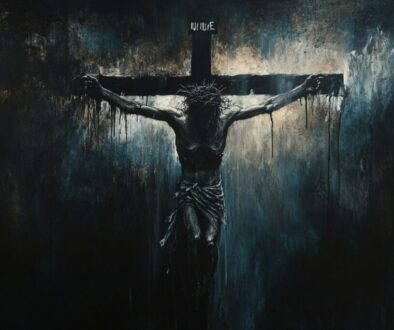
For his part, Jesus Christ left us an example, that we might follow in his steps: He committed no sin; no guile was on his lips. When he was reviled he did not revile in return; when he suffered, he did not threaten; but he trusted to him who judges justly. He himself bore our sins in his body on the tree, that we might die to sin and live to righteousness. By his wounds you have been healed. (1 Pe 2:22-24)
Jesus’ wounds can heal our anger and by his cross and resurrection he teaches us to raise our heart and mind beyond the confines of this passing world to the fulfillment of God’s promise, what eye has not seen, and ear has not heard, and what has not entered into the heart of man, what God has prepared for those who love him. Jesus, the author and perfecter of our faith, has also given us hope that, by the grace of God, we can indeed live by God’s commandments, live the righteousness that goes deeper than the scribes and Pharisees, and attain the fulfillment of the promise. (cf. He 12:1-2)
Seek a Deeper Connection with God and Join Lay Cistercians of South Florida
Lay Cistercians of South Florida, is a community of lay people who seeks to have a deeper connection with God by living a life inspired by the monks and nuns through Lay Monasticism. Learn more about what is a Lay Cistercian on our website. Anyone who aspires to do the same as us, and is a confirmed Catholic is welcome to join us! We meet every second Saturday of the month at Emmanuel Catholic Church in Delray Beach, Florida.

This Content Has Been Reviewed For Accuracy
This content has undergone comprehensive fact-checking by our dedicated team of experts. Discover additional information about the rigorous editorial standards we adhere to on our website.