The Holy Family Is The Example For Human Families – Sermon by Father Levine
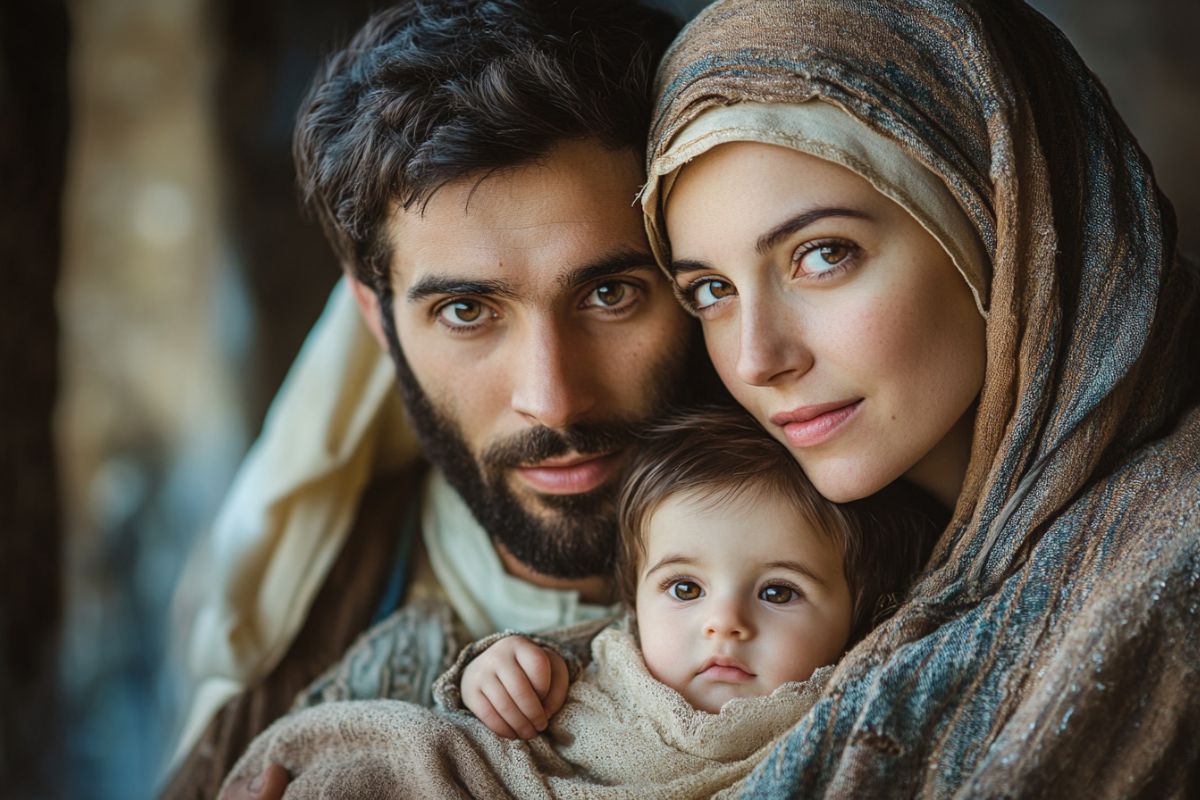
Fr. Joseph Levine; Holy Family Catholic Church and Missions, Burns, Oregon; December 28, 2025
In Jesus Christ we have a high priest who is able to sympathize with our weakness, because he was tested in every respect as we are, yet without sinning. (Heb 5:15) He was a man like us, in all things but sin, who lived in this same sin filled world. The same could be said of the Holy Family, they were likewise tested in every respect as we are, without sinning. Of St. Joseph, even, we must say that long before he was espoused to the Virgin, in preparation for his mission, he would have been completely purified of sin.
Today’s Gospel gives us a quick glimpse at the real human hardship the Holy Family endured, fleeing the murderous Herod and seeking refuge in exile in Egypt, then returning to the land of Israel, where they lived a life of simplicity, poverty (but not destitution), and obscurity in the town of Nazareth.
Jesus would say, My food is to do the will of him who sent me and accomplish his work. (Jn 4:34) The Holy Family too follows the will of God. The Holy Family followed the will of God into Egypt and the Holy Family followed the will of God, returning to Nazareth.
Yet, Jesus, in his infancy and childhood, submitted himself to the will of his Father, by submitting himself to the order of the family in which he was born. St. Luke expressly tells us that Jesus was obedient to Mary and Joseph. (cf. Lk 2:51)
Today’s Gospel also reveals the order of the family. St. Joseph is the head of the Holy Family; the angel appears to St. Joseph giving him instructions regarding the family; the angel tells St. Joseph to take the Child and his Mother to Egypt; the angel tells St. Joseph to return with the Child and his Mother to the land of Israel.
The Holy Family, as a unity, is subject to God through St. Joseph, as the husband and father and head of the household. Yes, the Immaculate Virgin is perfectly subject to God; Jesus, is himself God subject to God. Nevertheless, as a whole, as a unity, as a family, it is through St. Joseph that they are all together subject to God. On earth, St. Joseph represented God the Father, to the very Son of God, who always beholds the face of his Father in heaven.
When a family takes its name from the father, that tells us also that it is from the father that the family has its unity; it also tells us that the father represents the whole family before God; he is like the priest of the family.
We can also consider that the words of St. Paul in today’s 2nd reading were perfectly fulfilled in the Holy Family.
The Blessed Virgin Mary, the Immaculate Mother of God, was subordinate to St. Joseph; St. Joseph loved the Blessed Virgin without bitterness; Jesus, marvel of marvels, the Lord of the whole universe, obeyed them both. St. Joseph commanded Jesus and was certainly not harsh towards him.
St. Joseph and the Blessed Virgin both listened to the word of God, treasured it in their hearts, and the word of God ruled over the house in which the very Word made flesh quietly dwelt.
Life within that household was certainly characterized by compassion, humility, gentleness, and patience, all bound together beneath the tender domain of love as the bond of perfection.
We might wonder though if forgiveness could have any place in that sinless household?
Well, there would not be forgiveness of sin, but there would be forgiveness of such human mistakes and misunderstandings that are an unavoidable part of life. More remarkable, when Jesus, at age 12, stayed behind in the Temple, leaving Mary and Joseph in unspeakable sorrow, searching for him for three days – this was not a mistake on Jesus’ part – we can be sure that afterwards, Mary and Joseph forgave Jesus, the Son of God.
The Son of God made man, lives a human life and teaches us how to be human; through his sacrifice on the Cross, he wins for us the grace to live according to his teaching. So also the Holy Family, living a family life in this world, teaches families how to live together in charity, and having been lifted up to heaven intercedes for families that they may be faithful to the teaching.
One lesson, that goes beyond charity, but requires charity to fulfill, is the lesson about the need for authority. Yes, the home should be a place characterized by the tenderness and sweetness of love, but true authority makes that possible.
St. Joseph was the authority in the Holy Family. He had that authority from God. Indeed, the very nature of authority in the created world is to be subordinate to higher authority, which must ultimately be rooted in the supreme authority of God. That means that authority, to be true, must serve the higher authority.
Jesus, as man, willingly subjected himself to St. Joseph’s authority in the Holy Family, even though on the occasion of his remaining behind in the Temple, he reminded his parents that as the Son of God, he was himself the absolute authority.
We could consider with awe what it must have meant for St. Joseph to tell the Son of God what to do! What reverence, what love, what fear and trembling must have been in his heart whenever he gave a command to Jesus; he might have wished rather to be commanded by Jesus, but in humility he had to bear the mantle of authority that had been entrusted to him, for the good of Jesus and Mary.
Somehow, though, in sinful families – and we are all sinners – we want to make an exception. We want to deny, in practice, that the Holy Family can really serve as an example for us. We want to have it our own way. It is precisely this self-will that keeps us from sharing in the blessed life of the Holy Family.
Yet, it is evident that when authority is lacking in a family, the children suffer. It is evident, or should be, that children need the good order in the family that exists only when true authority is present. In an intact family, that authority resides first of all in the husband and father.
In the relation between husband and wife there will always be cases in which someone needs to give way and yield.
The husband can yield because he is weak and has effectively ceded his authority to his wife. The husband can refuse to yield because he is weak and is trying to prove himself. Yet, it is also possible for the husband to choose to yield, without ceding his authority. He can realize, humbly, that he has been mistaken. He can recognize that he might be right, but that in the circumstances insisting on his way will do more harm than good. He can recognize that in the particular matter right and wrong does not even enter the question, but it will be good to give his wife the gift of having her preference.
It is not always a question of authority and for its part authority does not exist so that a person can have his way, but it exists in service of the good of the whole, in which the members of the family find their good – there is a special good, a special happiness, that each one enjoys for being part of a family in which peace reigns. That is much better than having “my way” and doing what “I want.”
The husband can choose to yield, but when St. Paul urges wives to be subordinate to their husbands it certainly means that the wife should be inclined to yield, unless some significant good is at stake. A wife should recognize that she might be quite capable of getting her way; she has great power in the marriage and can often bring her husband to submit to her; but she also needs to recognize that if she gets her way, she undermines or usurps her husband’s authority, and that will be bad for everyone. She cannot replace him. Men and women are not interchangeable.
Of course, these days people are very concerned about abuse and rightly so, but abuse can go in either direction in a marriage, even though it is usually more evident when the husband abuses the wife. Nevertheless, the elimination of authority does not solve the problem of abuse but opens the door to other kinds of abuse.
A word of advice: take great care not to enter into an abusive relationship, but if you have given your word in marriage, then be prepared to suffer greatly if need be, after the example of a St. Monica or St. Rita. Such suffering requires great holiness that comes only through the grace of God and union with Christ crucified. Nor can we excuse ourselves on account of our lack of holiness; we should desire such holiness and we should beg God for that grace.
There is a world of difference between suffering continual abuse that destroys a person’s self-esteem, leading to a morass of self-pity and bitterness – the person yields, but resents; the victim becomes a sort of negative image of the abuser – there is world of difference between that sort of suffering and the suffering of Christ.
St. Peter, setting forth the suffering of Christ as the example for the Christian, said of him, He committed no sin; no guile was found on his lips. When he was reviled, he did not revile in return; when he suffered, he did not threaten; but he trusted himself to him who judges justly. He himself bore our sins in his body on the tree, that we might die to sin and live to righteousness. By his wounds you have been healed. (1 Pe 2:22-24)
When he suffered, Christ did not lose the peace that reigned in his heart; he did not lose that peace because he knew who he was, the very Son of God, and why he had come, to do the will of his Father and offer his life for our salvation. To suffer with him, we must not allow the abuse to take away the peace of heart that comes from knowing that we have been given the dignity, in Christ, of becoming children of God; we might not possess the clarity that he had, but we have every reason to trust ourselves into the hands of God as he did. We are indeed called to offer ourselves to God, through, with, and in Christ, most of all when we suffer unjustly from others and are powerless to do anything about it.
Yet, as I said, that requires great holiness, which requires great grace, which can only be attained through prayer. This all presupposes real faith, the sort that moves mountains.
Alas, often a person is already deeply wounded and hurt, as result of which he lacks possession of himself. In that situation, he finds that before he can truly suffer with Christ, he must learn to protect himself and heal from his wounds.
In the extreme cases, the Code of Canon Law affirms: “If either of the spouses causes grave mental or physical danger to the other spouse or to the offspring or otherwise renders common life too difficult, that spouse gives the other a legitimate cause for leaving, either by decree of the local ordinary or even on his or her own authority if there is danger in delay.” (CIC 1153.1)
What most separates us from the blessedness of the Holy Family is our self-will. The way to holiness requires that we reject the desire for dominance, abandon the insistence on “my way” and learn the humility that consists in submitting to the will of God, even when that is manifest to us in the will of another human being set over us. Even when I happen to be right, I should only insist on it when the “right” is important not my being right. Such holiness, free from “my way,” is required for the right exercise of authority.
This Is what Jesus meant when he told the Apostles, who were arguing about who was greater, You know that the rulers of the Gentiles lord it over them, and their great men make their power felt. It shall not be so among you; but whoever would be great among you must be your servant, and whoever would be first among you must be your slave; even as the Son of man came not to be served but to serve, and to give his life as a ransom for many. (Mt 20:25-28)
The one in authority must be completely focused on the good of those who have been entrusted to his care – that is service – even to the point of giving his life for them. So it is that St. Paul exhorted husbands saying, Husbands, love your wives as Christ loved the Church and gave himself up for her, that he might sanctify her … that he might present the Church to himself in splendor … that she might be holy and without blemish. (Eph 5:25-26,27)
The example and teaching of the Holy Family does not apply just to the natural family of husband and wife and children, but also to the supernatural family of the Church, and so also to the parish.
Seek a Deeper Connection with God and Join Lay Cistercians of South Florida
Lay Cistercians of South Florida, is a community of lay people who seeks to have a deeper connection with God by living a life inspired by the monks and nuns through Lay Monasticism. Learn more about what is a Lay Cistercian on our website. Anyone who aspires to do the same as us, and is a confirmed Catholic is welcome to join us! We meet every second Saturday of the month at Emmanuel Catholic Church in Delray Beach, Florida.

This Content Has Been Reviewed For Accuracy
This content has undergone comprehensive fact-checking by our dedicated team of experts. Discover additional information about the rigorous editorial standards we adhere to on our website.