The Hierarchy of Service and the Sacrifice of Charity – Sermon by Father Levine
Fr. Joseph Levine; Holy Family Catholic Church, Burns, Oregon; April 2, 2026
The themes prescribed for the Holy Thursday homily are the priesthood, the Holy Eucharist, and fraternal charity. We could perhaps speak of these themes in another way as Christ, who gives himself to us through the Holy Eucharist; the hierarchy of the Church, which is the instrument of Christ’s priesthood in the gift of the Holy Eucharist; and fraternal charity, which has its source in the Holy Eucharist and is the pleasing offering given back to God through the Holy Eucharist.
We are familiar with the Latin verses of the “Tantum ergo”, the first verse of which translates as “Down in adoration falling, Lo! The sacred host we hail, Lo! Oe’r ancient forms departing newer rites of grace prevail; faith for all its defects supplying where the feeble senses fail.” Today’s first reading, speaking of the ancient Passover, spoke of the ancient form that departed, replaced by the Holy Eucharist, as the newer rite of grace, the new Passover of which the former was but a figure.
Yet, it is important that as God did not just deliver the people of Israel from Egypt, but gave them a rite of worship that commemorated that event, neither did the Son of God, Jesus Christ, merely deliver us from the slavery to sin and death by his Cross, he also gave us a new rite of worship that both commemorates and makes present the reality.
We are familiar with the words of consecration of the precious Blood: “This is the chalice of my Blood, the Blood of the new and eternal covenant, which will be poured out for you and for many for the forgiveness of sins. Do this in memory of me.”
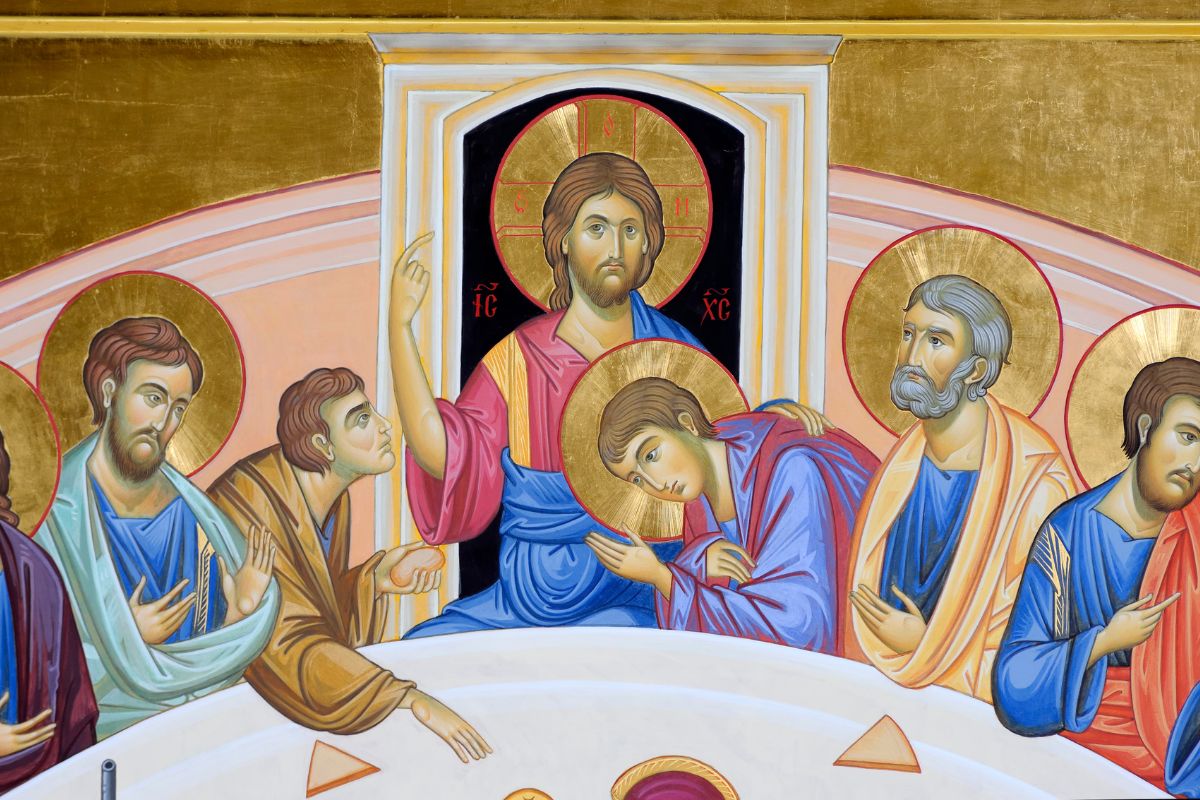
When he instituted the Holy Eucharist at the Last Supper, Christ offered the sacrifice of his Body and Blood, anticipating his sacrificial death on the Cross, to follow the next day. He thereby made visible the inner reality of what would outwardly appear as just another brutal crucifixion of a condemned criminal. He thereby declared his own priesthood, the eternal priesthood that establishes the new and eternal covenant. Consequently, he also inaugurated the new order of worship, worthy of the one God, because it is God worshipping God. Finally, he entrusted this order of worship to his Apostles, establishing thereby the hierarchical priesthood of the new covenant, of the Church.
Henceforth, so long as this world runs its course, everything revolves around the holy sacrifice of the Mass, the perpetual offering, in unbloody fashion, of the Body and Blood of Christ, the sacred mystery of which priests are the servants. This mystery is entrusted to the priesthood for the benefit of the faithful, who each in his own manner shares in the mystery.
One way we could look at this is through the reality called sacramental “character”.
There are three unrepeatable sacraments: baptism, confirmation, and holy orders. Holy orders, for its part, has three orders or levels, none of which can be repeated: diaconate, priesthood, and episcopate (the order of bishops).
These sacraments cannot be repeated because, in addition to the grace imparted by the sacrament, each of these sacraments stamps on the soul of the recipient an indelible spiritual mark, called “character”. The gift of sanctifying grace gives us to share in the divine life of Jesus Christ, the Son of God; sacramental character, which stamps the mark of Christ on the soul, commissions and empowers us to share in the threefold mission of Christ, priest, prophet, and king, in accord with the purpose of each sacrament, bearing witness to the word of God, administering some realm of Christ’s kingdom, at least our own body and soul, and sharing in his priestly worship, the glorification of God the Father.
The mission requires the grace, but once we have been stamped with the mark of Christ, we have the mission, whether we want it or not. Nevertheless, the character always calls us back to the life of grace, calls us to conversion, and promises us the grace we need for the mission. Sacramental character marks us invisibly to the eyes of men, but visibly to the angels and demons, as belonging to the spiritual army of Christ, whether as a loyal soldier or deserter. That is the reason for the old saying, “Once a Catholic, always a Catholic.”
Christ is one, and his mission is one. The motto of Pope Leo is “In illo uno unum”: “We are one in the one Christ.” Sacramental character lays a foundation by uniting us, in a very real objective way, in a hierarchical sharing in Christ’s mission, which culminates in the worship that gives glory to God. The real unity established by character needs to be filled out by the gift of God’s grace and a life of charity in fidelity to grace; then our unity in Christ is made perfect.
Baptismal character is the mark of the children of God, entitled to call upon God as “our Father”, to intercede through Christ on behalf of others, and to partake in the sacrifice of the Mass through the reception of holy communion.
The character of confirmation marks the Christian as a “soldier of Christ”, commissioned to bear witness to the truth of the Gospel, by word and deed, in the face of all adversity, even to the point of the shedding of blood.
The whole of the Christian life, nourished by the Holy Eucharist, is contained in the sacraments of baptism and confirmation. The whole life of a Christian, everything he thinks, does, and says, should be given back to God, through the mystery of worship in the Holy Eucharist.
The sacrament of holy orders exists to serve the Christian life in the body of the faithful, bringing them together visibly in the Body of Christ, which is the Church, uniting them to Christ the head of the Body, maintaining them in unity, nourishing them with the word of God and the Holy Eucharist, and bringing everything back to God, through Christ, in the worship of the Mass. In this way, the life of a priest is always for others, a continual washing of their feet. Hierarchy, which means “sacred order,” is the instrument by which God communicates his grace to the faithful and through which the faithful give themselves back to God in praise and worship.
We could say that the deacon serves the mystery of worship; the priest offers the worship of the Holy Eucharist; the bishop presides over the whole order of Christian worship, so that the life of the faithful is brought into unity and given to God.
What is pleasing to God is the offering of the Body and Blood of Christ, together with the devotion of the faithful individually, and above all, the united offering of their fraternal charity.
All this is summed up in Christ’s gift of love, the gift of himself on the Cross and in the Holy Eucharist. It is spelled out and specified and made practical by his command, As I have loved you, so must you love one another. (Jn 13:34)
This mutual love of Christians is not merely a nice thought or sentiment; it is something to be lived out in thought, word, and deed, in the whole manner in which we treat each other, in the whole of the attitude we maintain towards each other. Nor is this some nice add on, but it is what is called for by the mark of Christ stamped on our souls, and the life of grace that has been given to us. It is truly “fraternal charity” because we have been made children of God and brothers and sisters in Christ. It is our pleasing offering to God, through, with, and in Jesus Christ, offered on the altar.
Seek a Deeper Connection with God and Join Lay Cistercians of South Florida
Lay Cistercians of South Florida, is a community of lay people who seeks to have a deeper connection with God by living a life inspired by the monks and nuns through Lay Monasticism. Learn more about what is a Lay Cistercian on our website. Anyone who aspires to do the same as us, and is a confirmed Catholic is welcome to join us! We meet every second Saturday of the month at Emmanuel Catholic Church in Delray Beach, Florida.

This Content Has Been Reviewed For Accuracy
This content has undergone comprehensive fact-checking by our dedicated team of experts. Discover additional information about the rigorous editorial standards we adhere to on our website.