Christ Answers His Own Question – Sermon by Father Levine
Fr. Joseph Levine; Holy Family Catholic Church and Missions, Burns, Oregon; March 29, 2026
Do you not think that I can call upon my Father and he will provide me at this moment with more than twelve legions of angels? But all this has come to pass that the writings of the prophets may be fulfilled.
These words of Jesus are critical for understanding what Jesus is about and what is going on in his suffering and death.
On the one hand, there is the absolute power of God, capable at any moment of delivering him from his suffering. This is always a problem for us; we are forever perplexed and pained, “God, you have the power, why don’t you help? Right now.” On the other hand, there is the divine plan, from before the creation of the world, but revealed in the writings of the prophets. That Jesus suffers and dies is central to that plan. Jesus knows this, for he has come to fulfill that plan. Indeed, it is also his plan because he is one God with the Father from before the creation of the world.
So, then, what is Jesus about? What is his purpose?
He states his purpose at the Last Supper. Take and eat. This is my Body. … Drink from it all of you, for this is my blood of the covenant, which will be shed on behalf of many for the forgiveness of sins. I tell you, from now on I shall not drink of the fruit of the vine until the day when I drink it with you new in the kingdom of God.
First is the institution of the Holy Eucharist, which he also commands to be done in his memory, in memory first of all of his death and resurrection. The words of institution reveal Christ’s purpose: to offer his life, to shed his blood as a sacrifice to God, inaugurating a divine covenant, the new and eternal covenant, for the forgiveness of sins, which in turn opens the door to life in the kingdom of God, the life of grace in the Holy Spirit.
Jesus’s cryptic comment after the words of institution also speaks of his death and resurrection. I shall not drink of the fruit of the vine. The Psalmist tells us that God made wine to gladden their hearts. (Ps 104[103]:15) From the time of the Last Supper until he breathes his last on the Cross, Jesus will have no more joy in human life; only when he rises from the dead will he drink the wine of joy new, rejoicing now in the imperishable life of the resurrection. That is the life he prepares for us in the kingdom of God and which he already gives us to share in through the life of grace, nourished by holy communion.
Yet, for that exaltation, he needs to humble himself, becoming obedient to the point of death, death on a cross.
At the Last Supper, Jesus freely handed himself over to his Passion, to his suffering and death for the forgiveness of our sins, for our salvation. That means that he allows all that is human in him to suffer in human fashion at the hands of men. Though divinely he has the power, at any moment, to call a halt, to save himself and come down from the Cross, that is not the divine plan.
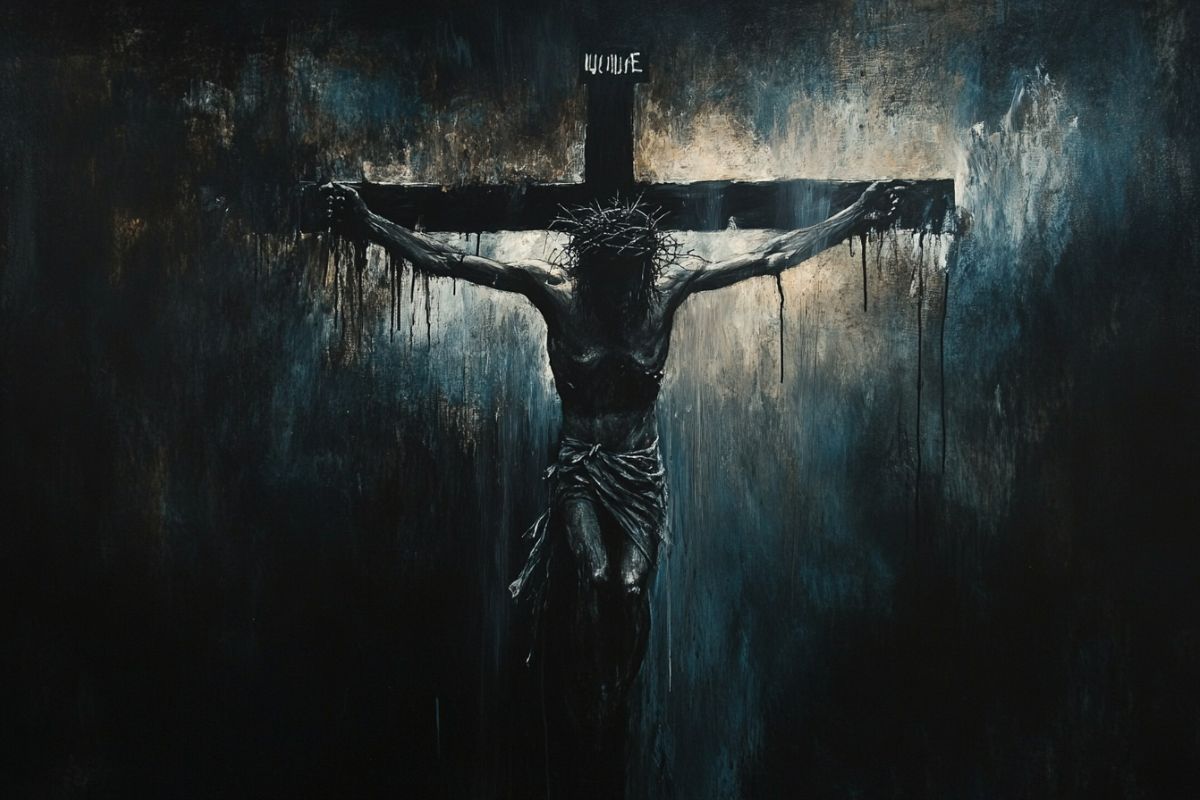
As a man, he suffers first in his mind, in anticipation of what is to come, submitting his human will to the will of the Father in prayer, while experiencing the failure of his sleeping Apostles, his friends. Then we see him submitting freely to the passivity of powerlessness: betrayed by a kiss, accused by false witnesses, condemned as a blasphemer by the High Priest, denied by Peter, handed over to the pagan governor, rejected in favor of Barrabas, hearing the voices of the crowd, crying out, crucify him, crucify him, handed over to be scourged and crowned with thorns, led out to be crucified, nailed to the Cross, mocked by all the bystanders, hanging there in agony, abandoned to the power of death, until the time arrives for him to breath his last. From the time Judas plants the kiss on his cheek until the time he breathes his last, he does nothing, says nothing, except what is necessary to bear witness to the truth. He does not rebel, he does not turn back, his purpose is firm, as a face set like flint, yet he is as an innocent lamb led to the slaughter. (Is 53:7)
Yes, upon the Cross, he cries out, My God, my God, why have you abandoned me, thereby giving voice to our questions. He is abandoned, because by the divine plan, he is delivered to the power of death. He is abandoned because at no point does God step in, nor does he make use of his own divine power, to free himself from or diminish in any way the suffering he is undergoing. Yet, he answers his own question, because the words of his cry, as he knows well, are the opening words of the Psalm that also speak of the purpose of the abandonment. I will proclaim your name to my brethren; in the midst of the assembly I will praise you.
This is what it means to drink the fruit of the vine new in the kingdom of God, after the resurrection, after being exalted to the right hand of the Father. We are his brethren, who share in the human nature of the Son of God, in whom we believe; we are the assembly in the midst of which he gives praise to God, offering anew his sacrifice of praise in the Holy Eucharist. Together with all Catholics throughout the world celebrating this Palm Sunday, we are the fruit of Christ’s sacrifice on the Cross.
The fickle crowds who hailed his entrance into Jerusalem on Palm Sunday and who cried out crucify him on Good Friday, nevertheless, by their hosannas, showed forth what was to come after his death, after their cries of crucify him had done their worst: namely, the praises of the angelic hosts, who welcomed the conqueror in his ascent to the Father’s throne and the praises of his Church resounding through the centuries. May our voices be joined in truth to the sacrifice of praise.
Seek a Deeper Connection with God and Join Lay Cistercians of South Florida
Lay Cistercians of South Florida, is a community of lay people who seeks to have a deeper connection with God by living a life inspired by the monks and nuns through Lay Monasticism. Learn more about what is a Lay Cistercian on our website. Anyone who aspires to do the same as us, and is a confirmed Catholic is welcome to join us! We meet every second Saturday of the month at Emmanuel Catholic Church in Delray Beach, Florida.

This Content Has Been Reviewed For Accuracy
This content has undergone comprehensive fact-checking by our dedicated team of experts. Discover additional information about the rigorous editorial standards we adhere to on our website.