A Quick Guide to Praying the Rosary in Latin
Published November 25, 2025
Praying the Rosary in Latin connects you to the timeless rhythm of the universal Church and the saints who came before. Latin has long been the Church’s sacred language—uniting believers across nations and centuries in a single voice of devotion. Whether you’re drawn by its reverence, history, or beauty, learning to pray the Rosary in Latin can deepen your meditation and anchor your prayer life in a rich spiritual heritage.
In this article, you’ll find a complete guide to praying the Rosary in Latin with confidence. We include all essential prayers in Latin and English. Explore a step-by-step guide, pronunciation and meditation tips, and how Latin can enrich your spiritual life.
Why Pray The Rosary In Latin?
Latin has been the Church’s universal language for over a millennium. Praying the Rosary in Latin lets you join a tradition shared by saints, popes, and faithful Catholics throughout history.
Latin’s solemn rhythm focuses the mind and helps the heart enter deep contemplation, setting prayer apart from daily noise. Praying in Latin is not about perfection; it joins your voice with generations past and present in unified faith.
Rosary Prayers In Latin
Here are the Rosary’s prayers in Latin with English translations, arranged in sequence. Each prayer includes a brief commentary for understanding.
+ Signum Crucis | + Sign of the Cross
Latin Text:
In nómine Pátris, et Fílii, et Spíritus Sáncti. Amen.
English Translation:
In the name of the Father, and of the Son, and of the Holy Spirit. Amen.
The Sign of the Cross opens and closes Catholic prayers. Starting the Rosary this way dedicates the time to the Trinity and sanctifies your intentions.
Symbolum Apostolorum | Apostles’ Creed
Latin Text:
Crédo in Déum Pátrem omnipoténtem, Creatórem cáeli et térræ. Et in Jésum Chrístum, Fílium éjus unícum, Dóminum nóstrum, qui concéptus est de Spíritu Sáncto, nátus ex María Vírgine, pássus sub Póntio Piláto, crucifíxus, mórtuus, et sepúltus. Descéndit ad ínferos: tértia díe resurréxit a mórtuis: ascéndit ad cáelos: sédet ad déxteram Déi Pátris omnipoténtis: índe ventúrus est judicáre vívos et mórtuos.
Crédo in Spíritum Sánctum, sánctam Ecclésiam Cathólicam, Sanctórum communiónem, remissiónem peccatórum, cárnis resurrectiónem, vítam ætérnam. Amen.
English Translation:
I believe in God, the Father almighty, Creator of heaven and earth. And in Jesus Christ, His only Son, our Lord, who was conceived by the Holy Spirit, born of the Virgin Mary, suffered under Pontius Pilate, was crucified, died, and was buried. He descended into hell; on the third day, He rose again from the dead; He ascended into heaven, and is seated at the right hand of God the Father almighty; from there He will come to judge the living and the dead.
I believe in the Holy Spirit, the holy catholic Church, the communion of saints, the forgiveness of sins, the resurrection of the body, and life everlasting. Amen.
Recited on the crucifix, the Apostle’s Creed declares the core tenets of faith. It grounds the Rosary in Christianity’s truths before meditation.
Oratio Dominica | Our Father
Latin Text:
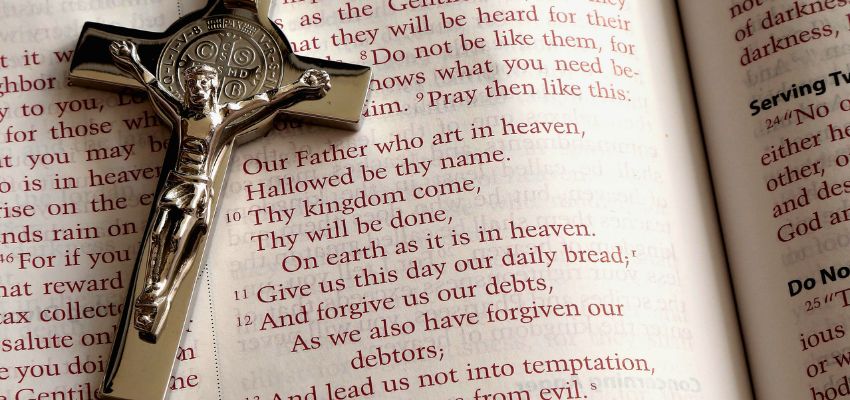
Páter nóster, qui es in cáelis, sanctificétur nómen túum. Advéniat régnum túum. Fíat volúntas túa, sícut in cáelo et in térra. Pánem nóstrum quotidiánum da nóbis hódie, et dimítte nóbis débita nóstra sícut et nos dimíttimus debitóribus nóstris. Et ne nos indúcas in tentatiónem, sed líbera nos a málo. Amen.
English Translation:
Our Father, who art in heaven, hallowed be Thy name. Thy kingdom come, Thy will be done, on earth as it is in heaven. Give us this day our daily bread, and forgive us our trespasses, as we forgive those who trespass against us. And lead us not into temptation, but deliver us from evil. Amen.
Taught by Christ, this prayer connects you with generations who spoke these Latin words. It starts each decade and prepares you for meditation.
Ave Maria | Hail Mary
Latin Text:
Áve María, grátia pléna, Dóminus técum. Benedícta tu in muliéribus, et benedíctus frúctus véntris túi, Jésus. Sáncta María, Máter Déi, óra pro nóbis peccatóribus, nunc et in hóra mórtis nóstræ. Amen.
English Translation:
Hail Mary, full of grace, the Lord is with thee. Blessed art thou among women, and blessed is the fruit of thy womb, Jesus. Holy Mary, Mother of God, pray for us sinners, now and at the hour of our death. Amen.
The Ave Maria is the core of the Rosary, repeated ten times per decade. Its first part is from Scripture, the second a prayer for Mary’s intercession.
Gloria Patri | Glory Be
Latin Text:
Glória Pátri, et Fílio, et Spíritui Sáncto. Sícut érat in princípio, et nunc, et sémper, et in sáecula sæculórum. Amen.
English Translation:
Glory be to the Father, and to the Son, and to the Holy Spirit. As it was in the beginning, is now, and ever shall be, world without end. Amen.
This short hymn concludes each decade. It shifts focus to the Trinity, praising God in meditation.
Oratio Fatimae | Fatima Prayer
Latin Text:
Dómine Jesu, dimítte nobis débita nostra, líbera nos ab ígne inférni, perdúc in cælum ómnes ánimas, præsértim eas, quæ misericórdiæ tuæ máxime indígent.
English Translation:
O my Jesus, forgive us our sins, save us from the fires of hell, lead all souls to Heaven, especially those in most need of Thy mercy.
Requested by Our Lady at Fatima, this optional prayer is said after the Gloria Patri for the salvation of souls.
Salve Regina | Hail Holy Queen
Latin Text:
Sálve Regína, Máter misericórdiæ; víta, dulcédo, et spes nóstra, sálve. Ad te clamámus, éxsules fílii Hévæ. Ad te suspirámus, geméntes et fléntes in hac lacrimárum válle. Éja érgo, Advocáta nóstra, íllos túos misericórdes óculos ad nos convérte. Et Jésum, benedíctum frúctum véntris túi, nóbis post hoc exsílium osténde. O clémens, O pía, O dúlcis Vírgo María.
English Translation:
Hail, Holy Queen, Mother of Mercy; our life, our sweetness, and our hope. To thee do we cry, poor banished children of Eve. To thee do we send up our sighs, mourning and weeping in this valley of tears. Turn then, most gracious Advocate, thine eyes of mercy toward us, and after this our exile, show unto us the blessed fruit of thy womb, Jesus. O clement, O loving, O sweet Virgin Mary.
This Marian antiphon ends the Rosary and is both a hymn of praise and a plea for Mary’s guidance on our journey to Christ.
Oremus | Concluding Prayer
Latin Text:
Orémus: Déus, cújus Unigénitus per vítam, mortem et resurrectiónem súam nóbis salútis ætérnæ præmia comparávit: concéde, quæsumus: ut hæc mystéria sacratíssimo beátæ Maríæ Vírginis Rosário recoléntes, et imitémur quod cóntinent, et quod promíttunt, assequámur. Per eúndem Chrístum Dóminum nóstrum. Amen.
English Translation:
Let us pray: O God, whose only begotten Son, by His life, death, and resurrection, has purchased for us the rewards of eternal life, grant, we beseech Thee, that meditating upon these mysteries of the Most Holy Rosary of the Blessed Virgin Mary, we may imitate what they contain and obtain what they promise, through the same Christ our Lord. Amen.
This final prayer states the Rosary’s purpose: meditate on Christ’s life, embody the virtues, and seek eternal life.
Mysteries Of The Rosary In Latin
Praying the Mysteries of the Rosary guides meditation on Christ’s and Mary’s lives. Each set is prayed on specific days, walking through the Gospel. Announce each mystery in Latin to let the language and rhythm deepen your reflection.
Mysteria Gaudiosa (Joyful Mysteries) — Monday And Saturday
(Also on Sundays during Advent and Christmastide)
- Prímum Mysterium Gaudiósum: Annuntiatio (The First Joyful Mystery: The Annunciation)
- Secúndum Mysterium Gaudiósum: Visitatio (The Second Joyful Mystery: The Visitation)
- Tértium Mysterium Gaudiósum: Nativitas (The Third Joyful Mystery: The Nativity)
- Quartum Mysterium Gaudiósum: Presentatio (The Fourth Joyful Mystery: The Presentation)
- Quíntum Mysterium Gaudiósum: Inventio Domini nostri Iesu Christi in templo (The Fifth Joyful Mystery: The Finding of the Child Jesus in the Temple)
Mysteria Dolorosa (Sorrowful Mysteries) — Tuesday And Friday
(Also on Sundays during Lent)
- Prímum Mysterium Dolorósum: Cruciatus in Horto (The First Sorrowful Mystery: The Agony in the Garden)
- Secúndum Mysterium Dolorósum: Flagellatio Domini nostri Iesu Christi (The Second Sorrowful Mystery: The Scourging at the Pillar)
- Tértium Mysterium Dolorósum: Coronatio cum Spinis (The Third Sorrowful Mystery: The Crowning with Thorns)
- Quartum Mysterium Dolorósum: Bajulatio Crucis (The Fourth Sorrowful Mystery: The Carrying of the Cross)
- Quíntum Mysterium Dolorósum: Crucifixio (The Fifth Sorrowful Mystery: The Crucifixion)
Mysteria Gloriosa (Glorious Mysteries) — Wednesday And Sunday
(Except during Advent, Christmastide, and Lent)
- Prímum Mysterium Gloriósum: Resurrectio (The First Glorious Mystery: The Resurrection)
- Secúndum Mysterium Gloriósum: Ascensio (The Second Glorious Mystery: The Ascension)
- Tértium Mysterium Gloriósum: Descensus Spiritus Sancti (The Third Glorious Mystery: The Descent of the Holy Spirit)
- Quartum Mysterium Gloriósum: Assumptio Beatae Mariae Virginis in Caelum (The Fourth Glorious Mystery: The Assumption of the Blessed Virgin Mary into Heaven)
- Quíntum Mysterium Gloriósum: Coronatio Beatae Mariae Virginis in Caelum (The Fifth Glorious Mystery: The Crowning of the Blessed Virgin Mary)
Mysteria Luminosa (Luminous Mysteries) — Thursday
- Prímum Mysterium Luminosum: Baptismus Iesu (The First Luminous Mystery: The Baptism of Jesus)
- Secúndum Mysterium Luminosum: Miraculum ad Nuptias in Cana (The Second Luminous Mystery: The Miracle at the Wedding in Cana)
- Tértium Mysterium Luminosum: Proclamatio Regni Dei (The Third Luminous Mystery: The Proclamation of the Kingdom of God)
- Quartum Mysterium Luminosum: Transfiguratio (The Fourth Luminous Mystery: The Transfiguration)
- Quíntum Mysterium Luminosum: Ultima Cena (The Fifth Luminous Mystery: The Last Supper)
How To Pray The Rosary In Latin
Praying the Rosary in Latin follows the same familiar structure as in English—only the language of the prayers changes. Here’s how to pray step by step:
Begin Your Latin Rosary With Intention And The Sign Of The Cross
Find a quiet place to focus. Hold the crucifix, make the Sign of the Cross, and state your intention—be it for thanksgiving, guidance, or intercession.
The Opening Prayers
On the crucifix, recite the Apostles’ Creed. Then, pray one Our Father and three Hail Marys (for Faith, Hope, and Charity), concluding with the Glory Be.
The Sequence Of Each Decade
The Rosary in Latin has five decades. Each decade involves a sequence of prayers on beads, guiding your meditation on the life of Christ.
- Announce the Mystery — On the large bead before the decade, announce the corresponding mystery (e.g., Primum Mysterium Gaudiosum: Annuntiatio).
- Pray the Our Father — On that same large bead, recite the Oratio Dominica (Pater Noster or Our Father).
- Pray the Hail Marys — On each of the ten smaller beads that follow, recite one Ave Maria (Hail Mary), keeping a slow and prayerful pace as you move bead by bead.
- Pray the Glory Be — In the space after the tenth bead, recite one Gloria Patri (Glory Be) in thanksgiving and praise.
- Pray the Fatima Prayer (Optional) — It’s customary to follow the Gloria Patri with the Oratio Fatimae (O My Jesus), offered for mercy and the salvation of souls.
Repeat this sacred sequence for all five decades, letting the rhythm of the beads and the Latin prayers guide your contemplation of the mysteries of faith.
Meditating On The Mysteries
As you recite each decade, visualize the event of Christ’s life that the Mystery recalls. Let the Latin words rhythmically support your meditation, not distract from it. Focus on meaning, not mastery—prayer is an act of love, not linguistic perfection.
Concluding The Rosary
After completing all five decades, pray the Salve Regina (Hail, Holy Queen) and conclude with the Sign of the Cross. Finish in silence, offering thanks for the grace of prayer and the peace it brings.
Common Mistakes And Tips For A Deeper Latin Rosary Experience
Praying the Rosary in Latin offers spiritual depth but can challenge beginners. Here’s how to overcome common difficulties and keep your prayer meaningful.
- Mispronouncing Latin words. Don’t let pronunciation intimidate you. Use Latin Rosary audio guides or recordings by native Church Latin speakers. With practice, the rhythm will feel natural.
- Rushing through the beads. The Rosary isn’t a race. Pray slowly and deliberately, allowing the Latin words’ repetition to foster calm and focus. A slower pace deepens contemplation and reduces distraction.
- Losing the meaning when using Latin. Don’t worry if you don’t understand every word. You can keep an English translation handy or meditate on the Mysteries visually. What matters is your heart’s intention, not your linguistic mastery.

Embracing The Rosary In Latin: A Timeless Path Of Prayer
Praying the Rosary in Latin offers more than learning a new prayer language; it connects you to a centuries-old dialogue with God. Start simply, perhaps with one decade, and use resources like audio versions or bilingual prayer cards to aid your journey. Each Latin word you learn connects you to the Church’s living heritage—the same prayers whispered by monks, martyrs, and saints for generations.
If you wish to grow deeper in this contemplative tradition, explore how the Lay Cistercians can support your spiritual life through community, prayer, and reflection.
Seek a Deeper Connection with God and Join Lay Cistercians of South Florida
Lay Cistercians of South Florida, is a community of lay people who seeks to have a deeper connection with God by living a life inspired by the monks and nuns through Lay Monasticism. Learn more about what is a Lay Cistercian on our website. Anyone who aspires to do the same as us, and is a confirmed Catholic is welcome to join us! We meet every second Saturday of the month at Emmanuel Catholic Church in Delray Beach, Florida.

This Content Has Been Reviewed For Accuracy
This content has undergone comprehensive fact-checking by our dedicated team of experts. Discover additional information about the rigorous editorial standards we adhere to on our website.

About The Author
Hello there! I’m Corinne Grace. I believe in the power of storytelling to connect and educate, which is why I strive to bring each article to life with clarity and purpose. It’s not just about what’s written, it’s about making an impact on the reader.