The Baptism of Jesus Brings Us the Reality of His Birth – Sermon by Father Levine
Fr. Joseph Levine; Holy Family Catholic Church and Missions, Burns, Oregon; January 11, 2026
The problem of the nativity scene is that it can easily become no more than a sweet memory of something that happened long ago (2,000+ years) and far away. We need then to keep firmly in mind what we profess in the Creed:
“For us men and for our salvation he came down from heaven, and by the Holy Spirit was incarnate of the Virgin Mary and became man.” The child born in the manger is the Son of God, consubstantial to the Father, become man for our salvation.
Everything regarding Jesus Christ, the Son of God made man, everything from his conception in the womb of the Virgin Mary to his death on the Cross and his burial, everything from his resurrection from the dead to his ascension into heaven was “for us men and for our salvation.”
It was not just for those men who were privileged to live and meet him when he walked the earth, but was for all men, in every time and place, including here and now.
That is also why it is fitting that the Christmas season opens with the celebration of Christ’s birth and closes with the celebration of his baptism.
The baptism of the Lord belongs to the mystery of the Epiphany, the manifestation of the Lord; it would have done us no good had the Son of God been born among us as a man, unless he had also been made manifest to us, made known to us, precisely as the Son of God. He accomplished our salvation by dying for us, as the Lamb of God, offered in sacrifice, but the sacrifice was worthy of God because the One who offers and is offered is the very Son of God. The keystone of our faith is always that the man who did this on our behalf, Jesus Christ, is the very Son of God.
In his baptism, which is part of his work of fulfilling all righteousness or justice, so as to make us to be just and righteous in the eyes of God, it is made known to us, made manifest to us, who Jesus is, what he does for us, how that touches us concretely here and now, and what we become in him.
Before I enter into the details, however, let me clarify something in the 2nd reading that could be misleading. St. Peter says to Cornelius: I see that God shows no partiality. Rather in every nation whoever fears him and acts uprightly is acceptable to him.
Taken out of context, this could easily be taken to mean that there is no need to believe in Jesus Christ, no need to be baptized; rather all that is needed is to fear God and act uprightly. The proper context, though, makes clear that not only Jews (like St. Peter) but the Gentiles, all the nations are called to salvation in Christ.
As we heard last Sunday, on the Solemnity of the Epiphany: It was not made known [manifest] in other generations as it has now been revealed to his holy apostles and prophets by the Spirit: that the Gentiles are coheirs, members of the same body, and copartners in the promise in Christ Jesus through the Gospel. (Eph 3:5-6)
Before the time of Christ, God chose one nation out of all the earth, the Jewish people, entered into a covenant with them, taught them his ways and prepared them for the coming of Christ. The import of St. Peter’s words is that now, through Christ, the mercy of God is being extended to all nations. Cornelius is the first among the Gentiles to hear the full preaching of the Gospel, to believe in Jesus Christ, and to be baptized. His “fearing God and acting uprightly” are not a substitute for faith and baptism but his preparation. He was found acceptable so as to be baptized.
Jesus’ own example in submitting to be baptized by John, not out of necessity, but to fulfill all righteousness, teaches us in a powerful way about why we needed to be baptized.
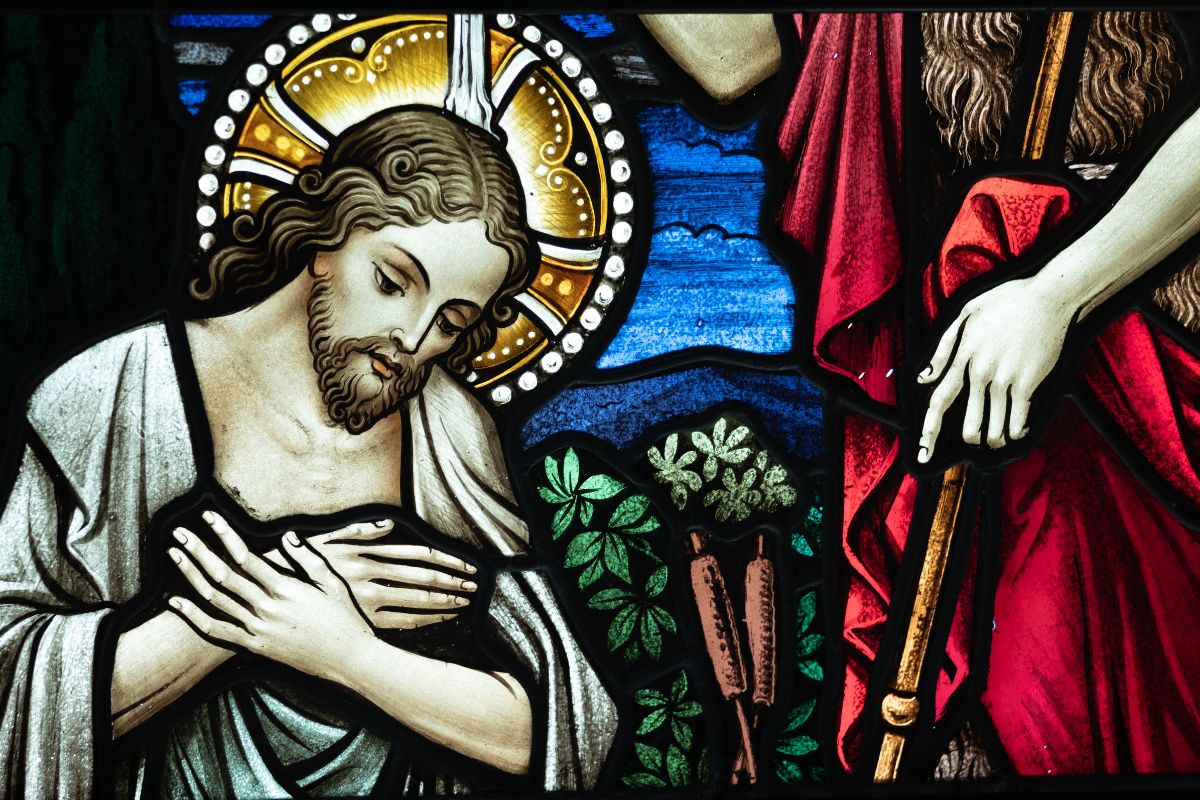
When Jesus was baptized, he was first immersed in the waters of the Jordan as a sign of his coming death, by which he does indeed fulfill all righteousness, giving worthy glory to God, who had been offended, blasphemed we could say, robbed of his glory by Adam and his descendants. Rising from the water, then, signifies his resurrection. Then through his death and resurrection, the heavens, which had been closed to man by Adam’s sin, are opened for Christ and for all who belong to him as members of his Body.
He said to Nicodemus, in the context of teaching about the need for baptism: No one has ascended into heaven but he who descended from heaven, the Son of man. (Jn 3:13)
In today’s 1st reading the prophet refers to Jesus as the covenant of the people. It is a curious expression. Moses was the mediator of the covenant between God and Israel; Jesus is the very covenant. The covenant joins the people to God and defines their relationship to God. Jesus is not merely the mediator of the new covenant, but the covenant itself; we are joined to God by being joined to Jesus, in his Body. It remains true that no one ascends to heaven, except the One who descended; unless we are joined to him, we cannot ascend with him.
Then, after his baptism, Jesus’ identity was revealed – as it was revealed definitively after his resurrection – by the dove, representing the Holy Spirit, and the voice of the Father, This is my beloved Son, with whom I am well pleased.
Later, before ascending to heaven, Jesus will give to his Apostles the “great commission”: Go and make disciples of all nations, baptizing them in the name of the Father and of the Son and of the Holy Spirit, teaching them to observe all that I have commanded you. (Mt 28:19-20)
In other words: “By means of baptism impart to them the reality that you have come to know in me and that was revealed in my baptism; by means of baptism unite them to my death and resurrection that they may be freed from sin, receive the gift of the Holy Spirit, and walk in the newness of the life of grace (cf. Rm 6:1-11; Acts 2:38); by means of baptism make them to become children of God sharing in the life of the only begotten Son of God, conformed to him, and so teach them to live as I lived, truly as children of God, that God’s plan may be realized and I become the firstborn among many brethren.” (Rm 8:28-29)
Baptism is the great gift that brings all the reality of who Jesus is and what he does for us into our lives. A great gift has been given us in our baptism, great power, the power to become children of God (cf. Jn 1: 12-13) and to live as children of God.
Jesus promised to the Samaritan woman a fountain of living water welling up to eternal life. (Jn 4:14) We see the fulness of this reality in the lives of the saints, a St. Peter, a St. Mary Magdalene, a St. Augustine, a St. Francis of Assisi, a St. Ignatius of Loyola – all saints in whom the transformation of life is evident – and closer to our own day, a St. Maria Goretti, a St. Giorgio Frassati, a St. Bartolo Longo, a St. Maximilian Kolbe, a St. Theresa of Calcutta, a St. Carlos Acutis, and so many more.
We see in the saints the power of baptism, but then we can look at the innumerable baptized Catholics today and wonder, “What happened?” We can look at ourselves and wonder, “What happened?” It seems as though if we have been given that fountain of living water, it has become in our lives a fountain that has been sealed up.
We prayed today “that we may be inwardly transformed through him whom we recognize as outwardly like ourselves.” (Collect) Do we really desire that transformation to take place in ourselves? Do we really desire to be refashioned in the likeness of Christ? Or do we just wish to be rescued from the distress that momentarily afflicts us?
We have been baptized; the fountain of living water is there within us. If the transformation is not in progress, that can only be because of a lack of faith, desire, and commitment on our part.
To make us children of God, baptism conforms us to the death and resurrection of Christ. That means that to experience the full power of baptism in our life must follow the way of the Cross, through death to resurrection. That means we must be ready to do and suffer whatever God requires of us that we might become like Christ.
Even though at present we might seem to ourselves to be no more than a smoking wick or a bruised reed, Christ has not given up on us.
Seek a Deeper Connection with God and Join Lay Cistercians of South Florida
Lay Cistercians of South Florida, is a community of lay people who seeks to have a deeper connection with God by living a life inspired by the monks and nuns through Lay Monasticism. Learn more about what is a Lay Cistercian on our website. Anyone who aspires to do the same as us, and is a confirmed Catholic is welcome to join us! We meet every second Saturday of the month at Emmanuel Catholic Church in Delray Beach, Florida.

This Content Has Been Reviewed For Accuracy
This content has undergone comprehensive fact-checking by our dedicated team of experts. Discover additional information about the rigorous editorial standards we adhere to on our website.