The Holiness Of The Priesthood in Service of the Universal Call to Holiness – Sermon by Father Levine
Fr. Joseph Levine; Holy Family Catholic Church and Missions, Burns, Oregon; April 26, 2026
We believe in Jesus Christ, the Son of God made man. The name Jesus was announced by the angel before he was born and means “Savior,” for he will save his people from their sins. (Mt 1:21) Christ is a title of an office that has become part of the name, because in this case, there is no separation between the person and the office. Christ comes from the Greek “Christos” and means “Anointed One”. So also “Messiah” comes from Hebrew and means “Anointed One”.
Jesus Christ then means “Anointed Savior”. He is anointed in his sacred humanity by the Father with the fullness of the Holy Spirit to give to those who believe in him, for the forgiveness of sins and the life of grace, the life of the children of God.
St. Peter, in today’s 1st reading, calls upon the people to repent of having crucified Christ, to be baptized, and to receive the gift of the Holy Spirit. If those who literally called for Christ’s crucifixion could repent and receive the mercy of God, then truly there is no sin so great that it puts a person beyond the reach of God’s mercy, except the hardness of heart that refuses to repent, even to the end. St. Peter urged the crowds to save themselves from this corrupt generation.
Well, since Jesus is the Savior and we are to be saved from this corrupt generation, it is important to understand correctly the meaning of the corrupt generation. Apart from our baptism, we would belong to the corrupt generation, and so long as we live in this world, we are in danger of falling back into the corruption of this generation. If we misunderstand the corruption, we will misunderstand the salvation, and perhaps, thinking less of salvation than we should, fail in our desire for salvation, which would in turn endanger our salvation.
For example, the sound of the words “corrupt generation” suggests great depravity and wickedness. Typically, the word “corruption” these days suggests to our mind something like taking bribes, like the policeman who, because he has been paid off, lets the drug dealer go. Corruption speaks either of great wickedness, dealing drugs (or worse), or complicity in great wickedness. We don’t think of ordinary day-to-day sins as “corruption”. Much less do we think of well-intentioned actions as “corrupt”, even if those good intentions are seriously misguided.
If, then, we are rightly to understand the “corrupt generation” and therefore our need for salvation, we need to understand what could be called the corruption of noble but misguided aspirations. They are corrupt the way the defective seed of a plant is corrupt; they are corrupt because they do not bring forth good fruit, except maybe in outward appearance.
We know well that good intentions readily go awry. It is not enough to mean well; we need to know not only the true purpose of life, but also the strength to pursue and persevere in that purpose.
Adam’s sin plunged the human mind into ignorance regarding the supreme purpose of life and deprived man of the means to attain that goal. As a result, even the noblest human aspirations have gone awry. Jesus, the Savior, has both revealed anew the true purpose of life and given back to us the means to attain that goal.
Jesus said, Work not for the food that perishes but for the food that endures to eternal life, which the Son of Man will give to you; for on him has God the Father set his seal. (Jn 6:27) If “work” is taken to signify all human activity and striving, Jesus has, by these words, taught the entire purpose of life, which is to attain eternal life, which is to know the one true God and Jesus Christ whom he has sent. (Jn 17:3)
If someone lives in ignorance of this purpose, then he will work for some other purpose, for some “perishable food”, and as a result, being misguided, things will go awry, despite the best of intentions. Or, if he has the purpose, but not the means, the imperishable food, the Holy Eucharist, the source of grace and strength, he will also fail to attain the purpose, and so his life will go awry.
I would dare say that the history of the modern world, in turning first against the Church, then against Christ, then against God, has not so much been a history of depravity and wickedness, though it has ended in that, but a history of good intentions gone awry. It has been a history of turning aside from the generation of grace to the corrupt generation, incapable of realizing the true human purpose.
The Lord is my shepherd; there is nothing I shall want.
Well, if we are to save ourselves from this corrupt generation and so follow the path to eternal pastures, we need the guidance of a true shepherd, the Good Shepherd, Jesus Christ. The Good Shepherd guides us by right paths. To follow those paths, of course, we need to hear the voice of the Shepherd, calling us by name. The word “vocation” simply means “a calling”.
There is a general call or “vocation” that Christ, the Good Shepherd, gives to all his sheep, the call to holiness. Holiness consists in the love that makes us like to God, the love that is proper to the children of God, the love that flows forth from the life of grace, the love that conforms to the sacrificial love of Jesus Christ himself, the love that unites us to God.
Within the general call or vocation to holiness, there are two great “right paths”, two paths of committed love, the path of virginity or celibacy for the sake of the kingdom of God, and the path of marriage. All lesser paths, if they are “right”, must in some way relate to these two main paths.
Through the supernatural path of virginity and celibacy, a man or woman places himself exclusively at the service of God and his kingdom; it is a path of radical availability to God; a path that bears witness to the truth that in this world we have no lasting home, but that our true home is in the world to come. The path of virginity proclaims with the Psalmist, For me it is good to draw near to God, (Ps 73[72]:28) and shows forth the radical demands of the supreme commandment, You shall love the Lord your God with all your heart, with all your soul, and with all your mind. (Mt 22:37) And yet, through the religious life, this path is followed in community, which calls for the fulfillment of the commandment that is inseparable from the love of God: You shall love your neighbor as yourself. (Mt 22:39)
Through the path of marriage, the natural vocation of the human race, a man and woman, commit themselves to serving in love each other and the children God gives them. It is a path that leads to God through the commandment, You shall love your neighbor as yourself. (Mt 22:39) Yet, precisely through the sacrament of matrimony, husband and wife are committed to helping each other and their children on the pilgrim path to the heavenly kingdom.
It seems that I missed something. I did not mention the priesthood. Yes, we could speak about the priesthood as a third “path of love”, but while the path of virginity or celibacy and the path of marriage are paths to holiness, and while a priest through the faithful exercise of his ministry grows in holiness, the priesthood as such requires holiness because it is at the service of the work of the High Priest and Good Shepherd in leading others to holiness.
The priest is entrusted with the tools of the Good Shepherd, the rod of discipline, the staff of teaching, the table of Holy Eucharist, and the anointing oil of the sacraments, bringing the abundance of grace into human life.
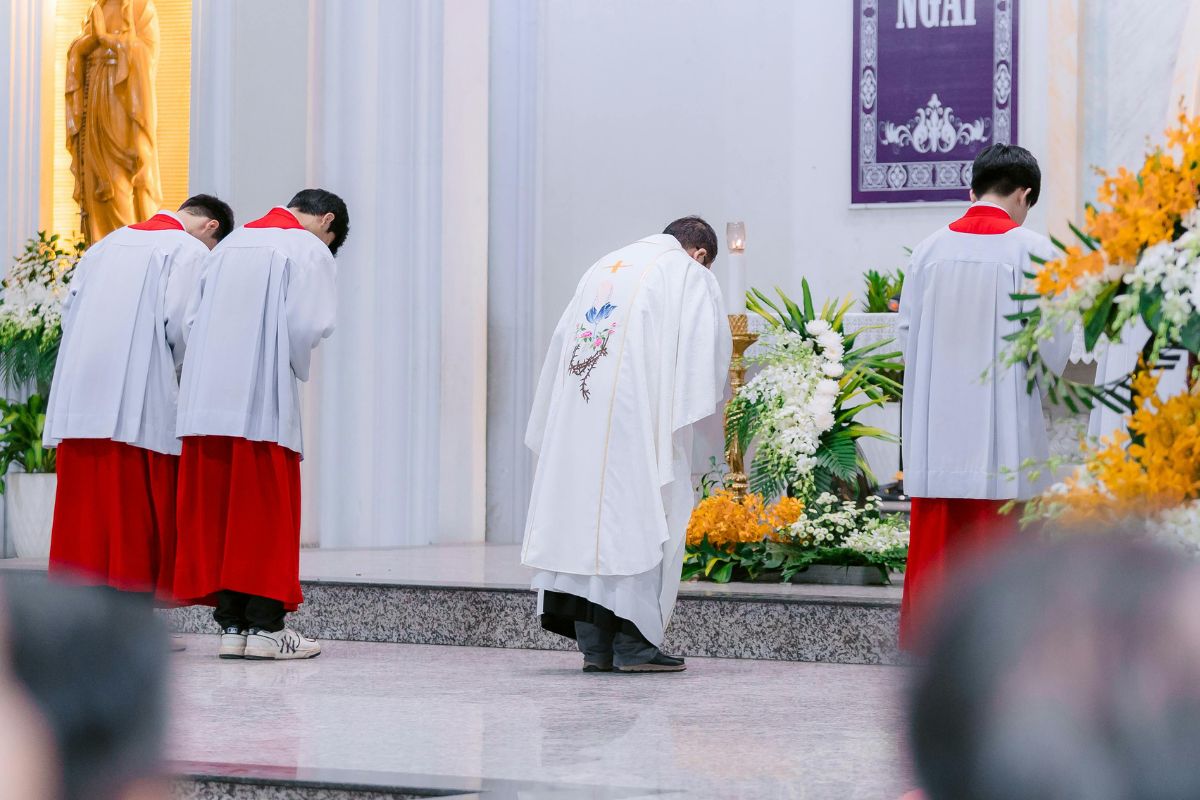
The shepherd-priest must enter the sheepfold, undertaking priestly ministry, making use of the tools of ministry, passing through the gate, which is Christ himself. To pass through the gate, which is Christ, means being conformed to Christ, not just through the fact of ordination to the priesthood, but through one’s life.
Today’s 2nd reading speaks to us of what that conformity to Christ means. Christ is the innocent Lamb of God who takes away the sins of the world; by his wounds we have been healed, healed especially of our rebellion against God. The priest, then, must let himself be healed by Christ’s wounds, so as to mirror Christ in obedience, innocence, and patient suffering.
The priest must enter to Christ’s flock, the faithful, with a life conformed to Christ, in order to lead the faithful through the gate of conformity to Christ into the pastures of eternal life. That means leading the faithful from the corruption of a generation that lives only for this world to a heavenly way of life, even upon earth.
Yet, there is not only the gate, which is Christ, but the gate-keeper, which represents the authority, given by Christ, to the Pope and the bishops united with him. That means a priest, in addition to a Christ-like life, must act legitimately under the authority of a bishop united to the Pope. There should be no “free-lance” priests. Indeed, priestly obedience, in the order of the Church, makes the priest like to Christ through the crucifixion of his self-will, makes him like Christ who was made obedient to death, even death on a Cross. (Ph 2:8)
There are priests who may appear as Christ, but the gatekeeper has not given them permission. Their lack of legitimate authority falsifies their likeness to Christ. They do not come through the gate, but act as thieves and robbers. They are all the more dangerous the more their lives appear to men to be good. In the end, they attach the sheep to themselves, not to Christ, and from themselves they have no power to save, but only to destroy. It is another example of good intentions and noble aspirations going awry.
There are priests, alas, who, while they are legitimate, working under the authority of a Catholic bishop, are not conformed to the Cross of Christ. They have the permission of the gatekeeper, but have not come through the gate. Of them, Jesus tells the sheep, Practice and observe whatever they tell you – insofar as it is faithful to Christ’s teaching – but not what they do; for they preach but do not practice. (Mt 23:3) In this way, even though the priest acts as a hired hand and not as a true shepherd, the sheep still hear the voice of the Good Shepherd. (Cf. Jn 10:13)
The standard of priestly holiness is very high indeed, for the priest must be completely empty of himself so as to be a ready instrument in the hands of Christ, the Good Shepherd. For a young man considering the call to the priesthood, this can be daunting. We are all unworthy, but were we to give priority to that consideration, no one would ever become a priest, and the Church would be lacking in priests. So to the young man considering the call to the priesthood, do not regard so much your unworthiness but the greatness of the task and the greatness of the need, and offer yourselves to the Good Shepherd, begging him to make you worthy to serve him.
The real question is, do I have the generosity to dedicate my life to the salvation of souls after the example of Christ, and am I willing to undertake the lengthy preparation that should prepare a man for not just the knowledge and skill, but, shall we say, the minimum of holiness required to get started?
Let us pray for each other, each one for those who are set in their vocation, that they may persevere in fidelity, each one for those who are still discerning their life’s path, that they may be open to God’s call with ready generosity.
Seek a Deeper Connection with God and Join Lay Cistercians of South Florida
Lay Cistercians of South Florida, is a community of lay people who seeks to have a deeper connection with God by living a life inspired by the monks and nuns through Lay Monasticism. Learn more about what is a Lay Cistercian on our website. Anyone who aspires to do the same as us, and is a confirmed Catholic is welcome to join us! We meet every second Saturday of the month at Emmanuel Catholic Church in Delray Beach, Florida.

This Content Has Been Reviewed For Accuracy
This content has undergone comprehensive fact-checking by our dedicated team of experts. Discover additional information about the rigorous editorial standards we adhere to on our website.