Jesus Christ, The Cornerstone – Sermon by Father Levine
Fr. Joseph Levine; Holy Family Catholic Church and Missions, Burns, Oregon; May 3, 2026
Come to him, a living stone … the stone that the builders rejected. Jesus is the living stone, which is an affirmation that challenges many common assumptions about Christ and Christianity. If Jesus is the living stone, the cornerstone of a spiritual edifice, then Christianity is not just an individual affair, not just “me and Jesus”, but is, we could say, the religion of Jesus. Further, since Jesus is not just the cornerstone of a spiritual edifice, but the stone that the builders rejected, then that calls us to reflect on who the builders are and what is the fate of buildings that are not built upon the living stone.
A warning is in order here. Today I will be speaking about religion and politics. I will say nothing about any specific government, politicians, or political “issues”. When I use the word “politics” here I am using it most broadly to speak of the organization of human society, whether in the State or the Church. In this sense, religion and politics are inseparable because religion itself is a form of human social organization in relation to God and because in the last analysis human social organization cannot be separated from mankind’s most fundamental relationship to God.
Those who are “spiritual” but not “religious” or those who are opposed to “organized religion” – there really is no other kind of religion – would reduce man’s relation to God to the purely private and personal realm, contrary certainly to the Catholic faith, but also to the social nature of man. We are not purely individuals, but our individual lives are inseparably bound up with the lives of other humans beings, with whom we share a common origin, a common nature, and a common vocation.
Jesus is the living stone, the cornerstone of an edifice, built by God and composed of the faithful.
Who are the builders who have rejected this stone?
In the first place, Jesus was rejected by the leaders of the Jewish people in his day, especially by the priests of the Jerusalem temple. This rejection led to the transference of the covenant from temple priesthood to the priesthood of Jesus Christ. Jesus himself, in his parable of the wicked tenants, citing the Psalm verse about the stone being rejected by the builders, concludes, Therefore I tell you, the kingdom of God will be taken away from you and given to a nation producing the fruits of it. And he who falls on this stone will be broken to pieces; but when it falls on anyone, it will crush him. (Mt 21:43-44) The evangelist then observes that the chief priests and Pharisees, upon hearing this, recognized that Jesus was speaking about them. (cf. Mt 21:45)
Yet, Jesus’ words would also apply to everyone in any time who attempts to build human society apart from Christ, the living stone, and so also apart from the edifice that is built upon Christ, the Catholic Church. Likewise, this applies to individuals who seek to build the edifice of their personal life apart from Christ and his Church.
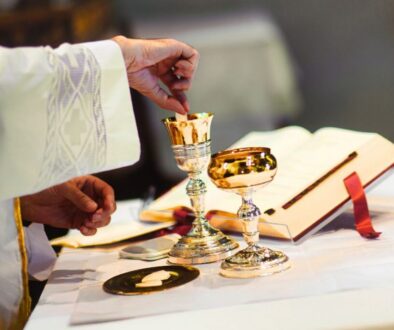
Jesus presented himself visibly, as the cornerstone, to the chief priests and Pharisees. There was the visible reality of his manhood and the invisible reality of his godhead. Today, Jesus presents himself visibly in the Holy Eucharist; there are the visible appearances of bread and wine together with the invisible reality of his manhood and godhead.
Today, Jesus Christ, the living stone, is found in the Holy Eucharist. He is the cornerstone of a complex structure that fit together of both visible and invisible elements.
The living reality of the Body and Blood of Christ brings together a whole invisible spiritual edifice, but the visible reality of the sacrament is the foundation of the visible reality of the Church. Because Jesus entrusted himself to his Apostles in the form of this sacrament, the fulfillment of his command, Do this in memory of me, requires both places of worship, with all the material resources that requires, as well as a visible organization, actually structured under the Pope, with bishops, priests, and deacons, together with the needed legal organization of canon law. There is in this world a visible, divinely established human society with its own proper law. It is called the Catholic Church.
Just as the divine and human are inseparably woven together in the person of Jesus Christ, so the visible and invisible are inseparably woven together in his Church. Only, in the case of Christ, exterior holiness perfectly matches and expresses interior holiness, while in the Church there are those who share in the exterior reality of the Church, without sharing the interior holiness of the Church and there are even some who share in the invisible holiness of the Church without sharing its visible unity.
The Second Vatican Council taught:
“Christ, the one Mediator, established and continually sustains here on earth His holy Church, the community of faith, hope and charity, as an entity with visible delineation through which He communicated truth and grace to all. But, the society structured with hierarchical organs and the Mystical Body of Christ, are not to be considered as two realities, nor are the visible assembly and the spiritual community, nor the earthly Church and the Church enriched with heavenly things; rather they form one complex reality which coalesces from a divine and a human element. For this reason, by no weak analogy, it is compared to the mystery of the incarnate Word. As the assumed nature inseparably united to Him, serves the divine Word as a living organ of salvation, so, in a similar way, does the visible social structure of the Church serve the Spirit of Christ, who vivifies it, in the building up of the body.” (LG 8)
As a living stone, Jesus is the altar, the priest, and the victim of sacrifice. The edifice that is built upon him is not a haphazard building but a temple in which God dwells and where he is worshiped through the offering of sacrifice. This is what takes place in the holy sacrifice of the Mass.
Let yourselves be built into a spiritual house to be a holy priesthood to offer spiritual sacrifices acceptable to God through Jesus Christ. St. Peter is speaking to all the baptized. Through baptism each one of the faithful is incorporated into the royal priesthood, each one of the faithful is called to offer spiritual sacrifices of faith, hope, and charity, acceptable to God through Jesus Christ, offered in the Holy Eucharist.
What does that mean? St. Paul writes, I appeal to you, brethren, by the mercies of God, to present your bodies as a living sacrifice, holy and acceptable to God, which is your spiritual worship. (Rm 12:1) The body though refers not just to the physical organism, but to our whole person, our imagination, emotion, and memory, together with the mind and will that directs our bodily life. So he writes, Yield yourselves to God as men who have been brought from death to life, and your [bodily] members to God as instruments of righteousness. (Rm 6:13) So, elsewhere St. Paul writes, Whatever you do, in word or deed, do everything in the name of the Lord Jesus, giving thanks to God the Father through him. (Col 3:17)
This is after the pattern of Jesus Christ, who offered his Body on the Cross in obedience to the will of God, and by that will we have been sanctified by the offering of the body of Jesus Christ, once for all. (He 10:10)
The spiritual sacrifice of the faithful is offered invisibly, by the soul in the grace of God, and visibly, together with all the faithful in the celebration of the Mass. On the altar there is offered together the Body and Blood of Christ, with the devotion of the faithful.
In addition to this royal priesthood of all the faithful there is in the Church the visible, sacramental priesthood, empowered to place the Body and Blood of Christ upon the altar and to join the offerings of the faithful to the sacrifice of Christ.
“Through the ministry of the priests, the spiritual sacrifice of the faithful is made perfect in union with the sacrifice of Christ. He is the only mediator who in the name of the whole Church is offered sacramentally in the Eucharist and in an unbloody manner until the Lord himself comes. The ministry of priests is directed to this goal and is perfected in it.” (Presbyterorum Ordinis 2)
The ministry of priests is wholly in service of building up the spiritual edifice of the faithful on the cornerstone of Christ. Woe to the priest if he seeks to build without Christ!
Yet, this whole visible edifice, built around the sacrament of the Holy Eucharist, belongs to this passing world and is in service of the world to come.
In today’s Gospel we heard Jesus tells us that he goes to prepare a place for us in the Father’s house so that where he is, we may also be.
Where is he? He is eternally in the bosom of the Father. No one has ever seen God, the only Son, who is in the bosom of the Father has made him known. (Jn 1:18)
Jesus tell us that he is the way, the truth, and the life.
He is the truth because he is the perfect image of the Father, who reflects the glory of God and bears the very stamp of his nature. (He 1:3, cf. Col. 1:15) He is the life, because he is One God with Father, who has life in himself and has given to the Son to have life in himself. (Jn 5:26)
To see Jesus in his divine nature is to see the Father, because they are One God; to see Jesus in his humanity is to see the Son of God who is One with the Father; to see him in the Holy Eucharist is to see the visible sign and sacrament of the real and substantial presence of the One who is One with the Father.
Jesus has gone to prepare a place for us in the bosom of the Father, but he is also himself, in his sacred humanity, the way to Father. He is the way as the living stone, the cornerstone, he is the way through the whole edifice of his Church, he is the way to whose life, to whose Cross our lives must be conformed.
The whole visible edifice of the Church is in service of this way, is in service of our arriving at the place prepared for us in the Father’s house. When the day comes in which the last enemy, death, is completely destroyed in the resurrection of the dead, this present visible edifice will pass away, giving way to a new heavens and a new earth in which justice dwells (2 Pe 3:13) and God will be all in all. (cf. 1 Cor 15:20-28)
In the end, all religion and politics will serve this supreme goal, or it will be eternally destroyed, together with those who refused to build on the foundation that is Jesus Christ. (1 Cor 3:11)
Seek a Deeper Connection with God and Join Lay Cistercians of South Florida
Lay Cistercians of South Florida, is a community of lay people who seeks to have a deeper connection with God by living a life inspired by the monks and nuns through Lay Monasticism. Learn more about what is a Lay Cistercian on our website. Anyone who aspires to do the same as us, and is a confirmed Catholic is welcome to join us! We meet every second Saturday of the month at Emmanuel Catholic Church in Delray Beach, Florida.

This Content Has Been Reviewed For Accuracy
This content has undergone comprehensive fact-checking by our dedicated team of experts. Discover additional information about the rigorous editorial standards we adhere to on our website.