Tongues Of Fire – Sermon by Father Levine
Fr. Joseph Levine; Holy Family Catholic Church and Missions, Burns, Oregon; May 24, 2026
Today we celebrate the great Solemnity of Pentecost, which brings the Easter season to its conclusion, and after Easter, ranks among the chief celebrations of the year, together with Christmas, Epiphany, and the Ascension.
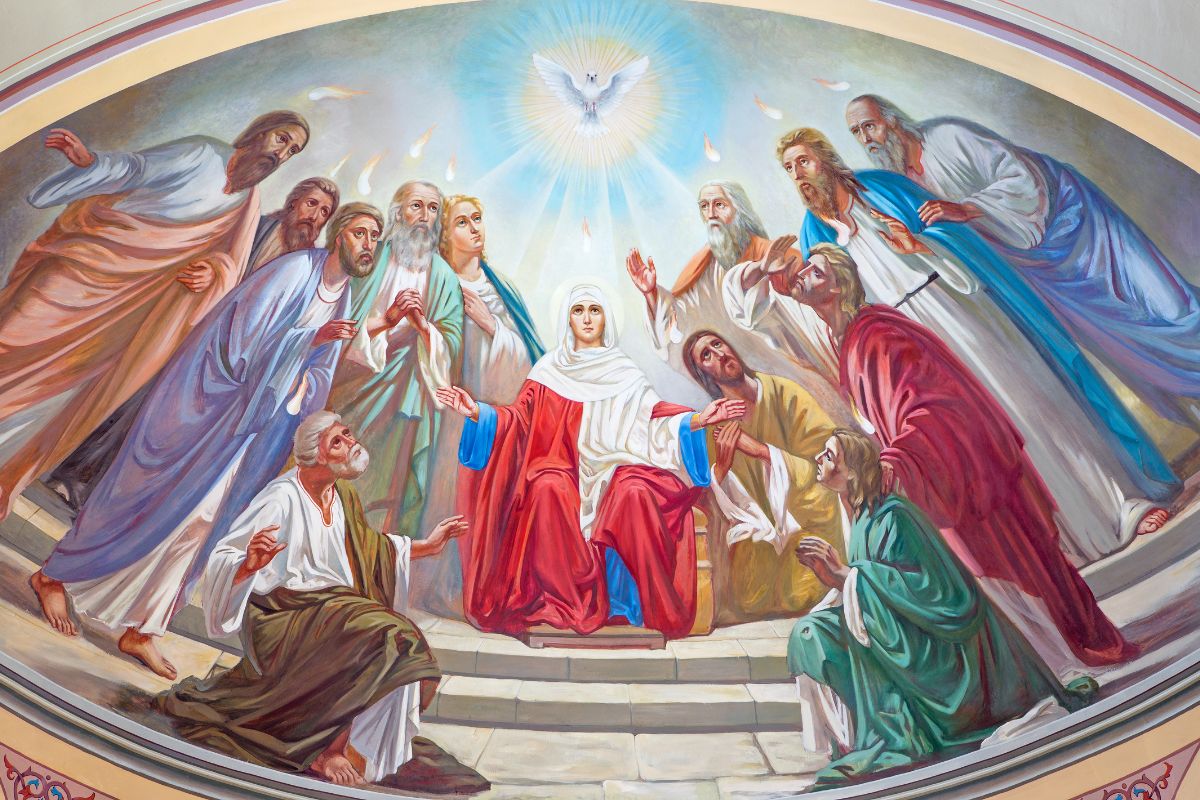
We identify Pentecost with the coming of the Holy Spirit, fifty days after Easter, but the difference between the Gospel and the 1st reading leaves us with a certain puzzle. In the 1st reading, we have the account of the coming of the Holy Spirit on Pentecost, but the Gospel takes us back to Easter Sunday, when Jesus breathes on his Apostles and says to them, Receive the Holy Spirit.
What is going on here? Which is it? Does the Holy Spirit come on Easter or on Pentecost?
When the Bishop was here for confirmations, he proposed a similar question. We identify the sacrament of confirmation with the gift of the Holy Spirit, but the Bishop asked when we first receive the Holy Spirit, and one of those to be confirmed correctly answered, “At baptism.”
The problem is a similar one because, in some way, Easter stands in relation to Pentecost as the sacrament of baptism stands in relation to the sacrament of confirmation.
The resolution of the problem consists in recognizing that the coming of the Holy Spirit is not a simple one-time affair, but corresponds to his chief work in the soul, the life of grace, and what accompanies that work, the virtues of faith, hope, and charity, and the seven gifts of the Holy Spirit. In one way, then, we can say the Holy Spirit comes to the soul whenever there is an increase of grace or charity in the soul. In another way, and perhaps better, we can say that the Holy Spirit comes whenever he begins a new work of grace in the soul.
For the Apostles on Easter, the work of the Holy Spirit was not their own baptism, but was the renewal of their baptism in the forgiveness of their sins, expressed in the words of Jesus, Peace be with you. He then entrusted to them also the work of forgiveness, through the sacraments of baptism and penance, whose sins you forgive are forgiven them, and whose sins you retain are retained. It is also important that he showed them the wounds in his hands and side. This means that for us the gift of the Holy Spirit has its origin in the wounds of Christ, through which, as man, he merited that gift on our behalf.
For Pentecost, though, the key words are actually found in today’s 2nd reading: To each individual the manifestation of the Spirit is given for some benefit. This benefit involves building up the Church, the Body of Christ, in charity and extending the kingdom of God through the proclamation of the Gospel. This indeed fits with the sacrament of confirmation, which, besides giving an increase in sanctifying grace, “gives us a special strength of the Holy Spirit to spread and defend the faith by word and action as true witnesses of Christ, to confess the name of Christ boldly, and never to be ashamed of the Cross.” (CCC 1303)
This is precisely what we see the Apostles and other disciples doing on Pentecost, when, by the power of the Holy Spirit, they proclaim the mighty acts of God. Certainly, those mighty acts refer primarily to all that God wrought in Jesus Christ, especially through his death and resurrection, together with all that he works in his Church and in us through Jesus Christ. Their words, however, are made persuasive by the miracle of the tongues, which enables everyone to understand and be moved by their words.
We need to consider, then, two things: the preliminaries of Pentecost that prepare for the coming of the Holy Spirit and the meaning of the fiery tongues in the ongoing life of the Church.
The preliminaries are important because while the Holy Spirit works intimately in our souls, he is given first of all to the Church and to those gathered in the unity of the Church. On Pentecost, the Holy Spirit came upon all those who were in one place together. Today, the whole Church cannot fit in one physical place within this world, but the members of the Church can prepare for renewal in the Holy Spirit by seeking to be together in the unity of the Church; following the motto of Pope Leo we are to be “one in the one Christ”; this is the unity of faith, hope, and charity, but also the unity of the visible communion of the Church. As the Apostles and disciples were gathered not just in an interior spiritual unity, but in the unity of one physical place that was a visible expression of their interior unity, the unity of the Church is not merely an invisible spiritual unity, but is shown forth by the visible reality of the Church. That one place together is achieved most of all in the celebration of Sunday Mass, when Catholics throughout the world gather in the same type of place, for the same activity, that has the same purpose, “whereby the faithful may express in their lives, and manifest to others, the mystery of Christ and the real nature of the true Church.” (Sacrosanctum Concilium 2)
But what about those tongues of fire?
St. Anthony of Padua said, “The man who is filled with the Holy Spirit speaks in different languages. These different languages are different ways of witnessing to Christ, such as humility, poverty, patience and obedience; we speak in those languages when we reveal in ourselves these virtues to others. Speech lives when works speak; let your words cease and your actions speak. … they spoke as the Holy Spirit gave them to proclaim. Blessed the one who speaks as the Holy Spirit gives, not following his own passion.” (Liturgy of the Hours, Vol III, June 13, translation adapted from the Latin)
Note that St. Anthony is not forbidding speech to proclaim the mighty acts of God but is insisting that such speech must be rooted in deeds and must be faithful to the truth of God’s word rather than a spouting of personal opinion.
Fidelity to the grace of baptism, which means practicing the virtues taught by Christ under the impulse of the fire of charity, prepares for the manifestation of the Holy Spirit in the life of the Christian. The manifestation takes place when those virtues mature and become so developed as to be visible to others. They are not practiced in order to be seen by men, rather proceeding from the depths of the soul, they become a light that shines before men so that they see the good works and give glory to God. (cf. Mt 5:16; 6:1)
Among the languages of virtue named by St. Anthony is patience. Alas, we often let our words come not from the patient flame of charity, but from the rash flame of anger. We have a hard time really accepting the words of St. James, Let every man be quick to hear, slow to speak, and slow to anger, for the anger of man does not work the righteousness of God. (Jm 1:19-20) When anger creeps into our speech, not only does it often wound others, but it skews our own view of reality. Anger blinds us, leading us to lose our sense of proportion; what is no disorder at all is perceived as one; a small disorder appears to us as great; and a great disorder consumes us as though it were the greatest evil in the world.
Another language of virtue, not named by St. Anthony but that needs to be talked about today because it has been forgotten or, if not forgotten, despised, while its contrary is exalted, is chastity, which is listed among the twelve fruits of the Holy Spirit. True chastity, whether of the single person, or marital chastity, or widowed chastity, or consecrated virginity or celibacy, goes hand in hand with the language of humility. On the other hand, God often punishes pride by allowing people to fall into various and humiliating forms of unchastity.
One reason for the failure of chastity, whether in thought or deed, is that it is treated merely from a natural human perspective, while the true supernatural character of Christian chastity, which means it must be sought in prayer, remains hidden from view.
From the natural human perspective, especially given our fallen nature, chastity is sought either from fear or from a sense of honor (“I don’t want to wallow in that mire.”), which leads to pride (“I give thanks to God that I am not like the rest of men” [Lk 18:11]), censoriousness (“Look at the way she is dressed and in church no less.”), and judgmentalism (“Look at those two. It is scandalous the way they are carrying on together.”). That is not to exonerate immodest dress or unchaste behavior, but merely to point out the wrong focus that emerges from pride and vainglory, a focus that exalts self at the expense of others. There is neither humility nor charity in that.
Supernatural chastity is a gift that must be sought from God in prayer, especially begging the intercession of the Immaculate Virgin Mary. It is a great treasure received in the frail vessels of our earthly flesh. (cf. 2 Cor 4:7) Indeed, when it is received as a precious gift it fosters humility rather than pride, precisely because of the awareness that it is not our achievement but a gift of God that we could easily lose or betray.
Chastity is by no means the highest of virtues, just as the opposing sins are not the most grievous of sins. Yet, joined to humility, it is one of the lowly virtues that lies at the foundation of the spiritual edifice, the temple that God would build in our soul. It is precisely in this context that St. Paul writes, Do you not know that your body is a temple of the Holy Spirit within you, which you have from God? You are not your own; you were bought with a price. So glorify God in your body. (1 Cor 6:19-20)
In the words of the Catechism of the Catholic Church: “Chastity means the successful integration of sexuality within the person and thus the inner unity of man in his bodily and spiritual being. … The chaste person maintains the integrity of the powers of life and love placed in him.” (CCC 2337,2338)
Chastity delivers the soul from the turmoil of passion, purifies the imagination, and opens the mind to the divine light. Chastity thus sets the person free to love others with purity of heart, free of self-interest, egoism, and seeking of consolation and pity.
One of the great crises of the day could be called the epidemic of loneliness. When a soul pursues the paths of unchastity and impurity, she either seeks an escape from loneliness or she seeks consolation in the midst of loneliness, but in the end she only finds herself enclosed more securely in the prison of loneliness. Chastity, on the other hand, delivers the soul from loneliness, making her a companion of angels and saints.
St. Paul writes, Be blameless and innocent, children of God without blemish in the midst of a crooked and perverse generation, among whom you shine as lights in the world. (Ph 2:15)
True supernatural chastity is a persuasive tongue of fire. Chastity is a radiant ornament that gives an additional luster to all the Christian virtues of both men and women but is a special ornament of Christian womanhood. This persuasive tongue of fire has been most evident throughout the centuries and also today in the life of consecrated women, the joyful radiant life of nuns and religious sisters, brides of Christ, who by their presence, their prayer, and their dedicated works of service and mercy have been a great source of the Church’s apostolic fecundity.
The work of the Holy Spirit begins when the soul hears the words of Jesus, Peace be with you, and receives the forgiveness of sins, that can heal even the wounds of unchastity, together with the gift of sanctifying grace. From there the Holy Spirit works outward, kindling the love of charity, forming the soul in the life and activity of the virtues, among which chastity serves as the guardian of the interior life, the temple of God within, the dwelling place of the Holy Spirit. When the life of supernatural virtue matures, under the guidance of the Holy Spirit, the Christian begins to speak with the tongues of fire, which is nothing other than the visible manifestation of interior virtue in exterior actions. A Christian must speak in many such languages, but different languages of virtue will shine forth more in one than in another. That is what we witness in the lives of the saints. The tongues of fire allow the Christian to proclaim the mighty works of God in Jesus Christ with persuasive words. This is how the preaching of the Gospel started in Jerusalem and has reached to the ends of the earth.
Seek a Deeper Connection with God and Join Lay Cistercians of South Florida
Lay Cistercians of South Florida, is a community of lay people who seeks to have a deeper connection with God by living a life inspired by the monks and nuns through Lay Monasticism. Learn more about what is a Lay Cistercian on our website. Anyone who aspires to do the same as us, and is a confirmed Catholic is welcome to join us! We meet every second Saturday of the month at Emmanuel Catholic Church in Delray Beach, Florida.

This Content Has Been Reviewed For Accuracy
This content has undergone comprehensive fact-checking by our dedicated team of experts. Discover additional information about the rigorous editorial standards we adhere to on our website.