God’s Mercy In The Mystery Of Jew And Gentile – Sermon by Father Levine
Fr. Joseph Levine; Holy Family Catholic Church and Missions, Burns, Oregon; August 16, 2026
In today’s 2nd reading St. Paul writes, I am speaking to you Gentiles. For his part, he is not a Gentile but a Jew. Underlying each of today’s readings is the theme of Jew and Gentile. Gentile simply refers to those who belong to the non-Jewish nations of the world. This theme, in fact, is central to understanding the whole of Scripture, both the New Testament and the Old.
A little background is necessary. After the first eleven chapters of Genesis, which give an account of creation and fall of man, the flood, and the story of the tower of Babel, the whole Old Testament recounts God’s work of salvation prepared in one people that he chooses out of all the nations of the earth to be his own. This begins when he calls Abraham, separates him from the nations, promises him offspring, a people, and a land, and enters into a covenant with him, the covenant of circumcision. Then there is the fulfillment of promises that takes place when God delivers Israel from Egypt, enters into a covenant with the whole people on Sinai, and leads them through the desert to the promised land. Once they are in the land, the fulfillment reaches a culmination in the kingdom of David and Solomon and the building of the Temple in Jerusalem. Yet, the whole path of fulfillment had been marked by the contrast between the infidelity of the people and the fidelity of God. This culminates in David’s kingdom when God promises to David an offspring who will reign over an eternal kingdom (cf. 2 Sam 7:13), which, however, is followed by Solomon’s infidelity in his old age. Solomon’s infidelity leads to the division of the kingdom, with the heirs of David, bearers of the promise reigning over the Kingdom of Judah in the south – the name “Jew” literally means “a member of the tribe of Judah” – and the Kingdom of Israel in the north.
After the reigns of David and Solomon, the Scriptural account turns to God’s judgment on the people announced by the prophets, ending finally in the exile, first of the northern tribes and finally of Judah, accompanied by the destruction of the temple and Jerusalem. Yet, because God is faithful, the people are not left without hope. There remains a prophecy of return, rebuilding, and salvation through the Messiah, the son of David. There is a partial fulfillment in the return of a portion of the Jews to the land and the rebuilding of a diminished temple, but the glory days of David and Solomon appear a thing of the past, while the people await the greater and fuller salvation to be brought by the Messiah.
In today’s 1st reading, the prophet Isaiah, who was active before the exile, announces, my salvation is about to come. In Hebrew, “my salvation” is “yeshuati” – that “Yeshua” is the Hebrew form of the name “Jesus”. In the Psalm we heard, May your way be known upon the earth; among all nations, your salvation. In Hebrew “your salvation” is “yeshuathecha”. Again, the name “Jesus” is contained in that expression. In Jesus all the promises of land, temple, worship, and kingdom are brought to fulfillment.
The 1st reading and Psalm also speak about the Lord’s salvation, Jesus, reaching to the nations, the Gentiles.
St. Jerome writes of the prophet Isaiah, “Although he occasionally turns his attention to present history and signifies the return of the people to Judea after the Babylonian captivity, nevertheless all his concern is for the calling of the Gentiles and the coming of Christ.” (Prologue to Commentary on Isaiah)
We can say, then, that God, in his providential design, arranged for the separation of Jew from Gentile, so that he could begin his work of salvation by separating one people from all the nations of the earth, instructing them in his ways and teaching them to await his promised salvation, a salvation that would be not just for the people first chosen, but for all the earth.
With this lengthy background, we can now consider first the Gospel and then the 2nd reading.
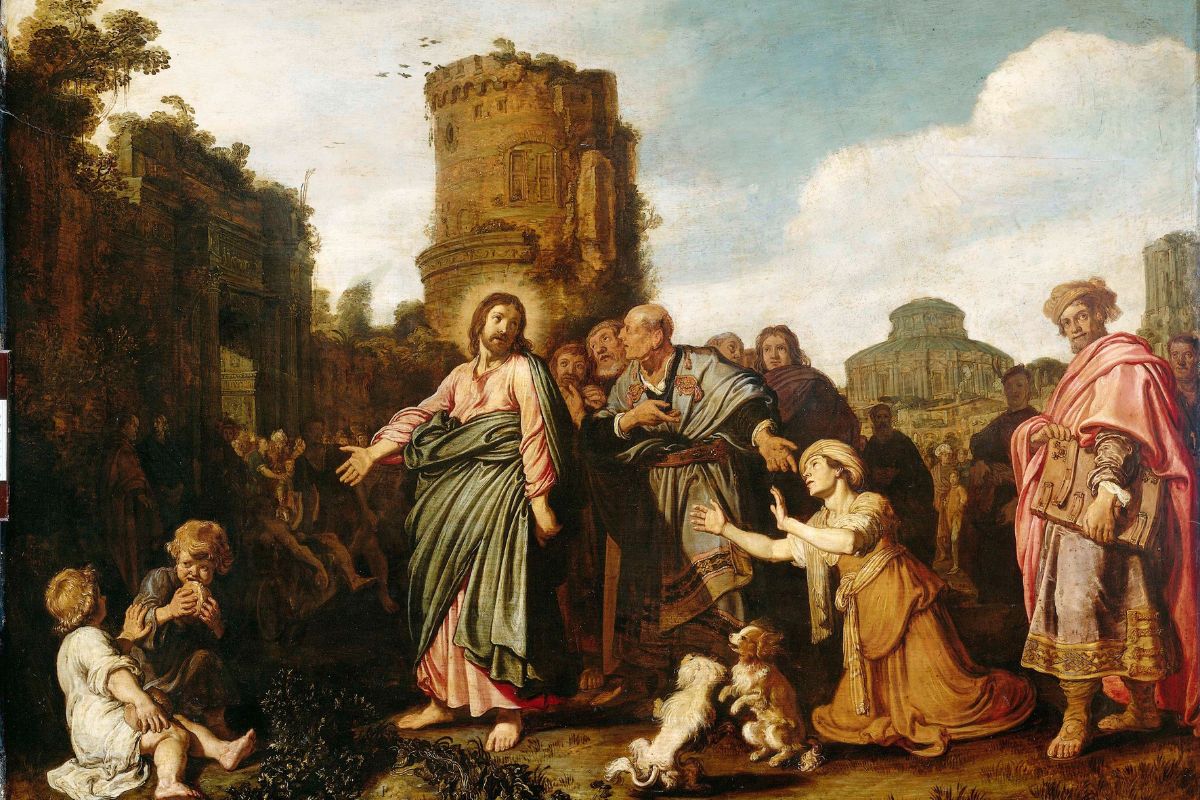
Without the Old Testament background and the division of Jew and Gentile contained therein, the harshness of Jesus towards the Canaanite woman in the Gospel is unintelligible; he is playing a role, that of a Jewish rabbi, in accord with the divine plan. The key words are: I was sent only to the lost sheep of the house of Israel.
First, what we need to recognize is that during his earthly life, Jesus lived, worked miracles, and preached among his own people, the Jews. He did not travel abroad except for his exile in Egypt in his infancy, when presumably the Holy Family resided among the Jewish exiles in Egypt, and this brief journey recounted in today’s Gospel, which was for the purpose of instructing his Apostles. He comes, in the first place, to his own people, to whom he was promised. St. Paul writes, I tell you that Christ became a servant to the circumcised to show God’s truthfulness, in order to confirm the promises given to the patriarchs. (Rm 15:8)
We are here dealing with a profound mystery in God’s design, a mystery that leads to a stunning paradox.
During the time of the Old Testament, God gave his full attention, as it were, to the Jewish people, seeming almost to neglect the rest of humanity. Nevertheless, St. Paul, speaking to a Gentile audience, notes that while in past generations he allowed all the nations to walk in their own ways; yet he did not leave himself without witness, for he did good and gave you from heaven rains and fruitful seasons, satisfying your hearts with food and gladness. (Acts 14:16-17) So also, the Son of God made man, in his earthly life, follows the same path, dedicating his ministry to the Jewish people, in fulfillment of the promise.
Yet, already during his earthly life, he gave indications of the universality of his Gospel. There is the Roman Centurion, serving in Galilee, who declares to Jesus, I am not worthy that you should enter under my roof, but only say the word and my servant shall be healed, about whom Jesus says, Amen, I say to you, not even in Israel have I found such faith. (Mt 8:8,10) There is the Samaritan woman whom Jesus meets by the well, from whom he asks a drink from the well and to whom he promises a drink of living water that will spring up to eternal life, who will announce to her countrymen, Come see a man who told me all that I ever did. Can this be the Christ. (Jn 4:29) To her Jesus announced, The hour is coming when neither on this mountain nor in Jerusalem will you worship the Father … the hour is coming and is now here, when the true worshipers will worship the Father in spirit and truth. (Jn 4:21,23) Then there is the Canaanite woman in today’s Gospel, whom Jesus puts to the test with his sharp division between Jew and Gentile, so as to elicit from her a greater act of faith, and who, for her perseverance and humility, wins some scraps at the master’s table.
During his earthly life, Jesus devoted his ministry to his own people, yet, St. John tells us, his own people received him not. (Jn 1:11) To which he adds: But to all who did receive him, who believed in his name, he gave power to become children of God. (Jn 1:12)
The difference between the time of Jesus’ encounter with the Canaanite woman and the time of the proclamation of the Gospel to the Gentiles is distinguished by the central event in God’s plan of salvation: Jesus’ death and resurrection. That is what makes all the difference.
Jesus offered his sacrificial death on the Cross – the death by which he atoned for Adam’s sin, reconciling the human race to God; the death by which he offered himself as the Lamb of God who takes away the sin of the world; the death by which he opened the flood gates of divine mercy, bringing forth the forgiveness of sins; the death by which he merited for those who believe the life of grace, the life of the children of God – he offered that sacrificial death on behalf of all men, Jew and Gentile. After his resurrection, he commissioned his Apostles to proclaim the Gospel to the whole world, making disciples of all nations, Jew and Gentile, beginning from Jerusalem. (cf. Mt 28:18-20, Mk 16:15-16; Lk 24:46-49)
So it is that, as we hear in today’s 2nd reading, You [Gentiles] once disobeyed but have now received mercy because of their [Jewish]disobedience. That is the stunning paradox: God prepared the Jewish people for a salvation that, apart from a small “remnant” consisting of the Apostles and other early disciples, the people rejected, while that rejection on the part of Jews opened up the door for the Gentiles, the other nations, to enter into the inheritance of Abraham, Isaac, and Jacob. So it is that Jesus, after praising the faith of the Centurion, said, Many will come from east and from west and sit at the table with Abraham, Isaac, and Jacob in the kingdom of heaven, while the sons of the kingdom will be thrown into the outer darkness. (Mt 8:11-12)
Nevertheless, St. Paul warns the Gentiles, saying that they must not exalt themselves on account of their faith, in comparison to the Jewish disbelief. The Gentiles are described as wild olive shoots grafted into the cultivated olive tree of ancient Israel.
To be a Christian, for Jew or Gentile, is to enter into the full inheritance, promised to Abraham and brought to fulfillment by Jesus Christ.
As the natural branches, the Jews, were broken out because of their infidelity, so the wild shoots, the Gentiles, could also be broken out. Likewise, as the wild shoots were inserted, all the more the natural branches can be reinserted. (cf. Rm 11:17-24) God has not rejected his ancient people, the Jews: the gifts and call of God are irrevocable.
Nor is God’s plan the perpetual separation of Jew and Gentile; the desire of Jesus, the Good Shepherd, is that there be one flock, one shepherd. (cf. Jn 10:16) So also St. Paul writes that Christ is our peace, who has made us both [Jew and Gentile] one, and has broken down the dividing wall of hostility, by abolishing in his flesh the law of commandments and ordinances [that is the law of Moses], that he might create in himself one man in place of the two, so making peace, and might reconcile us both to God in one body through the Cross, thereby bringing hostility to an end. (Eph 2:14-16)
Alas, where are we today? The Jews, as a body, do not belong to the Body of Christ, though there are individual Jews who have embraced faith in Christ. And the Gentiles? For centuries, beginning with Rome by the end of the 4th century, the Gentiles gloried in their faith in Christ. The Gentiles would say to the Jews, “Look the prophecies have been fulfilled, we have believed where you have disbelieved.” It was not a matter of the faith merely of individuals, but of whole nations, Rome, then France, then Spain, then Germany, finally all of Europe from Britain to Russia, from Scandinavia to Sicily. Now, what is left of the faith of the Gentiles? Not whole nations, but a remnant of believers scattered among the nations. The ancient olive remains standing, but branches, natural and wild, lay scattered at the foot of the tree. The peace desired by Christ, and achieved by his death, has not actually been realized, because it has been rejected by both Jew and Gentile.
What does this mean? It is as though we are seeing realized in our own time the words of St. Paul: God delivered all to disobedience, that he might have mercy on all.
Now let us turn back to the woman in today’s Gospel. She is treated harshly by Jesus who is putting her faith to the test. She believes that salvation is found in him; she recognizes that it is a salvation she does not deserve, to which she can lay no claim; for that she will humble herself before him and persevere in her plea for mercy, despite the harsh treatment. She displays dogged faith, dogged perseverance. That is the faith that was once the glory of the Gentiles.
And ourselves? If we think God is treating us harshly, we rebel. If his ministers treat us harshly – and may they not do so – we blame God and rebel. We might want salvation, but only on our terms, not as an undeserved mercy, but as a merited reward – we think we are deserving.
Jesus refers to the woman in insulting terms as a “dog” – which is how the Jews of the time referred to the Gentiles – she takes up the insult as the basis of her plea, even the dogs eat the scraps that fall from the master’s table. And us? We have received not mere scraps but the very food of the children, the Body of Christ in holy communion. Alas, the food does not give us much nutrition because we are lacking in dogged faith, dogged perseverance.
St. Paul concludes his treatment of the mystery of Jew and Gentile with words that we will hear, out of context, next Sunday:
Oh, the depth of the riches and wisdom and knowledge of God! How inscrutable are his judgments and how unsearchable his ways! For who has known the mind of the Lord or who has been his counselor? Or who has given the Lord anything that he may be repaid? For from him and through him and for him are all things. To him be glory forever. Amen. (Rm 11:33-36)
Seek a Deeper Connection with God and Join Lay Cistercians of South Florida
Lay Cistercians of South Florida, is a community of lay people who seeks to have a deeper connection with God by living a life inspired by the monks and nuns through Lay Monasticism. Learn more about what is a Lay Cistercian on our website. Anyone who aspires to do the same as us, and is a confirmed Catholic is welcome to join us! We meet every second Saturday of the month at Emmanuel Catholic Church in Delray Beach, Florida.

This Content Has Been Reviewed For Accuracy
This content has undergone comprehensive fact-checking by our dedicated team of experts. Discover additional information about the rigorous editorial standards we adhere to on our website.