The Offering of Fraternal Charity – Sermon by Father Levine

Fr. Joseph Levine; Holy Family Catholic Church and Missions, Burns, Oregon; September 6, 2026
Come, let us bow down in worship; let us kneel before the Lord who made us. For he is our God and we are the people he shepherds, the flock he guides.
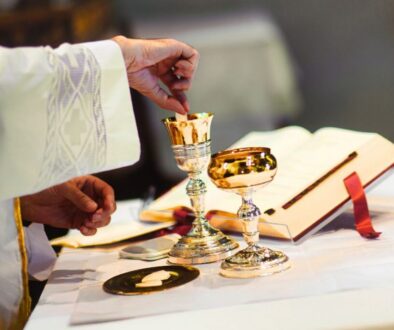
What is offered in worship at the Holy Sacrifice of the Mass? Well, first of all, the Body and Blood of Jesus Christ, offered once for all on the Cross, offered here and now through the ministry of priests. It is God worshipping God: the Son of God made man worshipping his Father in the Holy Spirit. (cf. He 9:14)
If that were all there was to it, there would be no need for his bloody sacrifice on the Cross to be extended to every time and place through the unbloody sacrifice of the Mass. The Mass enables us, here and now, to take part (to participate) in Jesus’ own worship of his Father, just as the Blessed Virgin Mary shared in Jesus’ redemptive work as she stood faithfully at the foot of the Cross. So, together with the Body and Blood of Christ, the devotion of the faithful is offered through, with, and in him; the devotion of the faithful individually, but also their fraternal charity.
Jesus left us his new commandment: as I have loved you, so must you love one another. (Jn 13:34) Jesus gave this commandment at the Last Supper, together with the gift of the Holy Eucharist; he wants the fulfillment of the commandment to be offered together with the Eucharistic sacrifice.
St. John, in his 1st Letter, writes of the identity between the new commandment, given by Jesus at the Last Supper, and the old commandment, Love your neighbor as yourself. (cf. 1 Jn 2:7-8) What makes the commandment “new” is Jesus’ example – as I have loved you – and his grace to follow the example.
Jesus’ example makes it a Christian commandment, for only a Christian, as one who believes that Jesus Christ is the Son of God made man, can follow his example. We follow him not merely because he gives the example of a good man, but we follow the example of the Son of God, in whom we believe, whom we love, whom we desire to please above all.
His example, as I have loved you, is given to us most perfectly in the Holy Eucharist, which is not just the sacrament of his Body and Blood, but through the total gift of his Body and Blood is also the sacrament of his undying love for us. Every time we hear the priest say, This is my Body, and elevate the host, and This is the chalice of my Blood, and elevate the chalice, we can recall his commandment, as I have loved you. When the priest gives us communion, saying, This is my Body, and we reply, Amen, we are saying “Amen” also to his commandment, As I have loved you.
Wow! When we contemplate the Lord’s example, we realize that we fall short, that we have a long way to go. I have a long way to go. As a preacher of the Gospel, I must not lower the standard, even if I fall short. Rather, like everyone else, I must aspire to reach the standard and beg from the Lord the grace to do so. Consequently, we must not give way to discouragement, but let him continue to guide us, the sheep of his pasture. If today you hear his voice, harden not your hearts.
Love your neighbor as yourself. How did Christ set the example? First, he removed all limits. No one is excluded; he shed his Blood for each and for all – even for those who refuse the gift of his love. So also, he taught us to forgive seventy times seven times (cf. Mt 18:22). Further, there is no limit in time, so long as this life and this world run their course. He loved us to the end (cf. Jn 13:1), to the last drop of his Blood poured out on the Cross. He continues to love us, sustaining his Church and binding himself through his sacramental covenant, forgiving our sins over and over in the confessional, and nourishing us continually with the Holy Eucharist.
He, the Son of God, also loves us as himself. He forgives our sins, desiring to make us like him, the sinless one. He bestows on us the life of grace, by which we become children of God, sharing in his life, the life of only the Son of God. (Cf. Jn 1:13; Rm 8:29; 1 Jn 3:1-2) That life of grace, which Jesus shares with us, is the beginning of eternal life here and now. This life of grace is what we must love most in ourselves and in others.
Let us, then, meditate together on what fraternal charity means for us, first of all, within the Church, the Body of Christ, the household of God. As St. Paul exhorts us: Do good to all men, and especially those who are of the household of faith. (Gal 6:10)
Love requires that we “do good”; it consists of actions more than words. St. John writes, Little children, let us not love in word or speech but in deed and in truth. (1 Jn 3:18) Good deeds come forth from a good will; we must want to love others; we must cultivate good will towards them. More than the greatness of the deed, what counts most with God is the good will shown in many small, ordinary day-to-day actions.
Well, on the emotional level, there are some people whom we feel good about, while we don’t feel so good about others. It is easy to love those we feel good about; it is more difficult when we experience feelings of repulsion or dislike. St. Francis overcame his repulsion and embraced a leper; so in order to facilitate goodwill towards others, we should seek to overcome our dislike toward them. When we have an opportunity to do good for someone we dislike, we should see that as a precious opportunity to reach out in love.
We must also think about what it means for someone to be our “neighbor”, someone “near” to us. In the parable of the Good Samaritan, Jesus made it clear that our “neighbor” is anyone who here and now stands in need of our help. Yet, now the neediness of the whole human race is brought to our awareness through modern media. The neediness of countless people, far away from us, is thrust in our face, not by chance, but by people pushing various agendas. When we recognize our powerlessness in the face of such vast need, we discover that the practice of love needs to recognize a certain order.
We should, indeed, pray for all men, because God desires all men to be saved and come to a knowledge of the truth. (1 Tim 2:1,4) Yet, when it comes to practical deeds, we need to consider the order in which God himself sets others in our life. There are our family and neighbors; there are our Catholic neighbors, among whom our fellow parishioners have a special place; and so also there is our local community. Finally, yes, our love should reach out in some way to include all our human neighbors. As human beings, we relate to each other through our bodies, which are limited in time and place, and so while our love can and should reach out beyond our present locality, it must be directed first of all to those physically present in our lives. Our bodies are an integral part of the person God made us to be.
Jesus Christ gave us the example in this as well. When he became man, taking a human body, he lived in a particular time and place, giving his immediate attention and human love to those who were physically present to him. Now, glorified at the right hand of the Father, he gives his love in a special way to those who are present to his Body in the Holy Eucharist.
Now, when we think about the command to “love our neighbor,” we generally think about how we interact personally with someone. We might think of the kindness and attention we show to a particular person. That, however, is only one aspect of love of neighbor.
A husband loves his wife and children when he is working to provide for their necessities; a wife loves her husband and children when she is cooking and doing laundry. Yes, a woman can work outside the home, but that is not typically the way she expresses her love for her husband; likewise, a husband must not be content just to put bread on the table, nevertheless for a man work is such an important part of how he shows love that for him unemployment is not just a matter of economics, but is perceived as a crippling and demeaning impediment in his ability to show love. Here we also see that a man and a woman have different ways of loving.
We can also consider teamwork when a group is engaged in a common task with a concrete goal, like a construction job. There might be a worker who is polite, kind, and attentive to his fellow workers, but a slacker. Because of his failure, everyone else has to compensate by carrying a greater share of the load. In other words, love requires both attention to others and doing one’s part in the shared work.
In the covenant community of the Church, that means we must each do our part to be faithful to the covenant by praying and keeping the commandments, whether others are present or not. We must each do our part in the spiritual combat, following the exhortation of St. Peter: Be sober, be watchful. Your adversary the devil prowls around like a roaring lion, seeking someone to devour. Resist him, firm in your faith, knowing that the same experience of suffering is required of your brotherhood throughout the world. (1 Pe 5:8-9)
Another aspect of the community of love, whether in the family or in the Church, is hierarchy. Some, like the prophet in today’s 1st reading, are in the position of “watchmen”, having care and supervision of others. So the parents, and especially the father, in the family; so the priest in the parish; so the bishop in the diocese. The watchman has a special duty and obligation to guide and correct those under his care – and woe to him if he fails – but he must do so with love, heeding St. Paul’s exhortation: Fathers, do not provoke your children to anger, but bring them up in the discipline and instruction of the Lord. (Eph 5:4) The “watchman” who is set over others in a position of care must remember that together with them he is a human being and a Christian, and that the sheep – even his own children – belong to Christ, not to himself. At the same time, since we are all under authority in one way or another, we should take heed to the words of St. Paul: Obey your leaders and submit to them; for they are keeping watch over your souls, as men who will have to give account. Let them do this joyfully, and not sadly, for that would be of no advantage to you. (He 13:17)
We come, next, to the particular matter of today’s Gospel, which reminds us that fraternal correction is a practice of love. For it to be a practice of love, we must take heed of our Lord’s words: First, take the log out of your own eye, and then you will see clearly to take the speck out of your brother’s eye. (Mt 7:5) We cannot rightly correct someone else unless we are habitually seeking to correct our own life. We cannot correct another out of love if we are seeking to exalt ourselves as being “in the right,” but only when we are truly seeking to help a brother or sister along the way.
There are also two aspects to this correction: when a brother or sister offends me and when a brother or sister offends God.
If someone does something offensive to me, then I need to consider whether the offense is such that I should just let it slide, or whether I should say something. In either case, I should not let it stew and fester inside of me, nor should I give vent to that bubbling stew by running around and telling other people how badly I have been offended. We need to learn to address problems with those who are the cause of the problems, not with third parties who can’t do anything about it.
Of course, neither should I go to the offending party with that bubbling stew and throw it in his face. That means that I need to be master of my own emotions – in other words, virtue is not an option on the path of love. Only by mastering my emotions will I be able to speak to the offending party in a proper manner, not calling names, not making accusations, without judgment, presuming the best. “I’m sure you didn’t mean it that way, but it really hurt me when you said that.”
When we become aware that a brother or sister has done something offensive to God, the same requirements hold. We need to regard the gravity of the offense and whether we need to speak. We need to master our own emotions and correct without making accusations but presuming the best. In addition, we need to ask, “Am I the person to make the correction?” Because the correction must proceed from fraternal charity, it requires true fraternal closeness. I can’t go to a stranger and correct him as a brother. Nevertheless, recognizing the stranger as a brother, I can pray for him as a brother. Indeed, prayer needs to precede correction.
Finally, though, in this matter of correction, while there are things we can and should correct, more often than not we will discover that we are powerless. We can’t change others, though God can. Each one of us is a “work in progress.” Each one of us is a pilgrim on the way, with a long way to go yet. So we must each learn to bear one another’s burdens, and so fulfill the law of Christ. (Gal 6:2)
We are in this together. Together, as Catholics, we should be pilgrim companions on the way to the heavenly Jerusalem. Along this way, Jesus tells us that where two or three are gathered in my name, there I am in the midst of them.
We are most truly gathered in the name of Jesus when we are gathered together for the celebration of the Holy Sacrifice of the Mass, when we are present here not just in body, but in spirit, mind, and heart, when we offer through, with, and in him, not just our private devotion, but the bond of our fraternal charity.
Ubi caritas est vera, Deus ibi est.
Seek a Deeper Connection with God and Join Lay Cistercians of South Florida
Lay Cistercians of South Florida, is a community of lay people who seeks to have a deeper connection with God by living a life inspired by the monks and nuns through Lay Monasticism. Learn more about what is a Lay Cistercian on our website. Anyone who aspires to do the same as us, and is a confirmed Catholic is welcome to join us! We meet every second Saturday of the month at Emmanuel Catholic Church in Delray Beach, Florida.

This Content Has Been Reviewed For Accuracy
This content has undergone comprehensive fact-checking by our dedicated team of experts. Discover additional information about the rigorous editorial standards we adhere to on our website.