Worship the Lord in Holy Attire – Sermon by Father Levine
Fr. Joseph Levine; Holy Family Catholic Church and Missions, Burns, Oregon; October 18, 2026
Repay to Caesar what belongs to Caesar and to God what belongs to God.
Over the centuries, much ink has been spilled on this passage, but today I would like to leave Caesar to one side, as being of comparatively small importance, and focus on the second part: Repay to God what belongs to God. What then does belong to God and how do we repay it?
The answer to the first part is relatively easy: everything belongs to God, including Caesar.
How, then, do we repay everything to God? It is not in our power to repay “Caesar” to God, though we can pray that “Caesar” might repay himself to God. Once upon a time, when Caesar repaid himself to God, the people would follow their kings, even if their motives were not always pure. Now, if Caesar is to repay himself to God, the people must first do so.
We can repay ourselves and whatever belongs to us or is under our authority to God. The work of repaying to God what belongs to him is what is called “worship”. We can and should worship not only as private persons but also by joining together in the common public worship of the people of God, the Church, which is called the “liturgy.” The Holy Sacrifice of the Mass is the chief expression of the liturgy, but the liturgy also includes the round of hours of praise during the day.
Let’s start with ourselves, because we cannot adequately take part in the liturgy unless we are willing to repay ourselves to God. There are four fundamental paths of worship, individually and collectively: adoration or praise; thanksgiving; expiation or satisfaction; and petition.
First, then, adoration or praise. These are not quite identical, but they are both directed to honoring God simply for being God. By way of adoration, the most fundamental act of worship, we submit ourselves, all that we are and have, completely to God, without condition or reserve. Gestures of bowing, kneeling, or even prostrating oneself on the ground all give bodily expression of this submission to God; they are ways by which we declare to God, “I belong completely to you; have mercy on me and do with me as you will.” While adoration, recognizing who God is, bows before him, praise, recognizing who God is, rejoices in him and seeks to proclaim his greatness. We praise God chiefly for his supreme power, his sublime wisdom, and his surpassing goodness.
The Church begins her daily liturgical prayer with a Psalm that expresses adoration: Come let us bow down and worship, bending the knee before the Lord, our Maker. For he is our God and we are his people, the flock he shepherds. (Ps 95[94]:6-7) To be his people and the flock he shepherds speaks of belonging to him not just through creation, but also through his covenant with his people.
Before the adoration, that same Psalm begins with the voice of praise: O come, let us sing to the Lord; and shout with joy to the rock who saves us, let us approach him with praise and thanksgiving and sing joyful songs to the Lord. (Ps 95[94]:1-2) And why should we do this? Because the Lord is God, a mighty God, the great King over all the gods. He holds in his hands the depths of the earth and the highest mountains as well. He made the sea; it belongs to him, the dry land, too, for it was formed by his hands. (Ps 95[94]:3-5)
So also today’s Psalm resounds with the voice of praise: Sing to the Lord a new song; sing to the Lord all you lands. Tell his glory among the nations; among all peoples, his wondrous deeds. For great is the Lord and highly to be praised; awesome is he, beyond all gods. For all the gods of the nations are things of naught, but the Lord made the heavens.
The voice of praise rejoices in God who created us, but also in the rock of our salvation, Jesus Christ, our Savior; Christ is the one who has given us the power to sing the new song; this is an interior song, a song that we sing by the way we live, the song of grace, the song of charity, the song of salvation.
A consequence of adoration and praise is a heart that is docile to the word and will of God: O that today you would hear his voice! (Ps 95[94]:8)
Second is thanksgiving: the same Psalm, with which the Church begins her day, exhorts us to approach him with thanksgiving. (Ps 95[94]:2) And another Psalm: Enter his gates with thanksgiving, and his courts with praise! Give thanks to him, bless his name! For the Lord is good; his mercy endures forever, and his faithfulness to all generations. (Ps 100[99]:4)
Praise and thanksgiving are closely allied, but there is this difference: praise rejoices that God is good, independent of the benefit we may have received; thanksgiving is grateful that we have benefited from his goodness.
In the third place, expiation or satisfaction is made necessary in a sinful world. We cannot worship God without acknowledging that we are sinners. The confession of sin requires that we beg his mercy, but also that we do what we can to make up for our sin (expiation or satisfaction), through Jesus Christ, our Redeemer.
David’s great Psalm of repentance begins by begging for mercy: Have mercy on me, O God, according to your merciful love; according to your abundant mercy blot out my transgressions. (Ps 51[50]:1) He goes on to beg for the gift of a clean heart: Create a clean heart in me, O God, and put a new and right spirit within me. (Ps 51[50]:10) That clean heart is made possible by the expiatory offering of a contrite heart: The sacrifice acceptable to God is a broken spirit; a broken and contrite heart, O God, you will not spurn. (Ps 51[50]:17) The final fruit is the expiation of public sacrifice: Do good to Zion in your good pleasure; rebuild the walls of Jerusalem. Then you will delight in right sacrifice. (Ps 51[50]:19) All the sacrifices of the Old Testament, the sacrifices of bulls, lambs, and goats, prefigured Jesus Christ, who offered himself as the perfect sacrifice on the Cross; this is the sacrifice that has been given to us to be offered in the Holy Mass, the Body and Blood of Christ, for the forgiveness of sins.
In the fourth place comes petition, which derives its strength from the first three. That is to say, if we are going to ask God for favors, our plea is made stronger when it is rooted in adoration, thanksgiving for favors already received, and expiation for offenses committed. Yet, petitionary prayer itself is a form of worship because when we ask God for what we need, we acknowledge our dependence upon him and that he is the source of every good gift. Every good endowment and every perfect gift is from above, coming down from the Father of lights with whom there is no variation nor shadow due to change. (Jm 1:17)
Adoration, thanksgiving, expiation, and petition speak of the manner in which we give ourselves to God in worship, but we should also think of the interior condition of the worshipper’s soul – the clean heart. This is expressed in today’s Psalm in the words, worship the Lord, in holy attire. This should bring to mind the wedding garment of divine grace that was revealed to us in last Sunday’s Gospel.
We can think of Isaiah’s prophetic song: I will greatly rejoice in the Lord, my soul shall exult in my God; for he has clothed me with the garments of salvation, and has covered me with the robe of righteousness, as a bridegroom decks himself with a garland, and as a bride adorns herself with her jewels. (Is 61:10)
When we read about Adam and Eve in the garden of Eden, we learn that bodily they were naked and without shame. (Gen 2:25) That bodily condition, representing the complete transparency of their mutual relationship, lived through the body, was made possible because spiritually they were clothed in the robe of divine grace, which not only made them friends and children of God, but set the interior of their soul in such perfect order, with emotion and imagination docile to a mind subject to God, that it was shown forth in the splendor of their faces, the ornament of their bodies.
When they sinned, the lost the spiritual robe of glory, their mind was plunged into darkness, their emotions and imagination became turbulent, and their naked bodies now revealed their shameful weakness and mortality. Even so, they had not lost the dignity of being created in God’s image. Clothes became necessary to proclaim and protect the dignity that had not been lost, the dignity that could still be recognized in the light of their faces.
Through his death and resurrection, in which we have come to share through our baptism, Christ has restored us to the grace of God; interiorly, we have been clothed anew with the spiritual garment, the wedding garment of divine grace. In the current state of humanity, clothing tells us that from ourselves we are poor and wretched; from God we have been blessed with grace and dignity. Even though clothes are something exterior to the person, they speak of how even our true interior dignity does not come from ourselves but from God.
The outer man remains in his weak and mortal condition; we must still struggle with God’s help, to overcome the disorder that we find within our own soul. So it is that even for the Christian, the dignity of the inner man must be expressed outwardly by holy attire.
The first form of holy attire is indeed the baptismal garment. Even though we do not wear our baptismal robe throughout life, we do well to remember our baptismal robe whenever we get dressed. Whenever we dress, we should remember that through our baptism our bodies have been made into a temple of the Holy Spirit. (cf. 1 Cor 6:19) Above all, we should dress with dignity when we join in the public worship of the Church at Holy Mass. Yet, the outward dress should express the inward virtue of the soul, manifest in right action.
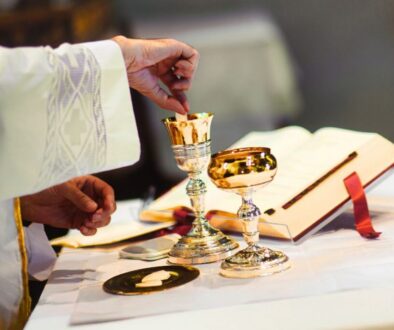
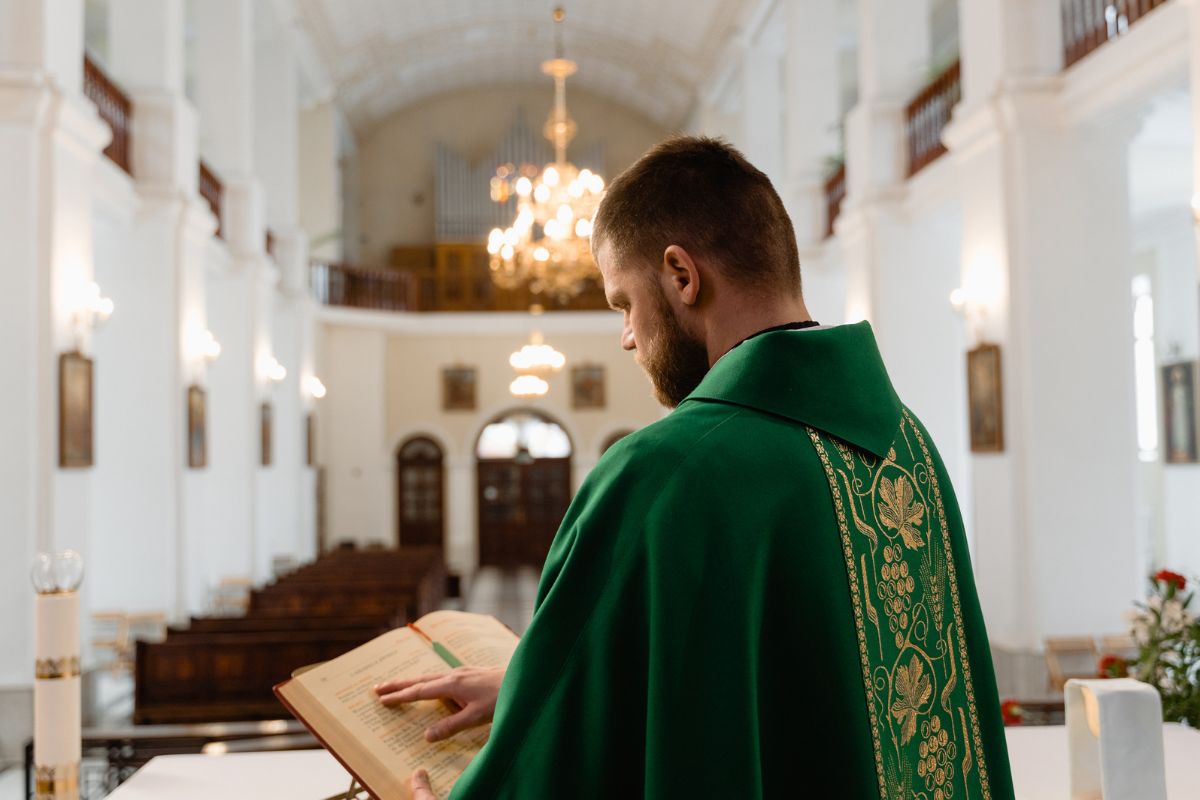
We can consider all this in the meaning of the priest’s Mass vestments. The priest, when he visibly exercises the priesthood at the altar, shows us how all the faithful, exercising their spiritual priesthood, should appear inwardly before God, who sees the heart. The priest at the altar is a sort of living, visible parable of what the interior life of the Christian, including the priest, should be like before God.
I will go through the full traditional attire of the priest, which has been somewhat simplified today. First, the black cassock represents the spirit of mortification and contrition, the death of the ego, our self-will, our union with Christ’s death. The black the priest wears on the street is a call to repentance; the color he wears at the altar is an invitation to the joy of true worship. When he vests for Mass, the priest first puts on the amice (which is no longer required), which represents the helmet of salvation, received as a gift. (cf. Eph 6:17) Then comes the alb, the long white robe, which has the same meaning as the baptismal garment. He then girds himself with the cincture, which represents the virtue of chastity – and all are called to the chastity proper to their state in life. Without the virtue of chastity in particular, and the virtue of temperance in general, a person does not have dominion over himself. Lacking dominion over himself, he becomes incapable of the other virtues, even if he outwardly performs some of their actions. Without temperance, a person becomes incapable of giving himself in love – for one cannot give what one does not have. Then comes the stole, which represents the promise of immortality, which gives us the virtue of hope. Mention should be made also of the maniple (which is no longer required), which represents the burden of sin, which the priest brings to the altar on your behalf, but which represents the contrite heart, begging for God’s mercy, that we must all bring with us to Mass. Finally, there is the chasuble, the ample outer garment of the priest, which represents the covering of charity, which brings everything to perfection.
Let me say something also about the headgear of bishop and priest, which represents the crown worn by the twenty-four elders in the book of Revelation, the crown which represents the fullness of perfection, the crown which they cast down before the throne of God, an act of worship that recognizes that their priestly perfection, their ability to worship God, is itself a gift. (Cf. Rev 4:4,10) We might say that the headgear is worn in order to be removed in honor of God.
The bishop’s miter is characterized by the emblem of the Cross, the triangular shape for the Holy Trinity, and the twofold peak, representing the word of God given to us in the Old Testament and the New, or the twin commandment of love of God and love of neighbor, or the divine and human natures of Jesus Christ, all of which the bishop is commissioned to preach and teach.
The traditional headgear of the priest is the black biretta, with a fourfold base, representing the four Gospels or four cardinal virtues, three fins, representing the three persons of the Holy Trinity or three theological virtues, and the single pom-pom on top, representing the unity of God.
Whether for priest or bishop, the headgear represents the knowledge given to us in faith which must direct, as from the head, our whole life and worship, which comes from God, through which we are subject to God.
Finally, though, to repay to God what belongs to God requires that we return to him, with thanksgiving, all his gifts, his supreme gift being the gift of himself, the gift of Jesus Christ, the gift of his Body and Blood in the Holy Eucharist, which has been given to us that we can worship God by giving God to God, that we can join in the very worship that God, the Son renders to God, the Father. Through, with, and in Jesus Christ, we give ourselves individually and we give ourselves bound together in fraternal charity according to Christ’s commandment. This is why we have the sing of peace before communion.
Seek a Deeper Connection with God and Join Lay Cistercians of South Florida
Lay Cistercians of South Florida, is a community of lay people who seeks to have a deeper connection with God by living a life inspired by the monks and nuns through Lay Monasticism. Learn more about what is a Lay Cistercian on our website. Anyone who aspires to do the same as us, and is a confirmed Catholic is welcome to join us! We meet every second Saturday of the month at Emmanuel Catholic Church in Delray Beach, Florida.

This Content Has Been Reviewed For Accuracy
This content has undergone comprehensive fact-checking by our dedicated team of experts. Discover additional information about the rigorous editorial standards we adhere to on our website.