A Still Small Voice – Sermon by Father Levine
Fr. Joseph Levine; Holy Family Catholic Church and Missions, Burns, Oregon; August 9, 2026
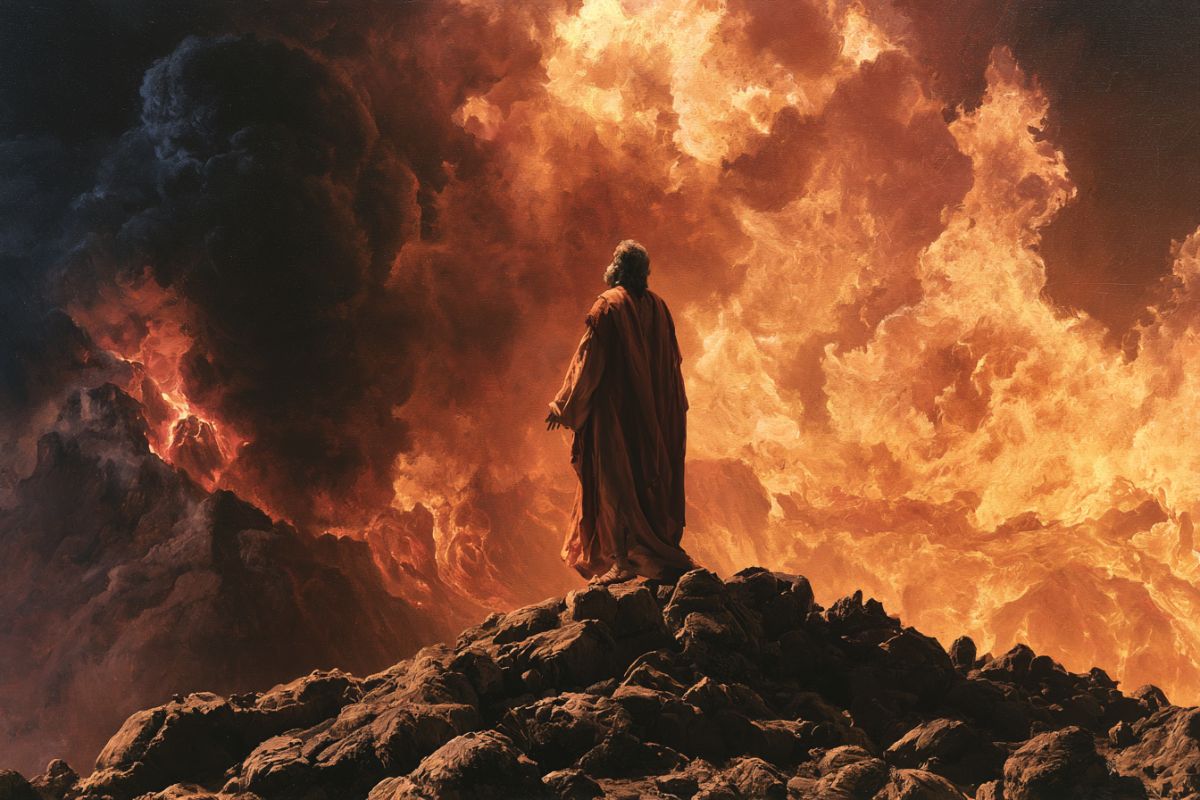
In today’s 1st reading we hear about the prophet Elijah hearing the voice of God in a tiny whispering sound at the mountain of God, Horeb. The Hebrew is difficult to translate, but it clearly expresses a manifestation of God’s hidden presence; the difficulty of translation involves a paradox, an articulate silence, a silence that speaks. So, I would suggest something like, “a voice of a small stillness,” which is quite literal. Or we could go with the elegance of the Protestant King James Version: “A still small voice.
Elijah had fled to the mountain of God, making an arduous journey through the desert. He was fleeing the persecution of the wicked Queen Jezebel who had led the people of God into idolatry.
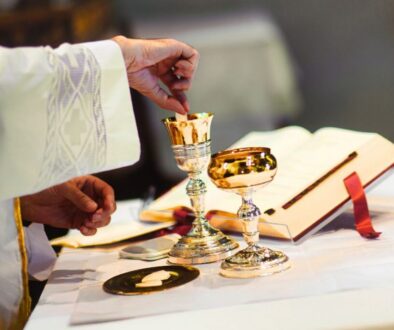
The true mountain of God is Jesus Christ, the man who is the very Son of God, who was born of the Virgin Mary and became man, whose holiness reaches to the very throne of God from which he came. For that reason, unlike Elijah, we do not need to make an arduous desert journey to reach the mountain of God. We need only journey so far as the nearest tabernacle in which Jesus dwells in the Holy Eucharist, in his True Body, born of the Virgin Mary, crucified, and risen from the dead.
Outwardly we need only make the simple trip to the nearest tabernacle, but inwardly we must make the desert journey of self-denial, taking up our Cross and following Jesus, so as to draw near to him not just with our body, but also in our heart.
The inward desert journey requires faith, prayer, and the cultivation of silence in the heart.
There is much noise to distract us on the outside: the distress of wildfires; the confusion of what could be called political, social, and economic earthquakes; the windy cacophony of the news media and social media. All this contributes to the interior noise of fiery passions, earthshaking sufferings, sorrows, and fears, not to mention windy thoughts and arguments, the din of slogans and the whirl of images.
The Lord is not found in any of these. It might not be in our power to silence them altogether, but we must learn to pay them no heed and direct our attention elsewhere to hear the voice of the Lord.
We must learn to look to the Lord in the tabernacle. We must learn to contemplate the face of Jesus in the Holy Eucharist. We must learn to listen to his language of silence.
Only then will we hear the voice of the Lord who speaks peace to his people.
Peace I leave with you; my peace I give you. Not as the world gives do I give it to you. Do not let your hearts be troubled or afraid. (Jn 14:27)
The world speaks words promising peace: “If you follow our rules, you will be successful and we will praise you, until you are longer useful to us”; or “If you have money and buy our products, they will give you peace of mind and happiness, but when the money runs out don’t come running for help.” The promises are false. Jesus Christ gives a true peace that begins in the heart.
The Gospel gives us the same message as the 1st reading. Like the disciples, we may feel alone and abandoned on the boat on the sea, struggling against adverse winds. The Lord has not forgotten us. He is our great High Priest, who has ascended to the top of the mountain, to the right hand of the Father. There he always lives to intercede for us. (cf. Heb 7:25) That perpetual intercession of his priesthood is always made present and active to us through the Holy Sacrifice of the Mass. Through the Holy Sacrifice of the Mass, we are able spiritually to ascend the mountain of God with him; through the Holy Sacrifice of the Mass, he wants to anchor our hearts at the right hand of the Father.
So St. Paul writes to us: If then you were raised with Christ, seek what is above, where Christ is seated at the right hand of God. (Col 3:1)
To reassure the disciples in the boat, Jesus came to them over the water, saying, Take courage, it is I; do not be afraid. He wants to come to us and speak these words to our heart in holy communion. Yet, to hear those words, we need to learn to listen for the still small voice.
It will help to consider what the still small voice said to Elijah and says to us.
We need some context. The kingdom of Israel was firmly established during the reigns of David and his son, Solomon. David was a mighty warrior who not only delivered Israel from the neighboring kingdoms but even extended Israel’s power over foreign nations. Solomon consolidated Israel’s power and built the Temple in Jerusalem. Yet in his old age, Solomon turned away from God, and the kingdom was divided after his death. The descendants of David, who had received the promise of the Messiah to come, ruled over the smaller Kingdom of Judah, in the south, centered upon the Temple in Jerusalem, while other kings ruled over the more powerful Kingdom of Israel in the north. Separated from the Temple in Jerusalem, the kings and people of the Kingdom of Israel also more easily strayed from the covenant. During this time, prophets arose calling the people back to fidelity to the covenant; Elijah stands at the beginning of a line of prophets in the Kingdom of Israel.
Elijah appears out of nowhere in the northern Kingdom during the reign of Ahab, the husband of the foreign princess Jezebel, who had been leading the people into idolatry. He appears as a rather fiery figure calling king and people back to fidelity to the Lord. He announces a drought of three years, and he shows forth the power of God on Mt. Carmel in a sort of duel of prayer in which he vanquishes the prophets of Baal and then prays for rain, which indeed comes. Jezebel, however, remained powerful, was not pleased, and sought to kill Elijah. So, instead of renewing the worship of God, Elijah finds himself defeated and fleeing for his life from Jezebel. That is the journey that leads him out into the desert to Horeb, the mountain on which God had revealed himself to Moses.
Although the more dramatic moments of Elijah’s life had gone before, what happens at Horeb is the supreme and decisive moment in his life. Here God speaks to him in a still small voice.
Today’s reading leaves us with that and does not tell us the content of the communication from God. The content is important: God sends Elijah back to Israel with renewed strength and hope to complete his mission, a mission that will continue after his departure through his successor, Elisha. God shows Elijah that despite the corruption of the life of Israel, he has not abandoned his people and that he is still at work in their midst. I will leave seven thousand in Israel, all the knees that have not bowed to Baal, and every mouth that has not kissed him. (1 Kgs 19:18)
At times, we might feel that we are the only ones – we might want to ask if we even count among those who are truly faithful? – we might feel that corruption is so widespread that hardly anyone else is serving the Lord. That is how Elijah, the prophet, felt in the midst of Israel’s corruption. God showed him that hidden amidst the corruption are many faithful souls who have not succumbed.
Henceforth, Elijah’s work will not be like the wind, the earthquake, and the fire, but will be like the still small voice, a slow and patient work, carried on more quietly, that will bear lasting fruit over time.
Let’s sum this up: Elijah was doing God’s will the best he knew how; he met with failure and discouragement because of the seemingly intractable corruption in the life of the people of God; he goes in search of God in the place where God had revealed himself when he established the covenant; there his hope and strength is renewed so that he is able to take up his mission anew, doing God’s will in a more perfect fashion; he is no longer ‘results oriented’ as we are today, but has learned to work with patience.
The still small voice didn’t really tell Elijah anything he didn’t already know so much as it taught him simply to do God’s will because it is God’s will. That focus on the will of God is what gave him strength and hope amidst such widespread corruption. The secret of the still small voice is that in this life the surest way to intimate union with God is found simply in doing his will.
What does that mean for us? It means, of course, loving God and loving neighbor, living in fidelity to the ten commandments, together with confessing our sins, attending Mass, and cultivating a life of prayer. That is the common way we must all follow, but we each have are particular task or mission in the household of God, defined in the first place by the circumstances of our life, our family, our work, and the community in which we live. It is here, among these people, in these times, that we must follow the path of love of God and love of neighbor.
This is lived out in so many simple daily actions that do not call attention to themselves: a mother holding her baby in her arms, smiling and cooing; the unending and repeated labor of doing laundry and cooking meals; moving cattle, haying, and mending fences; getting along with siblings, cultivating friendships, teaching children, caring for the sick; showing courtesy and kindness to those you meet in the grocery store; visiting someone who is lonely and needs your company for a little while; showing tenderness and patience to your spouse, disciplining your children not with anger but with patience.
Then there are all of our interior struggles, our temptations and fears, hidden from the eyes of men, seemingly insignificant, but yet precious in the eyes of God, in whose presence we live, from whom nothing is hidden, who values and cares for us more than we value and care for anyone in this world.
Seek a Deeper Connection with God and Join Lay Cistercians of South Florida
Lay Cistercians of South Florida, is a community of lay people who seeks to have a deeper connection with God by living a life inspired by the monks and nuns through Lay Monasticism. Learn more about what is a Lay Cistercian on our website. Anyone who aspires to do the same as us, and is a confirmed Catholic is welcome to join us! We meet every second Saturday of the month at Emmanuel Catholic Church in Delray Beach, Florida.

This Content Has Been Reviewed For Accuracy
This content has undergone comprehensive fact-checking by our dedicated team of experts. Discover additional information about the rigorous editorial standards we adhere to on our website.