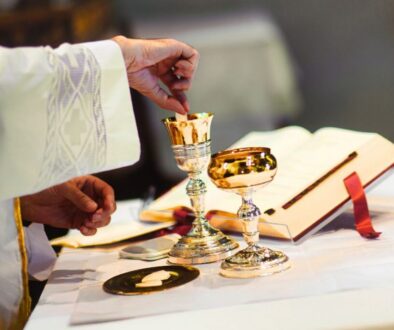
What Return Shall I Make to the Lord for All His Goodness to Me? – Sermon by Father Levine

Fr. Joseph Levine; Holy Family Catholic Church and Missions, Burns, Oregon; August 30, 2026
What return shall I make to the Lord for all his goodness to me? (Ps 116[115]:12)
The words of the Psalmist are incomprehensible to the person who lives from a sense of entitlement. The “entitled” person thinks that he has a right to happiness and all that is needed, in his judgment, for happiness. The entitled person thinks he deserves whatever good he receives in life, and when he is deprived of some desired good, he thinks that he suffers an injustice. The entitled person is incapable of receiving a gift, because even if it was freely and undeservedly given, the entitled person sees it as his due.
We know that the sense of entitlement is very widespread today, but I would suggest that it is even more widespread than commonly perceived. When we think of entitlement, we usually think of those who expect a reward without work on their part. Yet, there are also those, like the workers in the vineyard of the first hour (cf. Mt 20:1-16), who think that they are therefore deserving. On a basic human level, they are; they did indeed work. Yet, they fail to recognize how much, even on the human level, they received, without any merit of their own, what they needed to work. In the parable of the workers in the vineyard, the landowner was under no obligation to hire them in the first place. Even more, they fail to recognize before God that both their very ability to work and to bring the work successfully to completion are his gift.
A symptom of entitlement is self-pity. The person in the grips of self-pity mourns what he does not have because he thinks that he should have it.
The sense of entitlement makes real religion or spirituality impossible; it undermines our relationship to God. The entitled person wants to go before God and say to him, “See, Lord, how good I am? Look at what I have done to deserve your approval. I am worthy; give to me the reward I desire.”
The entitled person does not want to go before God and say, “Lord, behold how wretched and miserable I am, through my own fault; behold, I am utterly unworthy that you should gaze upon me with favor. Lord, I know I am unworthy, but I beg your mercy. May your mercy be glorified in me by making me worthy. To you be glory forever. Amen.” The entitled person does not want to go before God and say, “Behold, Lord, despite my unworthiness you have enriched my life with good beyond measure, good that is wholly undeserved. What return shall I make to the Lord for all his goodness to me?”
The attitude of utter poverty and dependence in the presence of God goes hand in hand with the recognition of being the recipient of his undeserved bounty. That is the first of the beatitudes that gives entrance into the kingdom of heaven: Blessed are the poor in spirit, for theirs is the kingdom of heaven. (Mt 5:3) That is the spirit of humility that lives in the truth of who we are before God. That is the source of true joy in receiving from God, which opens the heart to abundant generosity, ready to give without counting the cost.
What return shall I make to the Lord for all his goodness to me? The question arises out of profound gratitude at being the undeserved recipient of God’s boundless mercy. In today’s 2nd reading, St. Paul gives us the answer to the question.
God has given us a gift: everything we are and have is his gift. This is what St. Therese of Lisieux meant when she said, “Everything is grace.” (Her Last Conversations) There is grace in the “technical” sense, which is God’s gift of supernatural sanctification (sanctifying grace, which makes us truly to be his children) and the grace of supernatural help, “actual grace,” but St. Therese recognized that beyond this special meaning, everything that happens in our life is the work of divine providence, working for our salvation, a work that precedes anything that we do, a complete and undeserved gift.
Everything we are and have is a gift from God, and what God desires is that, recognizing his mercy, we freely return the gift to him with thanksgiving. This is the meaning of St. Paul’s exhortation: I urge you, brothers and sisters, by the mercies of God, to offer your bodies as a living sacrifice, holy and pleasing to God, your spiritual worship.
We are accustomed to thinking of sacrifice as renunciation, but that is secondary. In the first place, sacrifice is the joyful offering of a gift of love and gratitude to God (cf. 1 Chr 29:17); indeed, it should be the offering of our life in the body that he has given to us, as a gift of love and gratitude to God.
What return shall I make to the Lord? “Lord, you have loved me so, you have blessed me so abundantly, that I want to do everything the best I can for love of you. I want my every thought, word, and deed, and everything also that I must suffer, to be for love of you. I want to put the gifts you have given me at the service of my neighbor for love of you. I want to bring all of this to you and offer it at every holy sacrifice of the Mass.”
To offer such a sacrifice, we must follow the second part of St. Paul’s exhortation: Do not conform yourselves to this age but be transformed by the renewal of your mind, that you may discern what is the will of God, what is good and pleasing and perfect.
Do not conform yourselves to this age. That is where the law of the Cross, enunciated by Jesus in today’s Gospel comes into play. That is why renunciation has become part of sacrifice.
Because of Adam’s sin, we do not start life out with a recognition of God’s bounty, but with the predominant desire to fulfill our own needs. A child is born needy but has an instinctive trust of his parents. Yet, the inheritance of sin means that, apart from grace, the demand for the fulfillment of need outweighs the trust. The sense of entitlement is born from the egoistic demand for the fulfillment of need that is not guided and disciplined and brought into subordination to a higher good but instead is embraced as the purpose of life. “This age” or “the world” in the meaning of scripture refers to all the disorders of human society, including family dysfunction, all the disorders that wound trust and nourish egoistic demand.
It was necessary for Jesus to suffer on the Cross to make up for Adam’s sin, to give us an example of radical trust in the love of God, his Father and our Father, and to give us the power to follow his example. As a man, he freely submits himself to the most cruel torture and death, with complete trust in his Father – Father, into your hands I commend my spirit (Lk 23:46) – who will vindicate him in the resurrection. He shows to us that the Father is worthy of our complete and absolute trust, even in circumstances that humanly appear the most contrary, even when God seems to have abandoned us. (cf. Mt 27:46)
The 17th century English political philosopher, Thomas Hobbes, who indeed lived in a cruel time in English history, wrote that human life is nasty, brutish, and short, each man for himself in a war of all against all that could only be restrained by submission to an authoritarian government. (cf. Leviathan) Yet, the authoritarian government would not free people of their egoism but merely keep their egoistic pursuits within less destructive limits. That is a radical statement of the philosophy of “this age” or “this world”, one that seems to be reinforced by the apparent triumph of evil, just as evil seemed to triumph in the crucifixion of Christ.
Faith in Christ’s death and resurrection frees us from the cynical message of the world that would enslave us to the demands of our egoistic needs and reveals to us the working of God’s love, even in the midst of great suffering and trial, and gives to us the grace of a transformed mind that sees the goodness and gift of God and delights in his will.
The entitled person sees the misery of a life that seems to be nasty, brutish, and short, and abandons himself to cynicism, self-pity, and despair. We must indeed begin with the recognition of the innate misery of our sinful life, but go before God with that misery, begging his mercy, realizing that our misery is the claim we have upon his mercy. Then, the second step is to beg to recognize the gift of his goodness and mercy, to receive his mercy, to welcome his mercy, so as to be freed of our cynicism, capable of abandoning ourselves to him in absolute trust, and giving ourselves over to the offering of our bodies as a living sacrifice, holy and pleasing to God.
The Blessed Virgin Mary, the Mother of Mercy, assists us with her prayers and teaches us that his mercy is from age to age to those who fear him … for he has cast down the mighty from their thrones and lifted up the lowly; he has filled the hungry with good things, and the rich he has sent away empty. (Lk 1:50,52-53)
Seek a Deeper Connection with God and Join Lay Cistercians of South Florida
Lay Cistercians of South Florida, is a community of lay people who seeks to have a deeper connection with God by living a life inspired by the monks and nuns through Lay Monasticism. Learn more about what is a Lay Cistercian on our website. Anyone who aspires to do the same as us, and is a confirmed Catholic is welcome to join us! We meet every second Saturday of the month at Emmanuel Catholic Church in Delray Beach, Florida.

This Content Has Been Reviewed For Accuracy
This content has undergone comprehensive fact-checking by our dedicated team of experts. Discover additional information about the rigorous editorial standards we adhere to on our website.