
The Heavenly Wedding Feast and its Sacrament – Sermon by Father Levine
Fr. Joseph Levine; Holy Family Catholic Church and Missions, Burns, Oregon; October 11, 2026
Our 1st reading, Psalm, and Gospel give us different perspectives on the same reality. To grasp the different meanings, we need to read the word of God in the light of Christ.
The man, Jesus Christ, who is the Son of God, is the true mountain of the Lord, whose peak reaches the highest heaven, the very godhead. In him will be found the feast that truly satisfies all human desire; by his death and resurrection he has conquered death in himself, and when he comes in glory, he will destroy death forever. Once the web of death is destroyed, then also the veil that veils all peoples will be removed.
The heavenly feast will be enjoyed not just by that one nation, which in the time of the prophet Isaiah was the people of God, but by people of all nations who have believed in Christ. When the veil is removed, it will be a time of surprises – should we find ourselves part of that banquet, we will be surprised by who is present and who is missing; others will be surprised to see us there, and we will even be surprised to find ourselves there. When the veil is removed, conflicts that in this passing world seemed so significant will vanish as easily as a spider web.
The prophecy speaks of the heavenly feast, the vision of God himself, that we will attain only after we come to share in Christ’s victory over death by departing from this world in the grace of God.
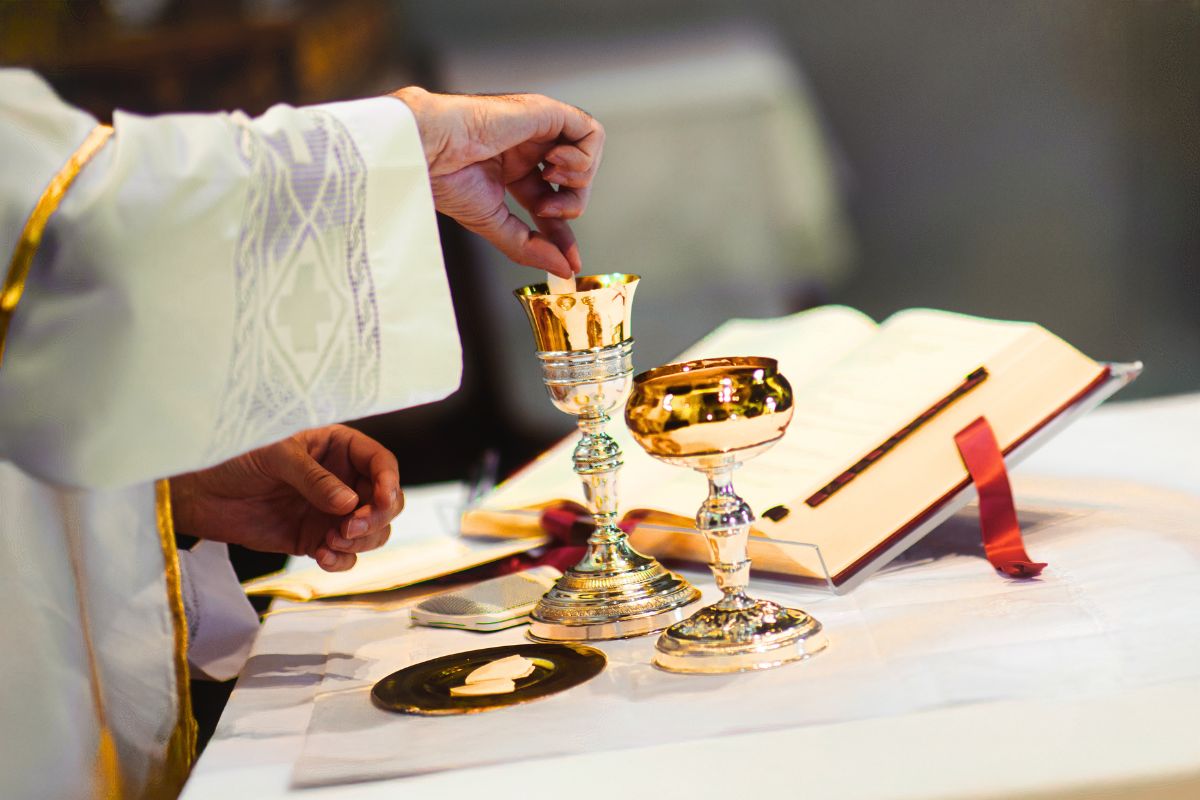
Nevertheless, it should be evident to all Christian believers that Christ himself has already prepared a banquet for us in this life, the banquet of his Body and Blood, given to us in the sacrament. Even though the veil remains, even though we might not feel anything, whenever we receive holy communion with faith and devotion, we are already tasting the essential reality of the heavenly banquet. Yet, because of the veil, we cannot tell who among those who receive the sacrament receives the full reality and who receives only the outward appearance; nor should we be quick to judge. We must remember that when the veil is removed, there will be many surprises; may they not be unpleasant ones for us.
Next we can consider the same reality through the lens of the Psalm. Of course, Christ himself is our shepherd.
The restful waters speak of the waters of baptism, that give us entrance into the kingdom of heaven and the spiritual pastures of the mountains of Israel; so also the restful waters speak of the life of grace, sanctifying grace, given to us through faith and baptism.
The overflowing cup and the table that we are given to enjoy, prepared in the sight of our foes, given us even amid the spiritual warfare of this life, even when we are assailed by demonic temptation, is again the Holy Eucharist. At the same time, we are made strong in battle, made strong for the spiritual warfare of this life through the gift of the Holy Spirit, given us through the anointing oil in the sacrament of confirmation. If we avail ourselves of the strength that has been given to us, we will avoid falling into mortal sin, which would separate us from the Lord’s table. If we remain faithful, we will know the goodness and kindness of the Lord in this life, and dwell in his house, the land of the resurrection, not just for years to come, but for eternity.
Yet, in this Psalm we must take note of how the Lord guides us on right paths, that is the paths of virtue, by means of his rod and staff. Consider that the Bishop carries a staff, a crozier, and so it is that the good shepherd guides us on right paths by the authority of his Church. Then we can also think of the Papal staff, topped by a crucifix, reminding us that Christ, the Good Shepherd, guides us along the way of the Cross, the paths of affliction and suffering. So long as we remain in the unity of the Church, practicing virtue by bearing the crosses the Lord gives to us, we have reason for courage, rooted in a well-founded hope.
Next, we turn to the Gospel. During the course of our lives, we know that there are invitations we are glad to accept, invitations that we can easily turn down, and invitations that we might like to turn down, but we know better. Well, in the time of Jesus Christ, in the human realm, an invitation to a royal wedding was an invitation to be desired and not to be turned down. In the parable, however, the invitation to the wedding feast represents an even greater and more desirable invitation: the invitation to the wedding feast of God, the King of kings.
Last Sunday, we had the stupidity of sin revealed in the tenants of the vineyard who said, This is the heir, come let us kill him and acquire his inheritance. (Mt 21:38) Well, we meet with the same stupidity again in those who excuse themselves from the invitation to the royal wedding. We also meet again with the theme of the transference of the covenant from Israel to the Church, from the first invited, who rejected the invitation (which means those among the Jewish people who did not believe in Christ) to the nations, which believed in the Gospel.
We should notice here that the punishment for rejecting the invitation, if we follow a literal interpretation, refers to a very specific historical event, long past – though its consequences echo through history. After Jesus’ death and resurrection, and after the preaching of the Apostles had been rejected in Judea, Roman armies came and, in 70AD (less than 40 years after the crucifixion), conquered a rebel Jerusalem and burned the temple and the city. Yet, as horrific as the event was, it was no more than a worldly disaster that was then over and done.
The words, Go out into the main roads and invite to the feast whomever you find, mirror the commands of Jesus after the resurrection, Make disciples of all nations (Mt 28:19) and, Go out into all the world and preach the Gospel to the whole creation. (Mk 16:15) The servants are, in the first place, the Apostles and their successors; then, in the second place, they are all who cooperate in the work of evangelization. The second invited include the bad and the good, just as at the celebration of the Mass, among those who receive communion, we cannot tell who really are the bad and who the good, until the veil is removed.
The removal of the veil will come when Christ returns, when the king comes in to meet the guests.
Here we meet the man without the wedding garment who is without excuse and who is bound hand and foot and cast into the outer darkness, where there is wailing and gnashing of teeth. This is quite jarring; indeed, it should be, as the outer darkness speaks of the eternal loss of hell, the final and ultimate exclusion from life, light, truth, goodness, and joy; final rejection and abandonment; utter and complete loneliness in loveless misery. All because he did not have a wedding garment!
It seems harsh in comparison to those who outright rejected the invitation, but still have an opportunity for repentance after their city is destroyed. We might think: maybe the man was poor and couldn’t afford the wedding garment.
The traditional interpretation that sees in the wedding garment the gift of baptismal grace, signified by the white baptismal garment helps. Once we understand that the garment had been given as a gift, then we see why the man had no excuse.
In the man’s presence at the feast, without the gift of the garment, we can see a greater contempt for the king than in those who refused the invitation outright. This man thinks so little of the king that he thinks nothing of showing up at the royal wedding without proper preparation. Have you ever arrived at a special event and found yourself underdressed for the occasion? Take note – the way we dress is not just a matter of comfort or self-expression; it is a sign of respect for others, or lack thereof. This man was underdressed and did not care one hoot. He showed utter contempt for the king, and in the parable the king represents God himself.
The punishment in the parable reveals God’s judgment on those who think little of the gift of baptismal grace that they have received. More than a judgment against those who have fallen away from the faith altogether, this is a judgment on those who are regular at Mass, the sacramental celebration of the divine wedding feast – Blessed are those called to the supper of the Lamb. This is a judgment on those who receive the Body and Blood of Christ as though it were just a bit of bread and wine. This is a judgment on those who think nothing of receiving communion in a state of mortal sin. It is a judgment on those who are not at all concerned to prepare for holy communion by the way the live their lives.
In the words of St. Paul: Whoever, therefore, eats the bread and drinks the cup of the Lord in an unworthy manner will be guilty of the body and blood of the Lord. Let a man examine himself, and so eat of the bread and drink of the cup. For anyone who eats drinks without discerning the body eats and drinks judgment on himself. (1 Cor 11:27-29)
And yet, so long as we are in the life, so long as the King does not make his solemn public entrance, so long as Christ has not yet returned, for even this sin a person can repent, go to confession, receive forgiveness, and have his wedding garment restored.
Let us, then, consider what a great gift we have been given; we have been invited to the wedding feast of the Son of God; it is our human nature that he weds; it is the Church that he weds. We are called to union with him in his Body. We are not just guests, but part of the Bride, the Church. At present the Bride is veiled beneath the mystery of faith; at present we partake of the wedding feast beneath the appearances of bread and wine that hide the reality of the Body and Blood of Christ. Let us recognize the greatness of the gift; let us give thanks for the wedding garment of baptismal grace; let us do all that is in our power to preserve that grace, to grow in that grace, so that when the veil is removed, we will find ourselves part of the feast not just in appearance, but in reality.
Seek a Deeper Connection with God and Join Lay Cistercians of South Florida
Lay Cistercians of South Florida, is a community of lay people who seeks to have a deeper connection with God by living a life inspired by the monks and nuns through Lay Monasticism. Learn more about what is a Lay Cistercian on our website. Anyone who aspires to do the same as us, and is a confirmed Catholic is welcome to join us! We meet every second Saturday of the month at Emmanuel Catholic Church in Delray Beach, Florida.

This Content Has Been Reviewed For Accuracy
This content has undergone comprehensive fact-checking by our dedicated team of experts. Discover additional information about the rigorous editorial standards we adhere to on our website.