The Priesthood In The Service Of The Heavenly Wedding Feast – Sermon by Father Levine
Fr. Joseph Levine; Holy Family Catholic Church and Missions, Burns, Oregon; November 8, 2026
Besides the bride and groom, I think those who get the most excited about weddings today are the bridesmaids. The cultures and roles are a bit different, but the virgins in today’s parable are something like the bridesmaids in a modern wedding. Only, there is something in the parable that would be quite unusual today – maybe even unusual then.
We could well imagine the disappointment of a young woman, hoping that her friend would choose her as a bridesmaid, only to find herself passed over. So much for that friendship. We could hardly imagine a circumstance in which the bridesmaids would be chosen, but would have to wait for the indeterminate arrival of the bride and groom, such that those who were not ready would be excluded from the celebration of the wedding. What a crushing blow!
Even though marriage has fallen on hard times these days, weddings are still recognized, or at least idealized, as the most joyous occasions of human life. I remember a woman who did not get married until her 40s, affirming that a girl dreams her whole life of her wedding day and wants that day to be perfect.
So, when Jesus likens the Kingdom of Heaven to ten virgins who go out with their lamps to meet the bridegroom when he comes, he is telling us that all the human hopes for joy and love that are bound up with weddings find their supreme instance and fulfillment in the Kingdom of Heaven. That is a fulfillment that will not disappoint.
Since the time of Adam and Eve, human life has passed through the way of weddings. Some have been happy occasions leading to happy marriages; others happy occasions that turned out to be disappointing; others forced, artificial, and miserable shams; others perhaps not so felicitous on the wedding day, but the marriage somehow turned out well. All of them, however, have been passing realities that belong to this passing world. Nevertheless, Christian marriage, sacramental marriage, points like the parable to the Kingdom of Heaven, which does not pass, which reaches its supreme perfection in eternity.
The Kingdom of Heaven is the most perfect union of love in which is found perfect, undying, and unending joy. The Kingdom of Heaven must be prepared for as the wise virgins in today’s parable prepared for the coming of the Bridegroom. Failure to prepare means missing out on the greatest reality, the greatest happiness, the greatest joy, the greatest love, for which we were all created. We can think of how “FOMO,” fear of missing out, shapes much human activity and decision-making. Finally, though, there is only one thing we should be afraid of missing out on: the eternal wedding banquet of the heavenly kingdom.
In the parable, being ready or missing out depends entirely on having oil for your lamp, or not. Consider your body to be a lamp, fashioned by God, made to shine with his light. Consider your soul to be the hidden and spacious interior of the lamp, made to hold the oil that signifies the grace of the Holy Spirit. To be ready so as not to miss out on the greatest reality for which we were created, we must not be content with the outward appearance; we must seek to possess the inward reality. Show is worthless; we must have the substance.
A man can go to Mass and receive communion, pray the rosary, live in outward fidelity to his marriage for his entire life, give money to the poor, volunteer his time for various works of service, do all the “right things”, and through many other ways live outwardly, in the eyes of men, so that people look at him and say, “See, he is such a good and devout Catholic.” He can do all those things and yet lack the interior grace and substance. Man looks upon the outward appearance but the Lord looks on the heart. (1 Sam 16:7)
Now, don’t get me wrong, if the heart is upright before God, the outward appearance will be there, though perhaps not in quite the way we might expect. Nevertheless, we can see much that belongs to the outward appearance and be deceived into thinking that it proceeds from a heart that belongs to God, that seeks to please him above all, that seeks to do his will purely because the person loves God. At times, behind what we see there lies hidden a secret sin that vitiates the whole; sometimes all the outward show results from a mere human attempt to compensate for a sin that has neither been repented nor forgiven; or sometimes the outward show, like the Pharisees, is indeed a show motivated not by the desire to please God, but by the desire to win the admiration of men.
The heart is deceitful above all things and desperately corrupt; who can understand it? ‘I the Lord search the mind and try the heart, to give to every man according to his ways, according to the fruit of his doings.’ (Jer 17:9-10)
If we are to be delivered from the deceits of our own heart, we must submit ourselves to the Lord’s searching, to the work of his purification, that he might create in us a clean heart and put in us a right spirit, that seeks to please him and to do his will. (Cf. Ps 51[50]:10) Then we will have within the vessels of our souls the true oil of the Holy Spirit, rather than the synthetic oil purchased from human praise.
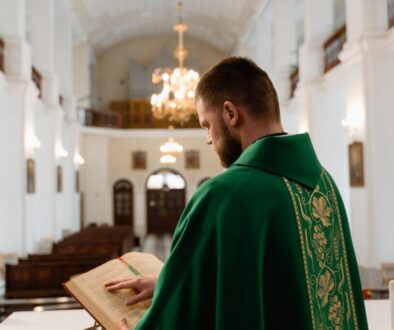
In the Diocese of Baker, today is “Called By Name Sunday,” in which we focus in a special way on “vocations”, especially the vocation to the priesthood. The priesthood is established by Christ wholly in the service of the Kingdom of Heaven, wholly in the service of the heavenly wedding banquet. Through the sacraments, the priest keeps us supplied with oil for our lamps and, if we come with lamps lit, we can already share in the heavenly wedding feast through the Holy Sacrifice of the Mass.
The priest’s service of the heavenly wedding feast is also what makes sense of what is often seen as an unusual, demanding, and unnecessary requirement of the priesthood, the life of celibacy.
In the words of Jesus, there are eunuchs who have been so from birth, and there are eunuchs who have been made eunuchs by men, and there are eunuchs who have made themselves eunuchs for the sake of the kingdom of heaven. He who is able to receive this, let him receive it. (Mt 19:12)
Very often today, in translation, the rather violent and degrading word, “eunuch”, is not used, but it is the word Jesus used. It the first two instances, from birth or by men, it speaks of a manhood that has been maimed and mutilated. It speaks of great suffering and humiliation on the part of a man who suffers a grievous birth defect, or has been subject to a terrible, irreversible, and lasting injustice. Alas, that in our own time such self-mutilation has been glorified.
In the third instance, the violence is metaphorical, not literal. No physical mutilation is involved. Rather, there is the free renunciation of a great good, namely marriage, together with the activities that are proper to marriage, though by way of grievous sin are often exercised in one way or another outside of marriage. Marriage is such a great good in human life, “the one blessing not forfeited by original sin, nor washed away by the flood” (from the Nuptial Blessing), that the renunciation of this good might seem equivalent to choosing a maimed humanity. The key, in Jesus’ words, is the motive: for the sake of the kingdom of heaven. The pursuit of the greater good, the eternal good, is what makes this great renunciation possible and desirable. When a man gives himself generously and totally to the kingdom of heaven, instead of being maimed, he attains a greater fulness in accord with the words of our Lord: whoever would save his life will lose it, and whoever loses his life for my sake will find it. (Mt 16:25)
In the service of the Kingdom of Heaven, the priest in the confessional is given a glimpse into the inner mystery of souls. That is the reason for the sacred seal of the confessional; the priest is given to share God’s knowledge of the heart, purely as a minister of his mercy. For that reason this knowledge must never be revealed to men, not even to prevent grave harm in this passing world. At the Last Supper, Jesus gave to St. John, the Beloved Disciple, the knowledge of the betrayer’s identity, knowledge that St. John, giving the pattern for the confessional seal, did not betray, not even to prevent Jesus from being arrested. (cf. Jn 13:25-27)
The priest, in the confessional, is given the privilege of sitting at the switching station of divine grace. I can remember when I first sat in the confessional at the historic St. Francis Church in Bend. It was an old fashioned wooden confessional. The richness of the wood made it seem to me that I was sitting in the Sacred Heart of Jesus, serving his love and mercy for sinners.
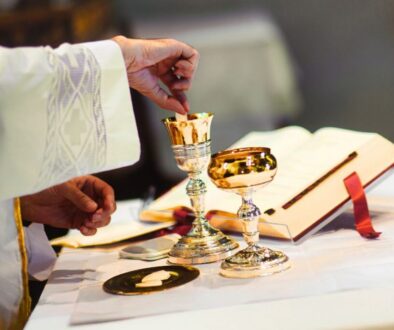
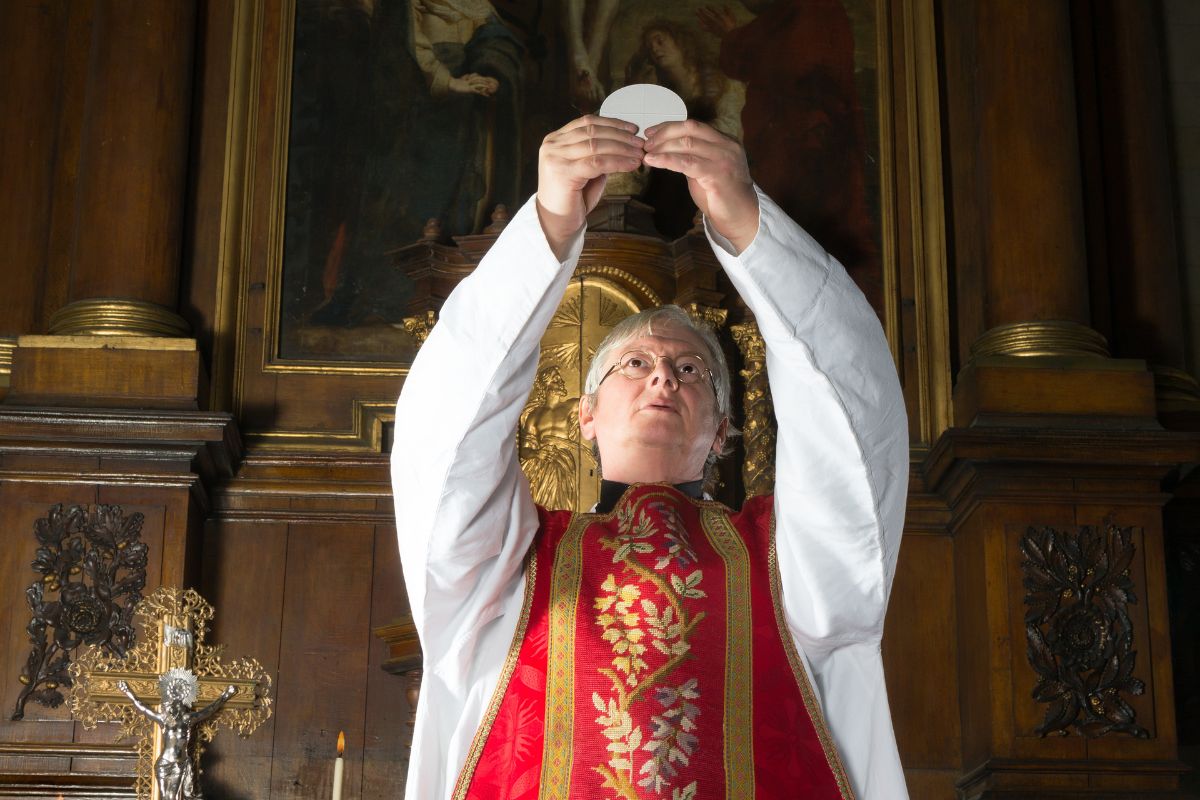
Of course the greatest privilege given to the priest in the service of the Kingdom of Heaven is to stand at the altar, to act in the person of Christ – as he does also when he forgives sins in the confessional. At the Mass, he gives his lips and his voice to Christ, to pronounce the words of consecration at which by the power of Christ the bread and wine are changed into the Body and Blood of Christ, offered in sacrifice for our salvation, given to us as the nourishment of the true life in holy communion, and remaining in the tabernacle as his abiding presence in our midst.
Words cannot describe what it is to stand at the altar and pronounce the words of consecration, as I do every day. I do not know how any priest can say those words without being struck by a deep sense of his own unworthiness. How is it given to me to do this?
For many years I served as a deacon, physically close to the priest and the bread and wine, as the priest said the words of consecration, and yet I was profoundly aware that I could not simply stand up, take a step over, and do what the priest was doing. In that short physical distance was contained an infinite distance in terms of sacred power; an infinite difference between the power of man and the power of God, for our salvation.
Now that I am a priest, yet a man of flesh and blood, it is given to me to pronounce those words. At times, I might think, “Well, I did not do a very good job of it; but thanks be to God that it does not depend upon me.” I must certainly strive to give it my best, but it does not depend upon my feeble best, but upon the power of Christ.
Who can be worthy of the priesthood? Who can live up to the high calling of the priesthood? Indeed, since the priest exercises his role in the visible realm, since it is a visible sacrament, the priest is exposed very much to the danger of carrying a lamp without oil, of being caught up in the exterior, visible reality of his ministry, while missing the heart and the substance of the reality.
The young man who considers the call to the priesthood could easily be deterred by his own sense of unworthiness, together with the great demands of the ministry, and the danger of failure in such a high calling.
Be not afraid! Seek God and put your trust in him. Seek the wisdom that comes especially through the intercession of the Blessed Virgin Mary.
Resplendent and unfading is wisdom, and she is readily perceived by those who love her, and found by those who seek her. She hastens to make herself known in anticipation of their desire; Whoever watches for her at dawn shall not be disappointed, for he shall find her sitting by his gate. For taking thought of wisdom is the perfection of prudence, and whoever for her sake keeps vigil shall quickly be free from care; because she makes her own rounds, seeking those worthy of her, and graciously appears to them in the ways, and meets them with all solicitude.
For everyone: Pray for priests; pray for vocations, to the priesthood and to the religious life; pray also for good and holy Christian marriages. Pray and carry oil with your lamps.
Seek a Deeper Connection with God and Join Lay Cistercians of South Florida
Lay Cistercians of South Florida, is a community of lay people who seeks to have a deeper connection with God by living a life inspired by the monks and nuns through Lay Monasticism. Learn more about what is a Lay Cistercian on our website. Anyone who aspires to do the same as us, and is a confirmed Catholic is welcome to join us! We meet every second Saturday of the month at Emmanuel Catholic Church in Delray Beach, Florida.

This Content Has Been Reviewed For Accuracy
This content has undergone comprehensive fact-checking by our dedicated team of experts. Discover additional information about the rigorous editorial standards we adhere to on our website.