The Last Enemy to be Destroyed is Death – Sermon by Father Levine
Fr. Joseph Levine; Holy Family Catholic Church and Missions, Burns, Oregon; November 22, 2026
When the Son of Man comes in glory, and all his angels with him, he will sit upon his glorious throne, and all the nations will be assembled before him.
Today we celebrate the universal Kingship of Jesus Christ, Son of God and Savior. In light of his coming in glory, I want to set forth right away that what matters is how we live our lives in this world, and that means how we treat one another and how we practice works of mercy. We cannot fulfill Christ’s commandment, as I have loved you, so must you love one another (Jn 13:34), unless we believe in Christ, belong to his Church, and so live the life of grace, letting our lives be shaped by his word and his sacraments. The way we treat each other outwardly must come forth from the inner reality of our heart, as we stand before God in Christ.
As we seek to meditate upon the meaning of Christ’s kingship, we must recognize three stages in his kingship. First is the preparatory stage: the man, Jesus Christ, the Son of God, lived upon this earth in poverty, humility, and suffering, without the honors of kingship, though as Son of God, he is always the true King. He then entered into his reign through his death, resurrection, and ascension into heaven. That leaves us with two stages in his kingship that are expressed in today’s 2nd reading: first, his present reign at the right hand of the Father, until he has put all his enemies under his feet; second, the consummation and perfection of his kingdom, when death is destroyed, the dead are raised, the judgment is completed, so that God may be all in all.
The passage from the present reign to the consummation of the kingdom will take place when the scene represented in today’s Gospel comes to pass, when those on the right hand hear the words of the Judge, Come, you who are blessed by my Father. Inherit the kingdom prepared for you from the foundation of the world; while those on the left hand hear the terrible words, Depart from me, you accursed, into the eternal fire prepared for the devil and his angels.
If we are to understand Christ’s present reign, in the midst of his enemies, we must do so in light of the eternal kingdom, the goal of his reign.
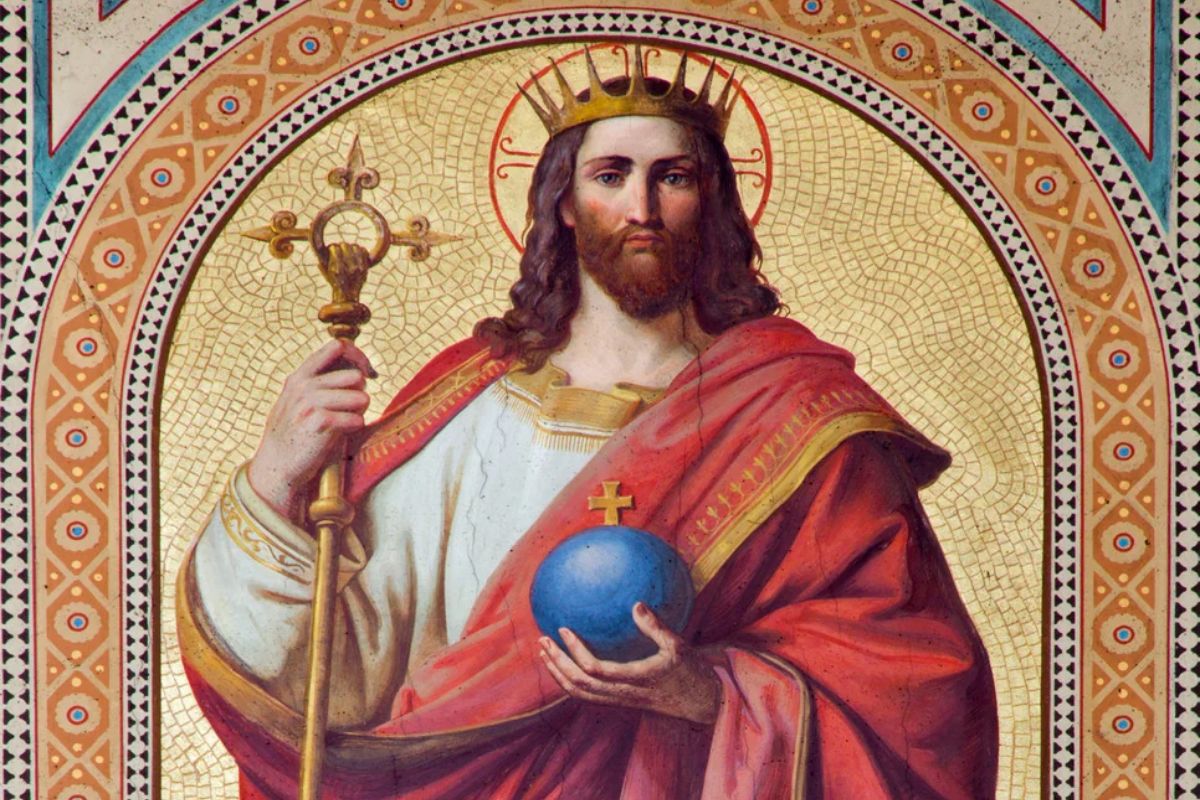
Now, if I could give a visual background to this homily, I would show you alternating images of Christ, the Pantocrator (the ruler of all), as he has been depicted high up in the apses of the great churches of Christendom, contrasted with the horrific violence men have perpetrated against each other since the time of Christ’s death on the Cross. Those images would include the violence directed against Christians and the destruction of holy places, the trampling upon holy things, all of which seem to deny the kingship of Christ. Yet, at the same time, I would put in the unfolding scenery, images of Christians, throughout the ages to this day, performing works of mercy, often in the midst of the violence and hatred that surrounds them.
In 1291, when the city of Acre, the last Crusader stronghold in the Holy Land, fell to the Muslim onslaught, there was a Dominican friar, Riccoldo of Montecroce, dwelling in Baghdad, seeking to spread the Gospel there. In Baghdad he personally witnessed countless Christians captured in the fall of Acre being mistreated and paraded in the slave markets. He wrote, “Why had such a slaughter and degradation befallen the Christian people and such temporal prosperity been granted to the perfidious race of the Saracens?” (Cited in The Two Swords of Christ, by Raymond Ibrahim, pg. 270) Riccoldo’s faith was put to the test, for it seemed to him that God was collaborating with Muhammed against the Christians. (cf. Ibid. pg. 272)
From roughly 650AD to 1095AD Christian Europe was caught between the twin scourges of the the pagan Vikings and the Muslim Saracens. The whole area from what is now Turkey to Egypt to Morrocco, taken over by the Muslims, had once been Christian. For not even two centuries, during the time of the Crusades, Christian Europe held its own, having reoccupied a small portion of the Holy Land, holding Jerusalem itself for less than a century from 1099 to 1187. From the fall of Acre in 1291 to the Battle of Vienna in 1683, and beyond, the Muslim empires were a continual threat and terror to Christian Europe.
In the meantime, from the time of Martin Luther (1517), Christian Europe began to disintegrate from within, such that by the time that Europe effectively conquered the world, occupying even lands formerly dominated by the Muslim empires, it had also effectively ceased to be Christian. What was left of Christendom was destroyed by the self-immolation of European civilization that is known to history as the First World War.
If we think of Christ the King as ruling over Christendom, it would seem that his kingdom was a great failure – rather like his crucifixion.
The First World War also brought in the first great atheistic communist revolution, the Russian Revolution of 1917.
Now, Marxism as a practice (and Marxism defines itself by practice) effectively exploits real injustices (and so long as the course of history runs there will be injustices) for the sake of gaining power. In the words of George Orwell’s satire Animal Farm, “Some animals are more equal than others.” As a theory, Marxism is an atheistic system that seeks to establish justice in the historical world. This means that the past is perceived as the realm of injustice, the present is the time for revolution, and the future is the realm of justice. The judgment of Christ is replaced by the judgment of history. This is “progressivism”.
From Friar Riccoldo’s cry of despair to Karl Marx and beyond, the human challenge to Christ the King has been, “Where is the justice?”
Pope Benedict XVI, in his Encyclical Letter, Spei Salvi (“By hope we are saved”), turned the tables on the Marxist argument by citing a great 20th century Marxist theoretician, Theodor Adorno. Adorno had pointed out “that justice —true justice—would require a world ‘where not only present suffering would be wiped out, but also that which is irrevocably past would be undone.’” (Spei Salvi 42)
The point made by Adorno is worth pondering. It bears on the question of capital punishment, because while capital punishment punishes the criminal, it does not restore the loss of life. A theft can be restored, but there is no compensation for rape, for slavery, for torture.
The Second Vatican Council, after citing the words of the Lord in today’s Gospel, Whatever you did for one of the least brothers of mine, you did for me, comments, “whatever is opposed to life itself, such as any type of murder, genocide, abortion, euthanasia or wilful self-destruction, whatever violates the integrity of the human person, such as mutilation, torments inflicted on body or mind, attempts to coerce the will itself; whatever insults human dignity, such as subhuman living conditions, arbitrary imprisonment, deportation, slavery, prostitution, the selling of women and children; as well as disgraceful working conditions, where men are treated as mere tools for profit, rather than as free and responsible persons; all these things and others of their like are infamies indeed. They poison human society, but they do more harm to those who practice them than those who suffer from the injury. Moreover, they are a supreme dishonor to the Creator.” (Gaudium et Spes, 27)
These “infamies” have taken place throughout history. Theodor Adorno asks, “How can they be undone? How can true justice be established if they are not undone?” This question also poses a challenge to historical Christendom for, whatever goods it brought to the world – and they are many – Christendom was far from immune to these infamies. Adorno’s question also is a challenge to any possible future Christendom, because the world’s future cannot undo the past.
We pray daily, Thy kingdom come, and insofar as possible we should indeed desire that Christ reign even in this passing world. Yet that “insofar as possible” is a big caveat. Our ability to establish justice in this world is always limited and relative. For that reason, the kingdom of Christ can never be altogether identified with any kingdom in this world, no matter how much that kingdom serves the kingdom of Christ.
Curiously, Adorno did recognize a possible answer to his despair of true justice, but it was an answer that he judged impossible – the answer would involve the resurrection of the body. The last enemy to be destroyed is death.
Only God can compensate those who have suffered injustice during their life in this world; only those deserve such compensation who, for their part, have not perpetrated injustice; even more, those who, far from perpetrating injustice, have given themselves to the practice of mercy.
We still have an important question: “Why does God allow all the infamies that have marked the pages of human history?”
Well, remember what I said at the beginning? What finally matters is how we live our lives in this world, which means how we treat one another and practice works of mercy. That is the outward expression of who we are inside. It is that inner character that Christ, the Good Shepherd and King, wants to form within us. All the infamies of history, finally, are the hammers and chisels through which he would sculpt our souls; or they are the challenges that, by putting us to the test, give us the opportunity to show that we do not love God just because things are going well, but because he is God.
In his great masterwork, “The City of God”, written in the wake of the sack of Rome by the Visigoths, in which he ponders the mysteries of divine providence in the work of human history, St. Augustine argues that the goods and ills of this world are common to the just and unjust alike; this teaches us that such goods are not the true reward of justice; for that reason we should not be disturbed if sometimes the wicked prosper and the good suffer; nevertheless, God reveals his justice because sometimes the unjust are visibly punished in this life and sometimes the just are rewarded. (cf. City of God, I.8-11)
All this means that to live as God desires we must practice heroic faith, heroic hope, and heroic love; this is the way of the saints; this is the way of the martyrs who shed their blood for Christ.
In the book of Revelation, the angel reveals to the seer John the great uncountable multitude of victors, clothed in white robes and carrying palm branches, and says of them, These are they who have come out of the great tribulation; they have washed their robes in the blood of the Lamb. Therefore they are before the throne of God, and serve him day and night within his temple; and he who sits upon the throne will shelter them with his presence. They shall hunger no more, neither thirst any more; the sun shall not strike them, nor any scorching heat. For the Lamb in the midst of the throne will be their shepherd, and he will guide them to springs of living water; and God will wipe away every tear from their eyes. (Rev 7:14-17)
This passage puts together the path through the great tribulation of this passing life, subject to many infamies, to the fulfillment of the heavenly kingdom. The Lamb is Christ the King and the Good Shepherd; the title of the Lamb, however, applies to him in a special way in the Holy Eucharist. Our King and Shepherd, who sits at the right hand of the Father in heaven, is present to us here and now beneath the veil of the Holy Eucharist.
There is no kingdom of the earth that can be equated with the Kingdom of Christ, but the one, holy, catholic, and apostolic Church is the chosen instrument of Christ, King and Shepherd, through which he guides and sanctifies his faithful in this world, leading them to the eternal kingdom. The Church is the presence of Christ’s kingdom in this world.
When Christ comes in the glory of his kingdom, in the new heaven and the new earth, the Church will be revealed in her glory as the holy city, new Jerusalem, coming down out of heaven from God, prepared as a bride adorned for her husband. (Rev 21:1,2)
There where God makes all things new, every tear shall be wiped away. (cf. Rev 21:3-5) Every cry of anguish and pain that goes up to the throne of God from an innocent heart, though forgotten, despised, trampled upon in this world, is heard by God and will receive its recompense from God.
Seek a Deeper Connection with God and Join Lay Cistercians of South Florida
Lay Cistercians of South Florida, is a community of lay people who seeks to have a deeper connection with God by living a life inspired by the monks and nuns through Lay Monasticism. Learn more about what is a Lay Cistercian on our website. Anyone who aspires to do the same as us, and is a confirmed Catholic is welcome to join us! We meet every second Saturday of the month at Emmanuel Catholic Church in Delray Beach, Florida.

This Content Has Been Reviewed For Accuracy
This content has undergone comprehensive fact-checking by our dedicated team of experts. Discover additional information about the rigorous editorial standards we adhere to on our website.