The Holy Spirit and Desire for the Holy Eucharist – Sermon by Father Levine
Fr. Joseph Levine; Holy Family Catholic Church and Missions, Burns, Oregon; August 2, 2026
Come Holy Spirit, fill the hearts of thy faithful and kindle in them the fire of thy love.
The fire of the Holy Spirit is not a fire that destroys, but a fire that purifies, transforms, and elevates, freeing us from the fear of destructive fires, within or without.
Two Sundays ago, we heard the words of St. Paul, The Spirit intercedes for us with inexpressible groanings. (Rm 8:26) That intercession of the Holy Spirit involves his inspiring in us those inexpressible groanings, which speak of an intense desire to receive the good that God wants to give us, a good that exceeds all that eye has seen, ear heard, or has entered naturally into the heart of man, (Cf. 1 Cor 2:9) and which coming from God, beyond the power of every created nature, always exceeds our human conception and the truth of any words that we use to speak about it.
In today’s 1st reading we hear God inviting us… or rather inviting those who are “thirsty”. For someone who is not thirsty, for someone who does not experience the intense desire and longing, inspired by the Holy Spirit, for someone who has hardened his heart against the grace of God, the invitation will have no meaning.
Three Sundays ago, in the parable of the sower, we heard about the seed that falls by the wayside, and immediately the birds of the air snatch up the seed, which is unable to penetrate the hardened ground. That is the heart that is hardened against God’s grace, that is fixed on fulfilling its own petty desires and has no interest in the immense good that God offers and promises.
Today’s reading uses the imagery of food and drink, the sustenance of our physical life, as the object of desire, while promising a bargain. We must purchase our ordinary food and drink using money, and the money is acquired by work. The food and drink given by God, that is to be desired with inexpressible groanings, is given us without paying and without cost.
In English we might still say that it is “gratis”. That Latin expression “gratis”, which has entered the English language, should remind us of another English word, “grace,” which derives from the Latin “gratia.” In Latin we say that the Virgin Mary is “gratia plena,” in English, “full of grace.”
Full of without paying and without cost? That sounds strange. Rather, full of that immense good that is given to us without paying and without cost.
The word “grace,” which is such a key word in the Christian vocabulary, speaks of an immense good that God gives us already in this life as a promise, downpayment, and beginning of the even greater good, glory, that is held in store for us in heaven. (cf. Ps 84[83]:12) The name “grace,” though, speaks of this immense good as an altogether free and undeserved gift from God, a gift that we must desire and a gift that enkindles in us the desire for the fulfillment of the promise.
This gift is attributed to the working of the Holy Spirit, the substantial and personal love, God who is love, proceeding from the Father and the Son. He is the first and supreme gift of God, and his chief gift is the gift of “grace,” “sanctifying grace,” which makes us truly children of God, crying out, Abba, Father. (cf. Rm 8:15-16) Where there is the gift of grace, there is the Holy Spirit; where there is the Holy Spirit, there is the gift of grace and every good.
Through the gift of sanctifying grace, the Holy Spirit dwells in the souls of the faithful as in a temple, or coming to dwell in the soul as in a temple, the Holy Spirit makes the soul to be a worthy temple, adorning it with his grace. (cf. 1 Cor 3:16) Then, because of the profound unity of soul and body that constitutes the human person, even the bodies of the faithful become temples of the Holy Spirit. (cf. 1 Cor 6:19)
Now, the Holy Spirit, God, the 3rd person of the Holy Trinity, is also spoken of as the finger of God. Jesus uses this language when says, If by the finger of God I cast out demons, then the kingdom of God has come upon you. (Lk 11:20) That is how St. Luke reports his words, but St. Matthew gives us the “translation,” saying, Spirit of God, rather than finger of God. (Mt 12:28)
If the Holy Spirit is the finger of God, Christ himself, the Son of God made man, who bestows the Holy Spirit upon his Church and through the Holy Spirit works in the souls of his faithful, can be called the hand of God. The Psalmist says, The right hand of the Lord is exalted. (Ps 118[117]:16) Indeed, because he humbled himself and made himself obedient unto death on the Cross, Christ has been exalted by the Father and set at his right hand in glory, and given the name that is above every name. (cf. Ph 2:5-11) From there he has extended his finger upon the Church, pouring out the Holy Spirit, starting from the day of Pentecost. (cf. Acts 2:33)
The Father extends his hand, Jesus Christ, and with his finger writes the law of the new covenant on the hearts of the faithful. (cf. Jer 31:33) This is to fulfill the divine purpose and fashion those who love God according to the image of his Son. (cf. Rm 8:28-29)
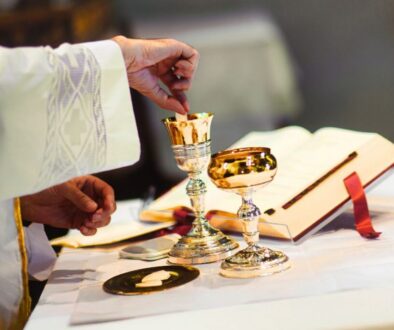
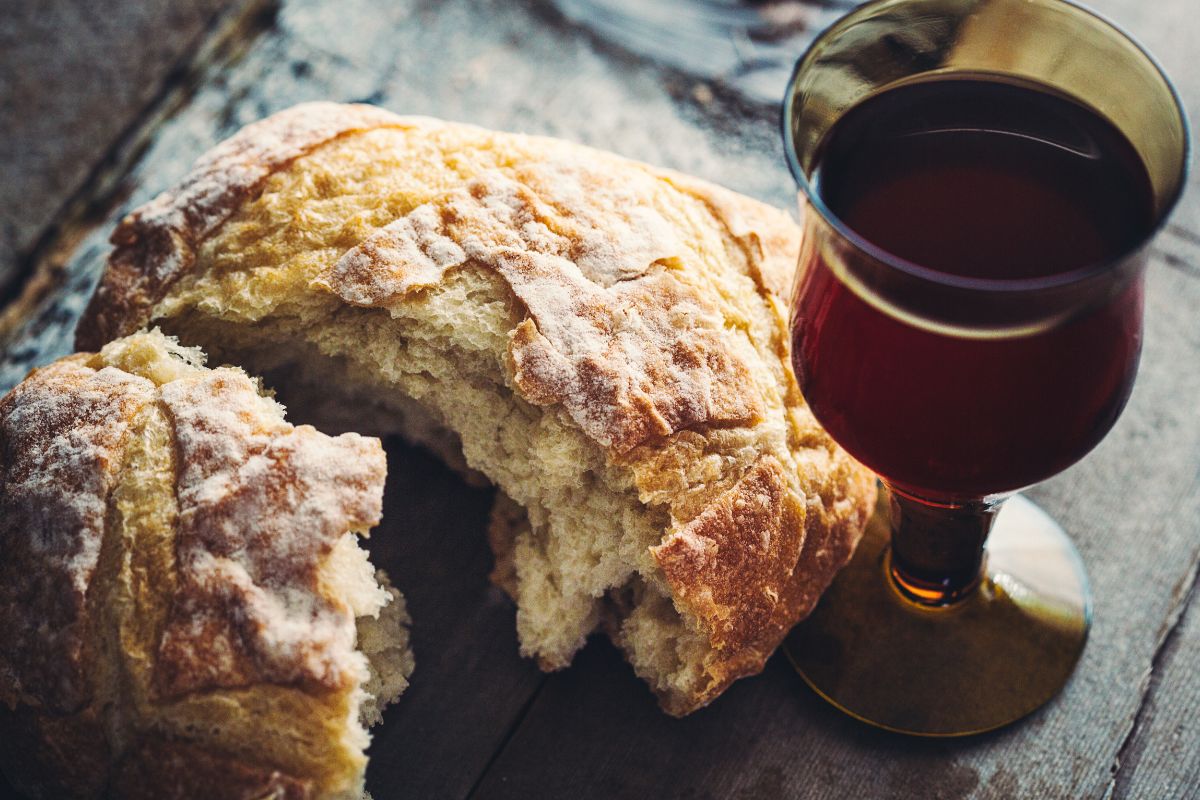
The Holy Spirit makes us long for the food and drink that God would give to us, food and drink given without paying, given without cost, given “gratis”, and so also a gift of grace. What does God give? He gives himself. Jesus Christ gives himself. This is my Body, given up for you. This is the chalice of my Blood, the Blood of the new and eternal covenant, poured out for you and for many for the forgiveness of sins. And my flesh is real food, and my blood is real drink. (Jn 6:55)
The food and drink of this life, for which we must pay, nourishes our bodies for a time before we die. The Body and Blood of Christ, which is given to us without cost, nourishes our souls for eternal life: He who eats my flesh and drinks my blood has life eternal, and I will raise him up on the last day. (Jn 6:54)
This food and drink is given to us without cost, but there is a work on our part, a divine work in which we must take part. Jesus said, This is the work of God, that you believe in him whom he has sent, namely himself, the Son of God made man. (Jn 6:29)
Man does not live on bread alone but one every word that proceeds from the mouth of God. (Mt 4:4) To eat of the bread of life, given us without cost, we must receive the word of God in faith, especially the word of God that says, eat and drink, this is my Body, this is my Blood, do this in memory of me.
This is given to us through the everlasting covenant that had been promised to David. This is given to us through the new and eternal covenant in the Blood of Christ, the Blood poured out on the Cross as the sacrifice for our sins, the sacrifice of our salvation, the sacrifice of the new and eternal covenant, the sacrifice to be renewed, with our participation, in every holy sacrifice of the Mass.
They all ate and were satisfied.
Yet, they could only be satisfied because first they were hungry. So what can separate us from the love of Christ? On his part, nothing, but on our part, lack of hunger, lack thirst, lack of desire, apathy. Sure, we desire many things, but to receive the love of Christ and never be separated from it, we must let the Holy Spirit stir up in us the one thing necessary, (cf. Lk 10:42) the desire for the good that God wants to give, in this life and the next.
Come, Holy Spirit, fill the hearts of your faithful and kindle in them the fire of your love.
Seek a Deeper Connection with God and Join Lay Cistercians of South Florida
Lay Cistercians of South Florida, is a community of lay people who seeks to have a deeper connection with God by living a life inspired by the monks and nuns through Lay Monasticism. Learn more about what is a Lay Cistercian on our website. Anyone who aspires to do the same as us, and is a confirmed Catholic is welcome to join us! We meet every second Saturday of the month at Emmanuel Catholic Church in Delray Beach, Florida.

This Content Has Been Reviewed For Accuracy
This content has undergone comprehensive fact-checking by our dedicated team of experts. Discover additional information about the rigorous editorial standards we adhere to on our website.