Mysteries of the Rosary: A Step-by-Step Beginner’s Guide
Published November 23, 2026
The Rosary is more than a sequence of repeated prayers. It is a way to reflect on the life, teachings, suffering, and Resurrection of Jesus Christ, with Mary guiding believers as they contemplate her Son. At the heart of this devotion are the mysteries of Rosary, inviting Catholics to meditate on important events in salvation history.
The Rosary has four sets of mysteries, each comprising five events from the lives of Jesus and Mary. Together, these 20 mysteries invite reflection on God’s love, Christ’s sacrifice, and the promise of eternal life.
For beginners, understanding what each mystery represents can make the Rosary more meaningful. This guide explains the four sets, their traditional prayer days, and how to pray each decade.
What Are the Mysteries of the Rosary?
The mysteries of the Rosary are significant occurrences in the lives of Jesus Christ and the Virgin Mary that Catholics contemplate while praying. They cover important moments in Christ’s life, from the Annunciation and Nativity to His Crucifixion and Resurrection.
Catholics use these mysteries as subjects for meditation, reflecting on Gospel events, their spiritual meaning, and their connection to Christian faith.
These are four sets of mysteries, each containing five events:
- Joyful Mysteries: Focus on the Annunciation, birth, and early life of Jesus.
- Sorrowful Mysteries: Reflect on the suffering and death of Jesus.
- Glorious Mysteries: Celebrate the Resurrection, Ascension, the coming of the Holy Spirit, and Mary’s heavenly glory.
- Luminous Mysteries: Explore significant events in Jesus’ public ministry.
The four sets contain 20 mysteries in total. A typical five-decade Rosary covers one set, with one decade for each mystery. Before the Luminous Mysteries were introduced, the traditional Rosary had 15 decades across the Joyful, Sorrowful, and Glorious sets.
This combination of vocal prayer and contemplation gives the Rosary its distinctive character. The repeated prayers provide a rhythm for reflection, helping believers focus on Christ’s life instead of simply reciting words. The United States Conference of Catholic Bishops (USCCB) describes the Rosary as a Scripture-based prayer centered on the mysteries of Christ’s life.
What Are the Five Mysteries of the Rosary in Each Set?
Each set follows a theme in the lives of Jesus and Mary. Reflecting on these events helps Catholics appreciate aspects of their faith, including humility, forgiveness, sacrifice, hope, and obedience to God.
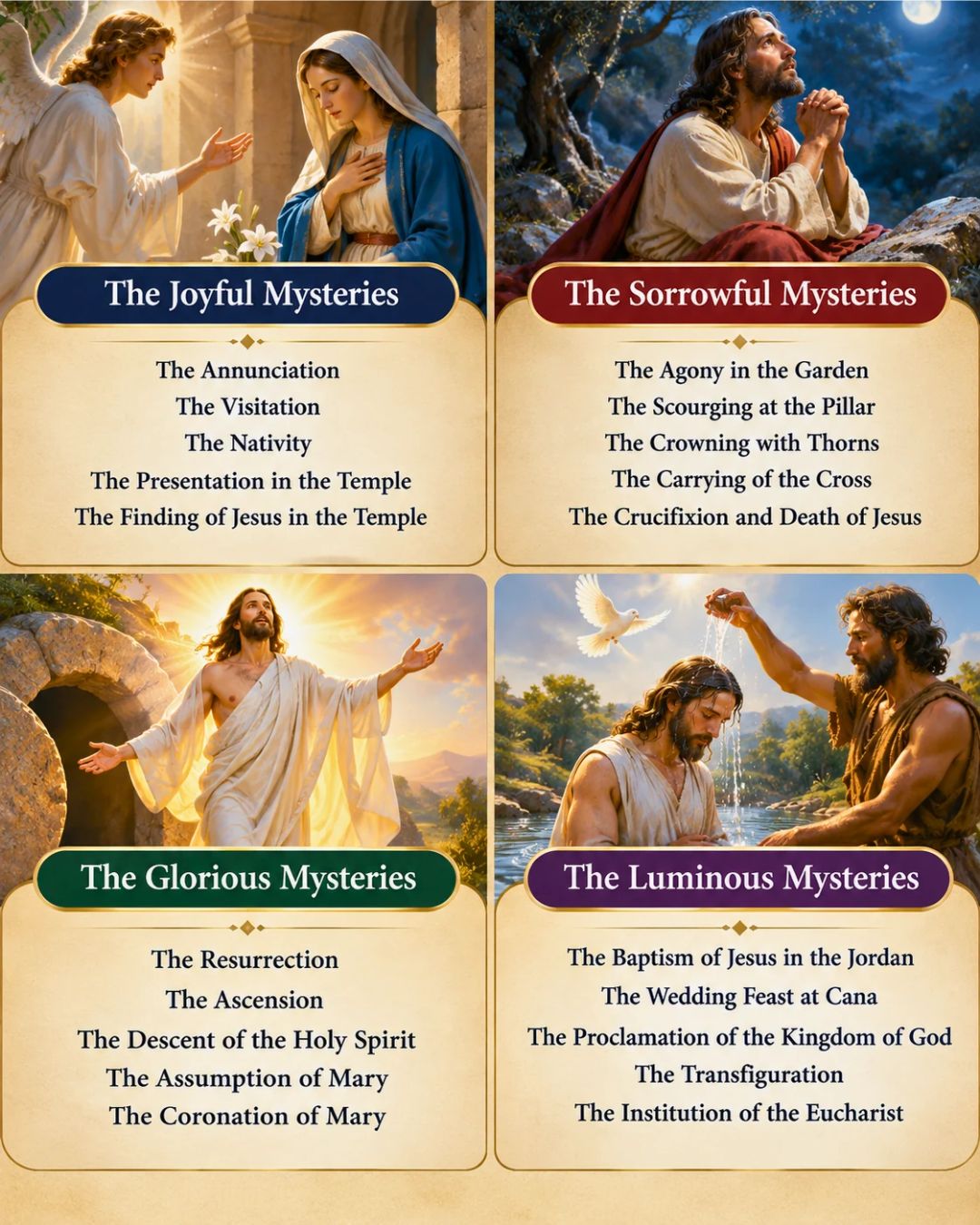
The Joyful Mysteries: The Birth and Early Life of Jesus
The Joyful Mysteries highlight the Incarnation and early years of Jesus. They highlight Mary’s faith, humility, and willingness to accept God’s plan.
The five Joyful Mysteries are:
- The Annunciation: The angel Gabriel tells Mary she will conceive and give birth to Jesus, the Son of God (Luke 1:26–38). Mary’s response shows humility and trust in God’s will.
- The Visitation: Mary visits her relative Elizabeth, who recognizes the significance of Mary’s role in God’s plan (Luke 1:39–56). This event highlights love, service, and care for others.
- The Nativity: Jesus is born in Bethlehem and laid in a manger (Luke 2:1–20). His humble birth reflects God’s love and the gift of salvation.
- The Presentation in the Temple: Mary and Joseph bring the infant Jesus to the Temple according to Jewish law (Luke 2:22–38). Their actions show obedience and dedication to God.
- The Finding of Jesus in the Temple: Mary and Joseph find the 12-year-old Jesus among the teachers in the Temple after searching for Him (Luke 2:41–52). This mystery encourages devotion and seeking God’s wisdom.
The Sorrowful Mysteries: The Passion and Death of Jesus
The Sorrowful Mysteries invite Catholics to reflect on Christ’s suffering and sacrifice. They cover the final hours of Jesus’ earthly life, from His prayer in Gethsemane to His death on the Cross.
The five Sorrowful Mysteries are:
- The Agony in the Garden: Jesus prays in the Garden of Gethsemane before His arrest, accepting the Father’s will despite His anguish (Matthew 26:36–46). His prayer teaches obedience and perseverance.
- The Scourging at the Pillar: Jesus is lashed before His Crucifixion (Matthew 27:26). This mystery recalls His suffering and willingness to endure pain for humanity. The pillar is part of the traditional depiction of this event.
- The Crowning with Thorns: Roman soldiers mock Jesus, place a crown of thorns on His head, and ridicule Him (Matthew 27:27–31). His response invites reflection on patience, humility, and forgiveness.
- The Carrying of the Cross: Jesus holds His Cross to the place of His Crucifixion (John 19:16–17). This event encourages believers to face difficulties with faith and perseverance.
- The Crucifixion and Death of Jesus: Jesus is crucified and gives His life for humanity (Luke 23:33–46). This final Sorrowful Mystery reflects God’s mercy and the meaning of Christ’s sacrifice.
The Glorious Mysteries: The Resurrection and Glory of Jesus and Mary
The Glorious Mysteries celebrate Christ’s victory over death and the promise of eternal life. They also reflect the Holy Spirit’s role and Mary’s place in the Catholic faith.
The five Glorious Mysteries are:
- The Resurrection: Jesus rises from the dead on the third day (Luke 24:1–12). His Resurrection represents victory over sin and death and renews hope of eternal life.
- The Ascension: Jesus ascends into heaven after appearing to His disciples (Acts 1:6–11). This mystery reflects His divine authority and promise of His return.
- The Descent of the Holy Spirit: The Holy Spirit comes upon the apostles at Pentecost, equipping them to proclaim the Gospel (Acts 2:1–4). This event highlights faith, spiritual renewal, and the Church’s mission.
- The Assumption of Mary: At the end of her earthly life, Mary is taken body and soul into heavenly glory. This Catholic doctrine offers hope in the promise of resurrection, as explained in paragraph 966 of the Catechism of the Catholic Church.
- The Coronation of Mary: Mary is honored as Queen of Heaven and Earth. Revelation 12:1 represents a woman clothed with the sun and crowned with twelve stars, imagery traditionally linked to Mary’s heavenly glory. In Catholic interpretation, the passage also carries broader significance for God’s people and the Church.
The Luminous Mysteries: The Public Ministry of Jesus
The Luminous Mysteries, also named the Mysteries of Light, focus on important moments in Jesus’ public ministry. Pope St. John Paul II introduced these five mysteries in 2002 to highlight Christ’s teachings and divine identity.
The five Luminous Mysteries are:
- The Baptism of Jesus in the Jordan: John the Baptist baptizes Jesus, and the Holy Spirit descends upon Him as the Father declares Him His beloved Son (Matthew 3:13–17).
- The Wedding Feast at Cana: Jesus carries out His first recorded sign by turning water into wine at Mary’s request (John 2:1–11). Mary’s words to the servants encourage believers to trust and follow Christ.
- The Proclamation of the Kingdom of God: Jesus calls people to repentance and announces the coming of God’s Kingdom (Mark 1:14–15). This mystery highlights conversion and faith.
- The Transfiguration: Jesus reveals His divine glory to Peter, James, and John on a mountain (Matthew 17:1–8). The event encourages believers to listen to Christ and remain faithful.
- The Institution of the Eucharist: At the Last Supper, Jesus gives His disciples bread and wine as His Body and Blood (Matthew 26:26–29). This mystery highlights the central place of the Eucharist in Catholic worship.
Together, the four sets offer a broad reflection on Christ’s life, from His birth and public ministry to His sacrifice and Resurrection.
Which Mysteries of the Rosary Are Prayed on Each Day?
Catholic tradition assigns particular mysteries to each day of the week. Following this schedule offers a simple way to organize prayers and reflect on different events in Christ’s life.
The traditional schedule is:
- Monday: Joyful Mysteries
- Tuesday: Sorrowful Mysteries
- Wednesday: Glorious Mysteries
- Thursday: Luminous Mysteries
- Friday: Sorrowful Mysteries
- Saturday: Joyful Mysteries
- Sunday: Glorious Mysteries
The traditional Sunday schedule varies during certain liturgical seasons. The Joyful Mysteries are prayed on Sundays during Advent, the Sorrowful Mysteries on Sundays during Lent, and the Glorious Mysteries on other Sundays.
These assignments are devotional recommendations, not strict requirements. Any set can be prayed on any day, especially when you have a specific intention or want to reflect on a particular event in Christ’s life.
How to Pray the Mysteries of the Rosary: A Step-by-Step Guide
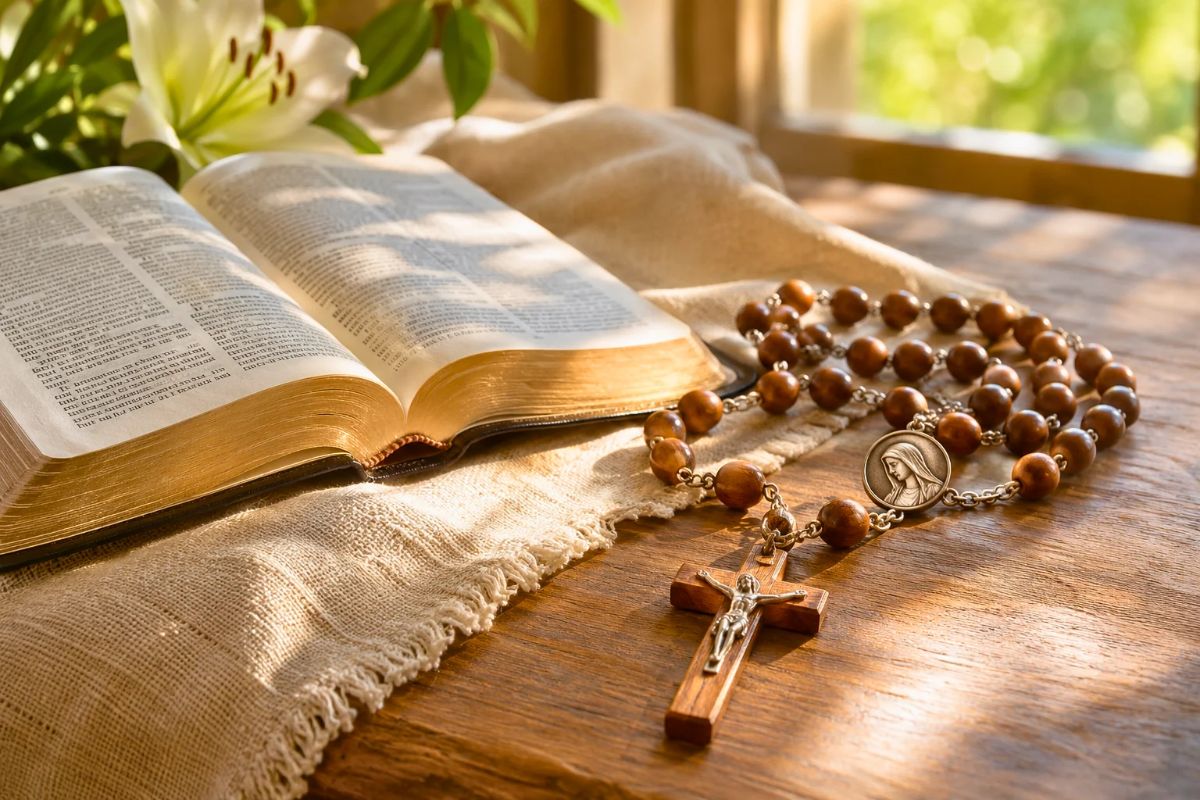
Praying the Rosary combines familiar Catholic prayers with meditation on five mysteries. Rosary beads help you keep track of each prayer as you move through the decades.
Follow these steps if you are learning the devotion for the first time.
Step 1: Start With the Sign of the Cross and the Apostles’ Creed
Hold the crucifix at the end of your Rosary beads and make the Sign of the Cross.
Then recite the Apostles’ Creed, which expresses the central beliefs of the Catholic faith, including belief in God, Jesus Christ, the Holy Spirit, and the Resurrection.
Step 2: Pray the Our Father and Three Hail Marys
Move to the first large bead above the crucifix and pray the Our Father.
On the next three small beads, recite three Hail Marys. These prayers are traditionally offered for an increase in faith, hope, and charity.
Step 3: Pray the Glory Be
After the three Hail Marys, recite the Glory Be.
This short prayer praises the Father, Son, and Holy Spirit before you begin meditating on the mysteries.
Step 4: Announce the First Mystery and Pray the Our Father
Announce the first mystery from the set you have chosen. For example, if you are praying the Joyful Mysteries, begin with the Annunciation.
Recall the biblical event. Read its corresponding Scripture passage before proceeding or quietly reflect on the scene.
Then pray the Our Father on the next large bead.
Step 5: Pray Ten Hail Marys While Meditating on the Mystery
Recite one Hail Mary for each of the next ten small beads. Keep the announced mystery in mind as you pray.
For example, while meditating on the Nativity, reflect on the birth of Jesus, the humility of His arrival, and the significance of God’s presence among humanity.
Reflect on the virtues demonstrated in the event and how they apply to your life. If your thoughts wander, gently return your attention to the mystery or pause briefly in silence.
Step 6: Complete the Decade and Continue With the Remaining Mysteries
After the ten Hail Marys, pray the Glory Be. You may also recite the Fatima Prayer, commonly added after each decade but optional.
Repeat the same sequence for the remaining four mysteries:
- Announce the next mystery.
- Pray the Our Father.
- Recite ten Hail Marys while meditating.
- Conclude with the Glory Be.
Continue until you have completed all five decades.
Step 7: Conclude With the Hail Holy Queen
After the fifth decade, recite the Hail Holy Queen, a prayer asking for Mary’s intercession.
Follow it with the traditional concluding dialogue and prayer, then make the Sign of the Cross to finish the Rosary.
If you are unfamiliar with the prayers, the USCCB’s How to Pray the Rosary guide provides a helpful reference.
Frequently Asked Questions
How many mysteries are there in the Rosary?
There are 20 individual mysteries divided into four sets of five: Joyful, Sorrowful, Glorious, and Luminous. A typical five-decade Rosary focuses on one set. Before the Luminous Mysteries were introduced, the traditional form comprised 15 decades across the first three sets.
Which three sets of mysteries were traditionally prayed before the Luminous Mysteries?
Before Pope St. John Paul II introduced the Luminous Mysteries in 2002, the traditional Rosary devotion focused on three sets: the Joyful, Sorrowful, and Glorious Mysteries. Each set contains five individual mysteries, making 15 in total. The addition of the Luminous Mysteries brought the number to 20.
Why did Pope John Paul II add the Luminous Mysteries?
Pope St. John Paul II introduced the Luminous Mysteries to highlight significant events in Jesus’ public ministry. These include His Baptism, the Wedding at Cana, the proclamation of God’s Kingdom, the Transfiguration, and the Institution of the Eucharist. He explained their purpose in his 2002 apostolic letter, Rosarium Virginis Mariae.
Can beginners pray the Rosary without knowing all the mysteries?
Yes. Beginners can use a printed prayer guide, a Rosary booklet, or a list of mysteries with corresponding Scripture passages. You can gradually learn the prayers and events through regular practice. There is no need to memorize everything before beginning.
Is the Rosary a prayer to Mary or Jesus?
The Rosary is a Marian devotion centered on Jesus Christ. Catholics ask for Mary’s intercession while meditating on important events in her Son’s life. The repeated Hail Marys accompany this meditation rather than replace prayer and devotion to Christ.
Reflecting on the Mysteries of the Rosary
Understanding the mysteries can make the Rosary more meaningful. The four sets invite reflection on Christ’s early life, public ministry, suffering, death, and resurrection.
You do not need to memorize all 20 mysteries of Rosary or every prayer before getting started. Begin with one set, follow the beads, and take time to reflect on each event. Consider the virtues each mystery reveals and how Christ’s example can guide your daily life.
With practice, the Rosary can become a familiar way to contemplate Scripture and deepen your relationship with Jesus through Mary’s intercession.
For more resources on Catholic prayer, faith, and contemplative spirituality, explore the educational articles at Lay Cistercians of South Florida and discover ways to make prayer a meaningful part of your daily life.
Seek a Deeper Connection with God and Join Lay Cistercians of South Florida
Lay Cistercians of South Florida, is a community of lay people who seeks to have a deeper connection with God by living a life inspired by the monks and nuns through Lay Monasticism. Learn more about what is a Lay Cistercian on our website. Anyone who aspires to do the same as us, and is a confirmed Catholic is welcome to join us! We meet every second Saturday of the month at Emmanuel Catholic Church in Delray Beach, Florida.

This Content Has Been Reviewed For Accuracy
This content has undergone comprehensive fact-checking by our dedicated team of experts. Discover additional information about the rigorous editorial standards we adhere to on our website.

About The Author
Hello there! I’m Corinne Grace, a nursing school graduate and devoted Catholic. I use my professional background and my own spiritual life to craft stories that promote the faith and foster positive spiritual growth.