Rosary Prayers: A Step-by-Step Guide for Beginners
Published November 25, 2026
Learning how to pray the Rosary can seem challenging at first. You need to remember several prayers, follow the beads, and meditate on mysteries. Once you understand the sequence, the devotion becomes easier to follow.
The Rosary prayers combine traditional Catholic prayers with meditation on momentous events in the lives of Jesus Christ and the Virgin Mary. Each decade focuses on one mystery, inviting reflection on Christ’s life, ministry, suffering, and resurrection.
A complete five-decade Rosary includes opening prayers, five decades, and concluding prayers. This guide explains each prayer and shows how to follow the sequence.
What Are the Main Prayers of the Rosary?
The Rosary uses several traditional prayers. Some begin the devotion, others are repeated during the five decades, and the remaining prayers conclude it.
Sign of the Cross
The Sign of the Cross opens and concludes the Rosary, expressing faith in the Holy Trinity.
Prayer:
In the name of the Father, and of the Son, and of the Holy Spirit. Amen.
Apostles’ Creed
The Apostles’ Creed summarizes fundamental Christian beliefs, including faith in God, Jesus Christ, the Holy Spirit, the Church, forgiveness, and eternal life.
Prayer:
I believe in God, the Father almighty, Creator of heaven and earth, and in Jesus Christ, his only Son, our Lord, who was conceived by the Holy Spirit, born of the Virgin Mary, suffered under Pontius Pilate, was crucified, died and was buried; he descended into hell; on the third day he rose again from the dead; he ascended into heaven, and is seated at the right hand of God the Father almighty; from there he will come to judge the living and the dead.
I believe in the Holy Spirit, the holy catholic Church, the communion of saints, the forgiveness of sins, the resurrection of the body, and life everlasting. Amen.
Our Father
Also called the Lord’s Prayer, the Our Father comes from Jesus’ teaching on prayer. It is recited once during the opening prayers and once at the beginning of each decade.
Prayer:
Our Father, who art in heaven, hallowed be thy name; thy kingdom come; thy will be done on earth as it is in heaven. Give us this day our daily bread; and forgive us our trespasses as we forgive those who trespass against us; and lead us not into temptation, but deliver us from evil. Amen.
Hail Mary
The Hail Mary is central to the Rosary. Its opening words come from the angel Gabriel’s greeting to Mary (Luke 1:28) and Elizabeth’s blessing (Luke 1:42). Its second part asks Mary to intercede for the faithful.
Prayer:
Hail Mary, full of grace, the Lord is with thee; blessed art thou among women, and blessed is the fruit of thy womb, Jesus. Holy Mary, Mother of God, pray for us sinners, now and at the hour of our death. Amen.
Glory Be
The Glory Be praises the Holy Trinity. It follows the three introductory Hail Marys and each decade.
Prayer:
Glory be to the Father, and to the Son, and to the Holy Spirit, as it was in the beginning, is now, and ever shall be, world without end. Amen.
Fatima Prayer
The Fatima Prayer is optional and is commonly recited after the Glory Be at the end of each decade. It is associated with the apparitions of Our Lady of Fatima in 1917.
Prayer:
O my Jesus, forgive us our sins, save us from the fires of hell; lead all souls to Heaven, especially those who have most need of your mercy.
Hail, Holy Queen
Also known as the Salve Regina, the Hail, Holy Queen is a traditional Marian prayer said after the five decades. It asks Mary to intercede for the faithful.
Prayer:
Hail, holy Queen, Mother of Mercy, our life, our sweetness, and our hope. To thee do we cry, poor banished children of Eve. To thee do we send up our sighs, mourning and weeping in this valley of tears. Turn, then, most gracious advocate, thine eyes of mercy toward us; and after this, our exile, show unto us the blessed fruit of thy womb, Jesus. O clement, O loving, O sweet Virgin Mary.
How to Pray the Rosary in Order: Step-by-Step
The Rosary begins at the crucifix, continues through the introductory beads, and moves into five decades. Follow these steps to keep track of the prayers.
Step 1: Begin With the Sign of the Cross
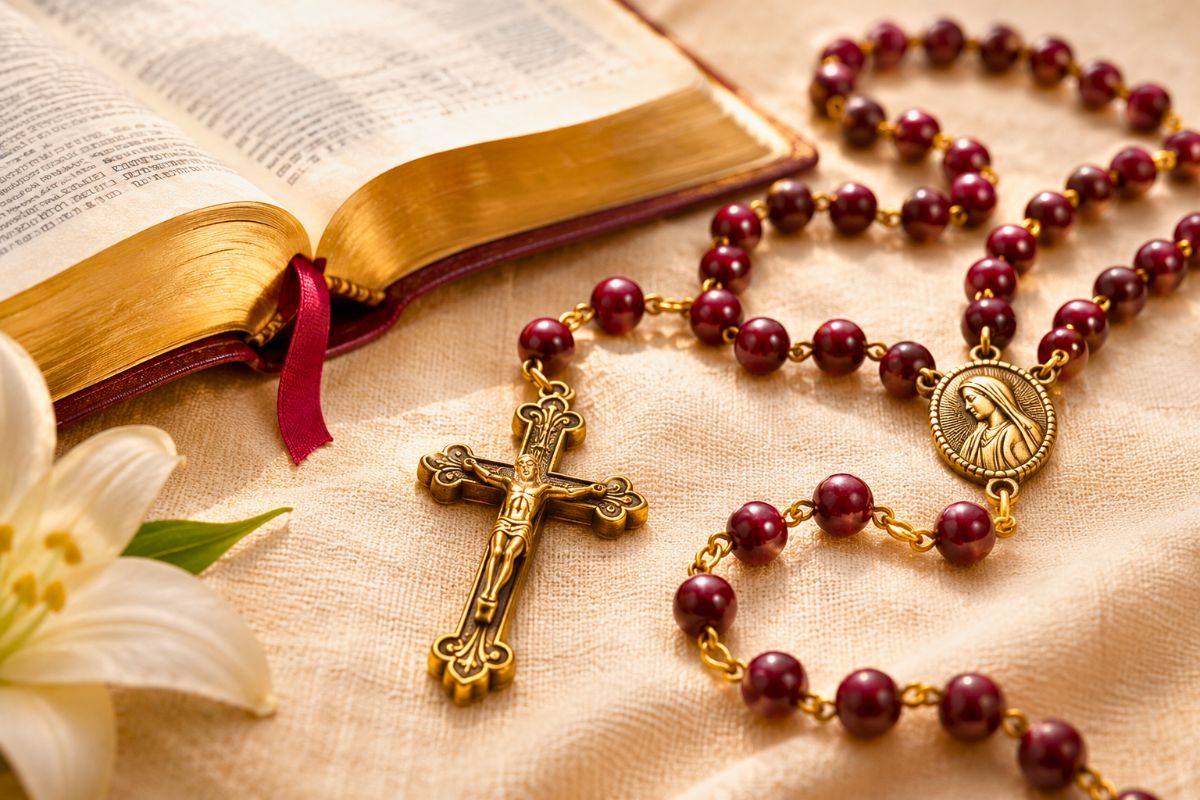
Hold the crucifix and make the Sign of the Cross, invoking the Father, Son, and Holy Spirit.
Step 2: Pray the Apostles’ Creed
Still holding the crucifix, recite the Apostles’ Creed and reflect on the Christian beliefs expressed in it.
Step 3: Pray the Our Father and Three Hail Marys
Move to the first large bead and pray the Our Father. Recite one Hail Mary on each of the next three smaller beads. These introductory Hail Marys are associated with faith, hope, and charity. After the third, pray the Glory Be.
Step 4: Announce the First Mystery
Announce the first mystery of the selected set. For example, the first Joyful Mystery is the Annunciation. Read a related Scripture passage or pause to reflect on the event.
Step 5: Pray the Five Decades
Each decade focuses on one mystery. Follow this sequence:
- Announce the mystery and reflect on it.
- Pray one Our Father on the large bead.
- Pray ten Hail Marys on the smaller beads.
- Pray the Glory Be.
- Recite the optional Fatima Prayer.
Repeat the sequence for the remaining four mysteries. During the Hail Marys, focus on the event being contemplated, such as Mary’s response to Gabriel during the Annunciation.
For additional instructions, consult the United States Conference of Catholic Bishops’ guide to praying the Rosary.
Step 6: Complete the Rosary With the Closing Prayers
After the fifth decade, pray the Hail, Holy Queen, followed by the traditional closing dialogue and concluding prayer. Finish with the Sign of the Cross.
What Are the Four Mysteries of the Rosary?
The mysteries are occasions in the lives of Jesus and Mary that guide meditation during the five decades. There are four sets, each containing five mysteries.
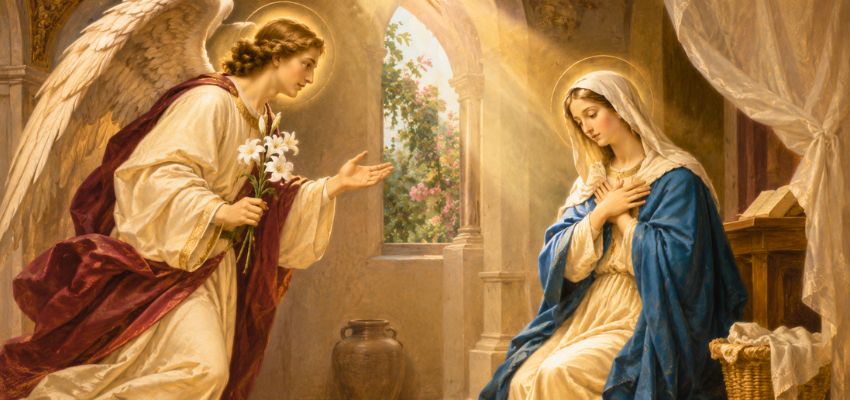
Joyful Mysteries
The Joyful Mysteries focus on the Incarnation and early life of Jesus.
- The Annunciation: Gabriel announces that Mary will become the mother of Jesus (Luke 1:26–38).
- The Visitation: Mary visits Elizabeth, who recognizes the blessing of Mary’s pregnancy (Luke 1:39–56).
- The Nativity: Jesus is born in Bethlehem (Luke 2:1–20).
- The Presentation: Mary and Joseph present Jesus in the Temple (Luke 2:22–38).
- The Finding of Jesus in the Temple: Mary and Joseph find Jesus among the teachers after searching for Him (Luke 2:41–52).
The Joyful Mysteries are prayed on Mondays and Saturdays, as well as Sundays during Advent.
Luminous Mysteries
Also called the Mysteries of Light, these focus on significant moments in Jesus’ public ministry. Pope John Paul II introduced them in 2002 through his apostolic letter, Rosarium Virginis Mariae.
- The Baptism of Jesus in the Jordan: The Holy Spirit descends upon Jesus after His baptism (Matthew 3:13–17).
- The Wedding at Cana: Jesus turns water into wine, His first recorded sign (John 2:1–11).
- The Proclamation of the Kingdom of God: Jesus announces the Kingdom and calls people to repentance (Mark 1:14–15).
- The Transfiguration: Jesus reveals His glory to Peter, James, and John (Matthew 17:1–8).
- The Institution of the Eucharist: Jesus establishes the Eucharist during the Last Supper (Matthew 26:26–29).
The Luminous Mysteries are traditionally prayed on Thursdays.
Sorrowful Mysteries
The Sorrowful Mysteries focus on Jesus’ suffering and sacrifice during His Passion.
- The Agony in the Garden: Jesus prays in Gethsemane before His arrest (Matthew 26:36–46).
- The Scourging at the Pillar: Pilate has Jesus scourged (Matthew 27:26).
- The Crowning With Thorns: Soldiers mock Jesus and place a crown of thorns on His head (Matthew 27:27–31).
- The Carrying of the Cross: Jesus carries His cross toward Calvary (John 19:16–17).
- The Crucifixion and Death of Jesus: Jesus dies on the cross (Luke 23:33–46).
The Sorrowful Mysteries are traditionally prayed on Tuesdays and Fridays, as well as Sundays during Lent.
Glorious Mysteries
The Glorious Mysteries focus on Christ’s Resurrection and the hope of eternal life. They also reflect on Mary’s place in the life of the Church.
- The Resurrection of Jesus: Christ rises from the dead (Luke 24:1–12).
- The Ascension of Jesus: Jesus ascends into heaven (Acts 1:6–11).
- The Descent of the Holy Spirit: The Holy Spirit comes upon the apostles at Pentecost (Acts 2:1–4).
- The Assumption of Mary: Mary is assumed body and soul into heavenly glory.
- The Coronation of Mary: Mary is crowned Queen of Heaven and Earth.
The Assumption and Coronation are Marian mysteries rooted in Catholic teaching and tradition; they are not narrated as specific events in a single biblical passage.
The Glorious Mysteries are traditionally prayed on Wednesdays and Sundays outside Advent and Lent.
This weekly schedule follows the USCCB’s traditional Rosary guide. It is a devotional pattern, not a strict requirement. Personal and liturgical circumstances may call for adaptations.
What Prayers Do You Say After the Rosary?
After the five decades, Catholics traditionally pray the Hail, Holy Queen, followed by a short dialogue and concluding prayer.
Hail, Holy Queen
The Hail, Holy Queen asks Mary to intercede for the faithful. Its complete wording appears in the main prayers section above.
Closing Dialogue
After the Hail, Holy Queen, recite:
Leader: Pray for us, O holy Mother of God.
Response: That we may be made worthy of the promises of Christ.
Rosary Concluding Prayer
Say “Let us pray” and recite:
Prayer:
O God, whose Only Begotten Son, by his life, death, and resurrection, has purchased for us the rewards of eternal life, grant, we beseech thee, that while meditating on these mysteries of the most holy Rosary of the Blessed Virgin Mary, we may imitate what they contain and obtain what they promise, through the same Christ our Lord. Amen.
Finish with the Sign of the Cross:
In the name of the Father, and of the Son, and of the Holy Spirit. Amen.
Frequently Asked Questions
Can you pray the rosary without beads?
Yes. Beads help you keep track of prayers, but they are not essential. You can use your fingers or another counting method while reflecting on each mystery.
How long does it take to pray the rosary?
A complete five-decade Rosary often takes 15 to 25 minutes. The duration varies with prayer pace and time spent reflecting on each mystery. Beginners may need longer.
Do you have to pray the Rosary every day?
No. Catholics are not required to pray the Rosary daily. Many include it in their regular prayer routine, but how often they pray it is a personal devotional choice.
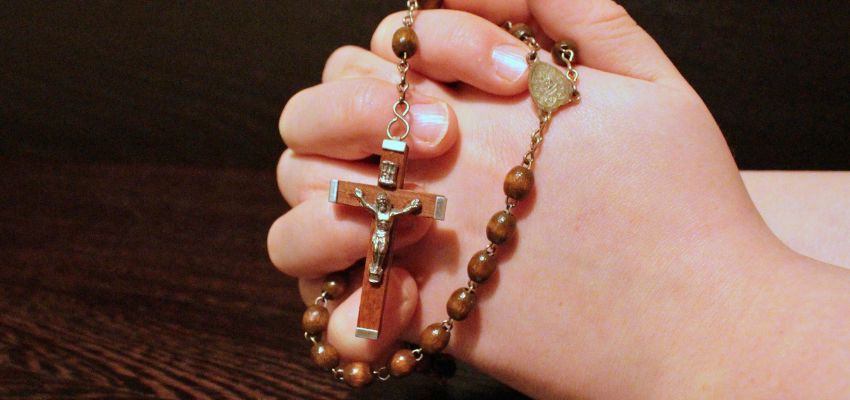
Begin Praying the Rosary With Confidence
Learning the Rosary takes practice, but understanding the rosary prayers in order makes the devotion easier to follow. Start with the opening prayers, reflect on the five mysteries as you pray each decade, and complete the devotion with the traditional closing prayers.
Each decade offers an opportunity to reflect on the life of Jesus and the spiritual lessons of the mysteries. Take your time as you become familiar with the prayers and their sequence.
For more guidance on Catholic prayer and spiritual practices, explore the Lay Cistercians of South Florida and discover additional resources to support your faith journey.
Seek a Deeper Connection with God and Join Lay Cistercians of South Florida
Lay Cistercians of South Florida, is a community of lay people who seeks to have a deeper connection with God by living a life inspired by the monks and nuns through Lay Monasticism. Learn more about what is a Lay Cistercian on our website. Anyone who aspires to do the same as us, and is a confirmed Catholic is welcome to join us! We meet every second Saturday of the month at Emmanuel Catholic Church in Delray Beach, Florida.

This Content Has Been Reviewed For Accuracy
This content has undergone comprehensive fact-checking by our dedicated team of experts. Discover additional information about the rigorous editorial standards we adhere to on our website.

About The Author
Hello there! I’m Corinne Grace, a nursing school graduate and devoted Catholic. I use my professional background and my own spiritual life to craft stories that promote the faith and foster positive spiritual growth.