He Who Believes And Is Baptized Will Be Saved – Sermon by Father Levine
Fr. Joseph Levine, Holy Family Catholic Church and Missions, Burns, Oregon; June 28, 2026
After his resurrection, when he appeared to his Apostles, Jesus sent them to proclaim the Gospel in all the world, saying, He who believes and is baptized will be saved. (Mk 16:15) Earlier, he had told Nicodemus, a prominent Pharisee, who had come to him at night, Amen, amen, I say to you, unless one is born of water and the Spirit, he cannot enter the kingdom of God. (Jn 3:5) In our creed we recite at Mass, we say, “I confess one Baptism for the forgiveness of sins.”
It seems to be pretty black and white: baptism by water is necessary for salvation. Well, if affirmed without qualification, that was the position of Fr. Leonard Feeney, an American Jesuit, serving in Boston and Cambridge in the 1940s and 50s, who was excommunicated by the Vatican in 1953, but was reconciled to the Church in 1972, without recanting his position, and died in 1978.
Now, in the first place, it is important for us to realize that salvation, especially since the sin of Adam, is not something we in any way deserve or can take for granted.
So, if in offering the gift of salvation, God sets certain requirements, like baptism, we are in no position to question or challenge him.
The 2nd Book of Kings recounts the story of Naaman, a Syrian army commander, foreign to Israel, who came to the prophet Elisha, seeking a cure for leprosy. Elisha commanded him to wash seven times in the Jordan River. Naaman went away angry, saying, I thought that he would surely come out … and call on the name of the Lord his God, and wave his hand over the place, and cure the leprosy. (2 Kgs 5:11) His servants, though, brought him to reason, saying, If the prophet had commanded you to do some great thing, would you not have done it? How much more rather, then, when he says to you, ‘Wash, and be clean’?” (2 Kgs 5:13) So Naaman followed the prophet’s instructions and was healed of his leprosy.
Like Naaman, we are in no position to question God’s requirement of baptism, but we should be grateful that what he requires is so simple.
If we are in no position to question God’s requirement of baptism, we should also realize that what God commands is not arbitrary; rather, it is full of meaning and wisdom. Understanding the meaning and wisdom of baptism will also help us understand the limits of God’s command and the error of Fr. Feeney and others. These errors are still with us today.
In today’s 2nd reading, St. Paul teaches us the meaning of baptism, a meaning that harmonizes with the teaching of Jesus that we heard in the Gospel, Whoever does not take up his cross and follow me is not worthy of me. Whoever finds his life will lose it and whoever loses his life for my sake will find it.
These words are central to the whole of Jesus’ teaching. Fittingly we find them embodied in stone at the center of the Catholic Church, the façade of St. Peter’s, crowned by a statue of Jesus, carrying his Cross, ready as it were to ascend to heaven, with the statues of the saints, who took up their cross and followed Jesus, on either side of Jesus and extending beyond the basilica on top of the colonnades that embrace the square of St. Peter’s.
First, there is Jesus Christ, the Son of God made man, who was crucified, died, and rose again from the dead. The mystery of his death and resurrection is the called the Paschal Mystery, or Passover Mystery, by which Jesus fulfilled all the figures of the Old Testament, especially that of the Passover Lamb, offering the true and perfect sacrifice to God, expiating our sins, reconciling us to God, touching us in the sacraments, bestowing on us the life of grace, and the pledge of future glory.
In the life of Jesus himself, then, we see two stages. There is his mortal, earthly life, like us in all things but sin, and also the immortal life of his resurrected body, now glorified at the right hand of God. Through his mortality, he did not share our sin, but he shared the consequences of our sin; through his death, he put to death the guilt of our sin; through his resurrection, he leads us, already in this mortal body, to the life of grace, turning bodily death for us into the gateway to the life of eternal glory in the presence of God.
His death and resurrection are thus for us the pattern of our life. To follow Christ means precisely to die to the life of sin so as to live the life of grace, the life of the children of God. Through the pattern of the Paschal Mystery of his death and resurrection, we enter into the life of grace; through the pattern of the Paschal Mystery, we pursue the path of life; through our own death, the Paschal Mystery is brought to completion in us, becoming the gateway to glory.
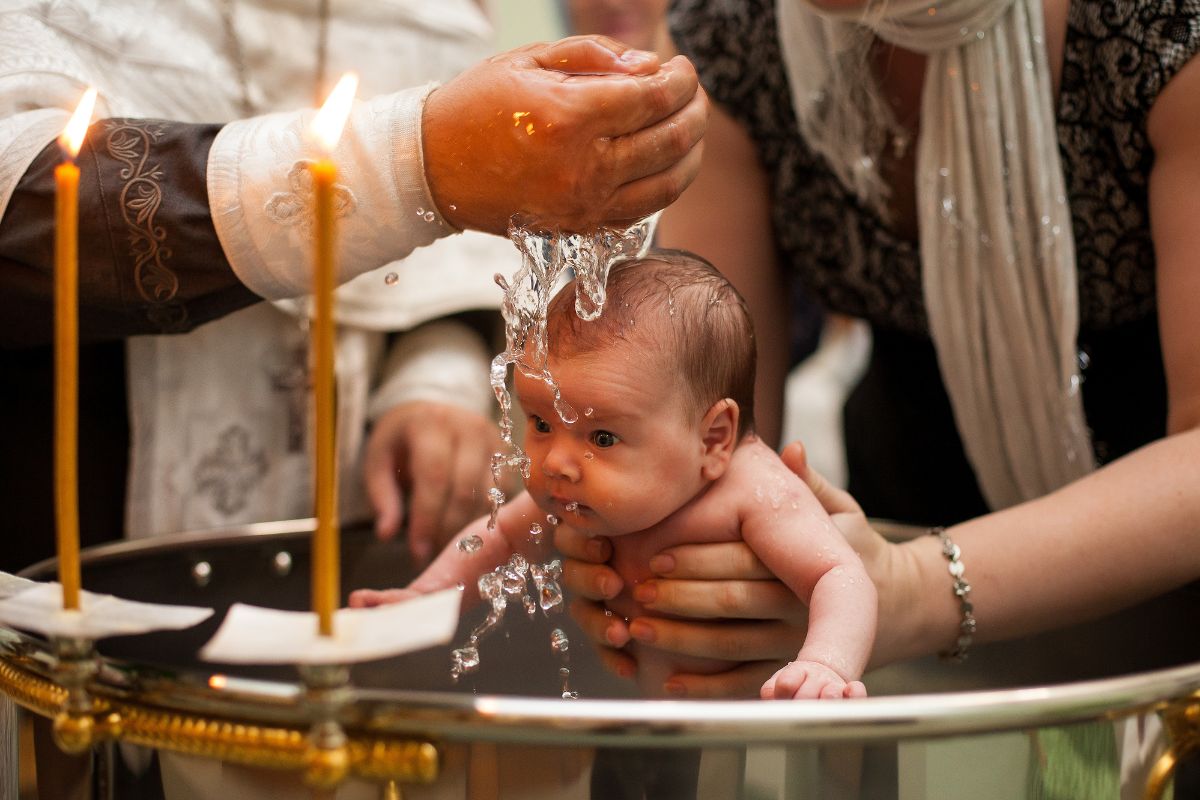
So, St. Paul tells us that we were baptized into Christ’s death. This is the meaning of the immersion, at least of the forehead, into the waters of baptism. Yet, Christ through his resurrection has defeated death, so we were buried with him through baptism into death, so that, just as Christ was raised from the dead by the glory of the Father, we too might live in newness of life.
The literal translation is “walk in the newness of life”. The newness of life is the life of grace, the life of the children of God. This life is a path with a destination. We must continue upon the path; we must be faithful to the path; we must persevere on the path until we reach the goal of salvation. The pattern for the path is the pattern that was given to us in baptism itself, death and resurrection, denying ourselves, taking up our cross, and following Christ. Through this death, sin must no longer have power over us. We must think of ourselves as dead to sin and living for God in Christ Jesus. This is the life given to us in our baptism.
This life is altogether undeserved on our part. It is truly “supernatural”, beyond the capacity of every created nature, even angelic, because it is a sharing in the very life and nature of God. Even leaving sin aside, God did not have to create us for this life; he could have left us with a purely natural life. Nevertheless, in his pure mercy and goodness, he chose to bestow on us something inconceivably greater than mere natural life.
Jesus speaks of the greatness of this gift in the parable of the wedding feast of the King’s son. (cf. Mt 22:1-14) The invitation to the royal wedding is a great and undeserved gift, but once given, it cannot be refused without grave offense. Further, one must accept the conditions of the invitation and accept the required wedding garment of grace, symbolized in the baptismal gown, and preserve it unstained.
Now, we can return to the question of the necessity of baptism. What is truly and absolutely necessary for salvation is the supernatural life of grace, which is attained and preserved by being united to the Paschal Mystery of Jesus Christ. Baptism is the ordinary means that God has provided for someone to be joined to the Paschal Mystery of Christ’s death and resurrection.
The Catechism of the Catholic Church teaches: “The Church does not know of any means other than Baptism that assures entry into eternal beatitude; this is why she takes care not to neglect the mission she has received from the Lord to bring about the ‘rebirth of water and the Spirit’ in everyone who is able to be baptized.” (CCC 1257, italicized words are my own translation of a difficult construction; cf. Latin and Romance language versions)
At the same time, we know that while “God has bound salvation to the sacrament of Baptism, … he himself is not bound by his sacraments.” (CCC 1257) When the Roman Centurion, Cornelius, summoned St. Peter to hear the Gospel from his lips, the Holy Spirit anticipated his baptism with visible signs, in order to reassure St. Peter and those accompanying him that circumcision as a Jew was not required as a prerequisite for baptism. (cf. Acts 10:30-48)
Further, contra Fr. Feeney, over the centuries the Church has recognized “baptism of blood” and “baptism of desire”.
Baptism of blood: “Those who suffer death for the sake of the faith without having received Baptism are baptized by their death for and with Christ.” (CCC 1258)
In 2015, ISIS released a video boasting of their beheading of 21 men on a beach in Libya. All 21 men died with the name of Jesus on their lips. 20 of them were baptized, Coptic Christians. The 21st, following the example of the others, dying with the name of Jesus on his lips, was, we assume, joined to the Paschal Mystery of Christ by his own death and the shedding of his own blood.
The baptism of desire is a vaguer concept. It most clearly applies to earnest catechumens, seeking baptism, who by some accident die before receiving baptism. (cf. CCC 1259)
Yet, the Church also teaches, “Since Christ died for all, and since all men are in fact called to one and the same destiny, which is divine, we must hold that the Holy Spirit offers to all the possibility of being made partakers, in a way known to God, of the Paschal mystery.” (Vatican II, Gaudium et Spes 22, cited in CCC 1260, emphasis added).
This teaching has often been abused either to contradict the necessity of baptism or even to proclaim that all without exception are saved. What we need to recognize here is a great unknown that must in no way be taken for granted.
The only way of salvation that God has actually revealed requires baptism; knowing his desire for our salvation, knowing that no one is condemned for what they were unable to know – that is called “invincible ignorance”, which does not include laziness, lack of concern for the truth, much less positive resistance to the truth or a willful ignorance – we reason that God provides some other means than baptism in water for them to be “partakers of the Paschal Mystery” and so be saved. We have no reason to believe that such unknown means is very effective; rather, we have every reason to believe that without explicit faith in Jesus Christ and baptism in water, a person’s salvation is in grave danger.
Indeed, not even baptism itself, without a life in fidelity to the gift, walking in the newness of life, is sufficient for salvation. Indeed, the gift of baptism, apart from the unity of the Catholic Church, the fullness of the means of salvation, the truth of the Gospel, and the seven sacraments, leaves a person exposed to all manner of dangers.
There are those who have been conformed to the Paschal Mystery through baptism and live in conformity to the Paschal Mystery. There are those who have been baptized, but through mortal sin, or even worse, loss of faith, are no longer conformed to the Paschal Mystery. It seems also that there are a few who, apart from baptism, apart from the visible Church, have been conformed to the Paschal Mystery, but in them the life of grace is gravely endangered by the error and ignorance in which they live.
For all of us, we should, on the one hand, hear the words of St. Paul, Let any one who thinks that he stands take heed lest he fall, (1 Cor 10:12), and so do everything in our power to follow Christ, be faithful to him, persevere in his grace, and so assure our own salvation. At the same time, in fulfillment of the commandment of God, love your neighbor as yourself, we should do what is in our own power, first by the example of a truly Christian life, second by insistent prayer, and third by the witness of words, to lead others to the path of salvation, which is found in the Catholic Church.
Seek a Deeper Connection with God and Join Lay Cistercians of South Florida
Lay Cistercians of South Florida, is a community of lay people who seeks to have a deeper connection with God by living a life inspired by the monks and nuns through Lay Monasticism. Learn more about what is a Lay Cistercian on our website. Anyone who aspires to do the same as us, and is a confirmed Catholic is welcome to join us! We meet every second Saturday of the month at Emmanuel Catholic Church in Delray Beach, Florida.

This Content Has Been Reviewed For Accuracy
This content has undergone comprehensive fact-checking by our dedicated team of experts. Discover additional information about the rigorous editorial standards we adhere to on our website.