What A Catholic Owes To His Nation – Sermon by Father Levine

Fr. Joseph Levine; Holy Family Catholic Church and Missions, Burns, Oregon; July 5, 2026
This weekend, our nation celebrates her 250th birthday. We are all indebted to the nation to which we belong in ways beyond our imagining, just as children are unaware of the extent of the debt they owe their parents. Indeed, just as we are to honor our father and mother, the 4th commandment also requires us to honor our nation.
I’m old enough to remember the Bicentennial celebration. I was 15 years old and living in Washington, DC. Our family went to the National Mall to join a crowd of a million or more for the fireworks celebration.
Gerald Ford was the unique unelected President, Jimmy Carter had not yet declared the “national malaise”, and Iran was still ruled by the Shah. Nevertheless, Ford had followed upon Nixon’s resignation in disgrace, and Ford had presided over the fall of Saigon the previous year. Yet, despite the dark clouds that hovered over the national life, I remember the general celebratory atmosphere, reflected in the network news and the major newspapers, in a time when there were not numerous alternative news sources. The celebratory atmosphere cut across the political spectrum. No one would have thought of asking if the crowd on the Mall was predominantly Democrat or Republican, liberal or conservative; we were all rejoicing in the simple fact of being American and enjoying American freedom. That American freedom, on the one hand, had allowed for the flourishing of faith and family, but on the other hand, allowed for the entry of the forces that have attacked and undermined faith and family.
Now, we have reached the 250th, and whatever else is the case, it does not seem to be an occasion of common rejoicing. The nation is divided as it has never been since the Civil War. I would dare say that if there is one thing that more than anything else has poisoned the political life of the nation in the past half-century, it would be the 1973 Supreme Court ruling, Roe vs. Wade, recognizing a constitutional right to abortion. Even though the decision has recently been overturned, the poison had already spread far and wide, through politics, law, medicine, and education.
The decision was uniquely divisive, even when it has been in the background, because finally, there is no room for compromise, and the spirit of compromise has been the glue that holds together American politics. There is no room for compromise because, in the last analysis, either it is alright to murder a baby, or it is not. What compromise can there be between the world view that justifies one side or the other of that “choice”.
Now, here we are, Catholic Americans, on this July 4th weekend, celebrating Mass for the 14th Sunday in Ordinary Time. Let us look for some Catholic light and Catholic hope on this occasion. Catholic light and hope are not naively optimistic, but realistic, as eternity is most real.
Now, 50 years ago, when I enjoyed the fireworks on the National Mall, I was not Catholic, nor religious in any way. My family was not religious. About five years later, I would be baptized into the Catholic Church and would also serve the nation for four years in the United States Coast Guard. After I became Catholic, I became aware of the deeply anti-Catholic history of our nation.
Once, when I was in the Coast Guard, I asked for special “liberty” on a Sunday to attend Mass onshore. The Chief Petty Officer granted my request but made a point of telling me that my request was no different than if a motorcycle enthusiast in our division had requested to attend a Harley-Davidson convention.
Our nation is deeply anti-Catholic, but historically, Catholics have served this nation with great patriotism. Catholics were distrusted as being loyal to a foreign Pope, who was likened in Protestant culture to the anti-Christ, but it was as though Catholics went the extra mile to prove their loyalty and love of the nation. This was especially manifest by the dedicated service of Catholics in World War I and World War II. Ironically, today the Pope is an American who grew up rooting for the Chicago White Sox.
What I want to say today is that the United States, in her present plight, desperately needs the Catholic faith. It is no longer by bending over backward to prove our loyalty that we must serve the nation, but it is by being faithful Catholics that we will most serve our nation.
Without doubt, the most famous line of the Declaration of Independence and, perhaps, the statement that most defines our nation, is: “We hold these truths to be self-evident, that all men are created equal, that they are endowed by their Creator with certain unalienable Rights, that among these are Life, Liberty, and the pursuit of Happiness.”
The Founders held these truths as “self-evident,” and yet, the course of our history has shown that the meaning of these truths is anything but self-evident. That lack of clarity has come home to haunt the nation in the past half-century. Different people mean different things by the same words, and it is impolite to talk about the difference, except perhaps to say, “Well, you have your truth, and I have mine.”
Extreme relativism has even found its way into the Supreme Court in rulings that upheld Roe v. Wade and opened the door to the culture of sodomy. “At the heart of liberty is the right to define one’s own concept of existence, of meaning, of the universe, and of the mystery of human life.” (cf. Planned Parenthood v. Casey, 1992 and Lawrence v. Texas, 2003) The poison remains in American culture.
Finally, the self-evident truths of the Declaration of Independence have no meaning unless truth itself is recognized and acknowledged.
St. John Paul II taught: “It must be observed … that if there is no ultimate truth to guide and direct political activity, then ideas and convictions can easily be manipulated for reasons of power. As history demonstrates, a democracy without values easily turns into open or thinly disguised totalitarianism.” (Centesimus Annus 46)
The Declaration speaks of equality, life, liberty, and happiness, all of which need to be measured by the truth of the Creator. All of this, in some measure, is accessible to the natural mind, but the natural mind has become so darkened that, without the light of faith, indeed the truth of the Catholic faith, the natural mind is reduced to confusion.
This should not come as a surprise if we consider well the words of Jesus in today’s Gospel: I give praise to you Father, Lord of heaven and earth, for although you have hidden these things from the wise and the learned, you have revealed them to little ones.
The “wise and the learned” are those who excel in the natural endowments of the mind, but lack supernatural faith. Yet, already in the time of the Old Testament, the author inspired with divine wisdom laments, They were unable from the good things that are seen to know him who exists, nor did they recognize the craftsman while paying heed to his works. (Wis 13:1)
Contrariwise, the Father makes known to little ones, who are willing to receive the word of God in faith, not only the basic truths of creation, including the truth that God created man, male and female, in his own image, but the truth otherwise hidden from all created minds, about the Son of God who reveals the Father to whom he will: this is the hidden truth of the Holy Trinity and the hidden truth of the Incarnation, the Son of God made man. Truths that were denied, or at least declared irrelevant, by the man who drafted the Declaration of Independence; truths that are taught even to those who are being prepared to receive their first communion.
So, in light of the hidden truth of the Creator, the Holy Trinity, what can we say about the self-evident truths of the Declaration?
First, the meaning of equality. It means equality in being created in the image of God, the Holy Trinity, endowed with the living powers of memory, understanding, and will, internal principles of the soul by which we can intelligently and freely pursue the goal of happiness. We are not speaking here of any old happiness, but the happiness for which we were created, which consists in union with God, which indeed is revealed to us as the vision of the Blessed Trinity.
It means equality in the sin sadly inherited from Adam and the redemption happily won for us by Christ on the Cross. It means also equality in the means of salvation, especially the sacraments of grace given to us by Christ, in the Church. That is to say that Christ and his sacraments are equally the way of salvation for all men.
It means equality in the goal, eternal life, the vision of God, the Holy Trinity, the “one denarius,” stamped with the image of the king, that is given in payment to each of the laborers in the vineyard, those of the first hour and those of the last. (cf Mt 20:1-16; 22:19-21)
Therefore, life has been given to each one of us by God, life in the image of God, so that we might know God’s love and freely respond to his love, freely pursuing the path of love. We pursue the path of love by obeying the ten commandments of love, whose full meaning, deeper than the righteousness of the scribes and Pharisees (cf. Mt 5:20), is taught by Jesus Christ, who also gives us the grace and power to keep the commandments. This is the way to reach the goal of love, which is the God who is love.
This love does not come from ourselves, but is given to us most of all through the gift of the Holy Spirit, the personal and substantial divine love, who proceeds from the Father and the Son, as their mutual love. He is the Spirit of Jesus Christ, who makes us belong to him, who dwells in us, who delivers us from every fleshly, worldly, and egoistic love, teaching us to put to death the deeds of the body so as to live the life of the children of God, crying out Abba, Father. (Rn 8:15)
This is the truth that sets us free. (cf. Jn 8:31)
Power politics will not save us, much less unite us. Jesus Christ is our Lord and Savior; he is the gift we must give to our nation by living as faithful Catholics.
Abraham Lincoln famously cited the words of Jesus to a divided nation: A house divided against itself cannot stand. (Mt 12:25) The dividing issue that threatened the nation was that of slavery. Today, the dividing issue is truth itself. In that regard, we could consider some other words of Jesus that come shortly after the ones cited by Lincoln: He who is not with me is against me, and he who does not gather with me scatters. (Mt 12:30)
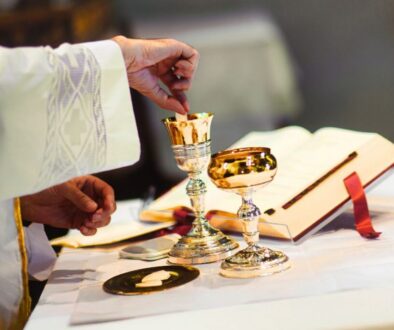
We can think of Jesus pronouncing these same words today, with his voice coming from his true Body, born of the Virgin Mary, present to us in the Holy Eucharist.
If we want to keep our nation from being scattered to the winds, like so many nations of the past, then we need to let ourselves be gathered into the unity of Christ’s Body, working also with him, in his harvest, to gather others together.
We must then evangelize our nation, starting with ourselves.
Seek a Deeper Connection with God and Join Lay Cistercians of South Florida
Lay Cistercians of South Florida, is a community of lay people who seeks to have a deeper connection with God by living a life inspired by the monks and nuns through Lay Monasticism. Learn more about what is a Lay Cistercian on our website. Anyone who aspires to do the same as us, and is a confirmed Catholic is welcome to join us! We meet every second Saturday of the month at Emmanuel Catholic Church in Delray Beach, Florida.

This Content Has Been Reviewed For Accuracy
This content has undergone comprehensive fact-checking by our dedicated team of experts. Discover additional information about the rigorous editorial standards we adhere to on our website.