We Do Not Know How to Pray as We Ought – Sermon by Father Levine

Fr. Joseph Levine; Holy Family Catholic Church and Missions, Burns, Oregon; July 19, 2026
There is the great vexing question, “Why does God allow evil?” Beneath that question, there is another, “Why does God allow evil men in his Church, as noxious weeds sown in the midst of the wheat?”
Today’s parable warns us that it is so; it happens; God allows it.
Therefore, we should not be surprised to find that the Holy Church is not composed purely of holy men, that it is not only a mix of saints and sinners, maybe even more sinners than saints, but there are downright evil men, who can be characterized as children of the evil one, the devil. Why should we be surprised when the first of them, Judas Iscariot, was counted in the number of the Apostles.
Today’s parable also warns us against the presumption that we have the capacity to root out all evil from God’s Church. There are evils here and there that can be defeated, but the attempt to eradicate all evils during the course of this passing life would lead to worse evils, destroying much good.
In any case, the parable does not answer the question, “Why does God allow this?”
But what happens if, in a spirit of faith, we accept the reality revealed in the parable? We learn to practice patience, together with vigilance and discretion, and we groan. Maybe that is the answer to the question, “Why?”
Does God want us to groan? Well, if we groan in the right way, yes. We do not know how to pray as we ought, but the Spirit himself intercedes for us with inexpressible groanings.
Returning to the parable, we should desire to be the good seed, the wheat in God’s field. If we should look within ourselves and think that perhaps we are rather weeds, then we should pray to God that he change us into wheat, through repentance and conversion of heart. It would be a miracle for God to change weeds into wheat (he has the power to do so), so also it is a miracle when God changes a wicked man into a good one. The latter miracle, however, cannot take place without the cooperation of the wicked man, cooperation that starts in his desire, even in his groaning, a sort of first fruits of the work of the Holy Spirit in his soul.
The wheat grows in a field by a principle of life hidden within; the principle of life hidden in God’s human wheat is the Holy Spirit. He is the Spirit of the Son who proceeds from the Father, or the Spirit who proceeds from the Father and the Son as their mutual, substantial, and personal love. (Cf. Jn 15:26, Gal 4:6) He bears witness to the Son, making him known, from within. The Father makes his Son known and draws us to him in faith through the working of his Holy Spirit. (cf. Mt 11:25-27; Jn 6:44) Through the Holy Spirit, the Spirit of Divine Love, the love of God is poured into our hearts. (Cf. Rm 5:5)
No one can say, ‘Jesus is Lord,’ except by the Holy Spirit. (1 Cor 12:3) Well, actually, anyone can say the words, “Jesus is Lord”. Yet, to say the words as a profession of faith coming forth from a heart that recognizes the truth, that is the work of the Holy Spirit. (Cf. Rm 10:9-10)
Through our baptism, we have been reborn to new life, the life of grace, the life of the children of God, through water and the Holy Spirit. (cf. Jn 3:5-6) Through faith and baptism, God has sent the Spirit of his Son into our hearts, crying, ‘Abba! Father!’ (Gal 4:6)
The Holy Spirit gives us the power not just to say the words, but to pray, in truth, in Jesus Christ, the Son of God, the Lord’s Prayer, the “Our Father”. The Holy Spirit gives us the power to live in the presence of our heavenly Father, who sees in secret. (cf. Mt 6:6)
St. Peter, without naming the Holy Spirit, sums all this up writing, His divine power has granted us all things that pertain to life and godliness, through the knowledge of him who called us to his own glory and excellence, by which he has granted us his precious and very great promises, that through these you may escape from the corruption that is in the world because of passion, and become partakers of the divine nature. (2 Pe 1:3-4)
Note that the world around us glorifies “passion”. To be “passionate” about something seems to excuse all sins. Well, to be passionate about something good, like beautiful music, in measure with the thing’s goodness (music is not a supreme or absolute good), is a good thing. Nevertheless, it is the good thing, which is higher than mere passion, that makes the passion to be good; there must also be something in us, the mind, which is superior to the passion, that is capable of recognizing the good and directing the passion thereto in due measure. Indiscriminate and unrestrained passion, the corruption in the world, falls under the condemnation of the works of the flesh. St. Paul warns us that the works of the flesh are plain: fornication, impurity, licentiousness, idolatry, sorcery, enmity, strife, jealousy, anger, selfishness, dissension, party spirit, envy, drunkenness, carousing, and the like. (Gal 5:19-21) Passionate indeed. These are opposed to the impulse of the Holy Spirit and exclude from the Kingdom of God. (Cf. Gal 5:17,21)
The Holy Spirit, the Spirit of true prayer, stirs up within us a longing for God and for the fulfillment of his promise. What no eye has seen, nor ear heard, nor the heart of man conceived, what God has prepared for those who love him. (1 Cor 2:9) Yes, we are God’s children now but it does not yet appear what we shall be, but we know that when he appears we shall be like him for we shall see him as he is. (1 Jn 3:2)
We do not know how to pray as we ought, because what God has promised, the vision of himself, the most Holy Trinity, exceeds all imagination, thought, and every human word. It surpasses every good that we have experienced as far as the Creator surpasses all his creatures.
The Holy Spirit intercedes for us, not as though he were standing outside us, before God, asking him to help us, but because he is within us moving us to long for the fulfillment of God’s promise, which he knows, because he is God, but which we cannot express in words, for which we can only groan and sigh as exiles longing for their homeland.
That is the heart of true prayer. When we find ourselves surrounded by evils, whether within or without, those evils should first of all serve as an occasion for our turning within, seeking that secret place in the presence of the Father, letting the Holy Spirit move us with ardent longing for the invisible God.
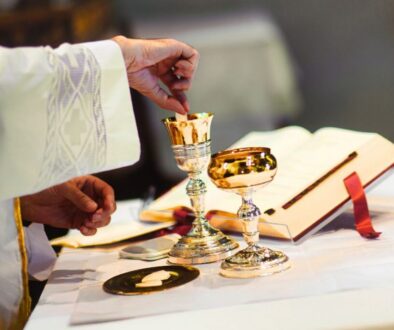
He, the Son of God, is there before us beneath the appearance of bread in the Holy Eucharist, but we do not see him. We know it only by the faith that leads us to cry out, Jesus is Lord! Where Jesus is, there is the Father, and there is the Holy Spirit. “Jesus, whom I look at shrouded here below, I beseech, send me what I thirst for so, some day to gaze on thee Face to face in light, and be blest forever with thy glory’s sight.” (St. Thomas Aquinas, Adoro te devote; Godhead here in hiding, Tr. by Gerard Manley Hopkins)
Jesus commanded us to pray always without growing weary. (Lk 18:1) We pray always insofar as the Holy Spirit moves us from deep within to long for God with those inexpressible groanings, insofar as that inexpressible longing is continual, deeply rooted and habitual.
Yet, we need words in prayer to remind us of God and of his promise and to nourish and stir up within us that longing. Without words, in our weakness, we will tend to forget. Without words, the visible reality around us will begin to absorb us and we will forget.
St. Augustine wrote: “When we cherish uninterrupted desire along with the exercise of faith and hope and charity, we pray always. But at certain stated hours and seasons we also use words in prayer to God, that by these signs of things we may admonish ourselves, and may acquaint ourselves with the measure of progress which we have made in this desire, and may more warmly excite ourselves to obtain an increase of its strength.” (Letter 130 to Proba, 9.18)
We are surrounded by evils, difficulties, and afflictions. In these, we turn to God and beg his help. We have so many needs, and it is good that we beg for God’s help in all our needs. We can express these needs in prayer to God. Yet, when we do so, we should thereby remember God himself and that our greatest need is for God himself. As we beg God for help in our needs, may those needs teach us to long for God, in whom every desire and longing finds its fulfillment.
Apart from our human relationships, our material needs, and our bodily pains, we inevitably must return within ourselves and face our unfulfilled longing, our weariness of soul, the recognition of our interior weakness and poverty. I said, “we must”, but we actually try to avoid it and dread it. The Psalmist would lead the way: Let me hear what God the Lord will speak, for he will speak peace to his people, to his holy ones, to those who turn to him in their hearts. (Ps 85[84]:8) If we are willing to enter into that dry and painful place within, if we are willing to let the Holy Spirit enter there, he will turn all of this into a blessed longing for God, a longing that will be fulfilled when we behold him “Face to face in light.”
Yet, we try to avoid it. Many people complain that they have no time to pray. No time to pray? No time to remember God? It takes but a moment, in the midst of our daily activities, to pause, to withdraw into that interior chamber, to turn a gaze upon God, to give forth a sigh of longing, and perhaps even a few brief words.
It takes but a moment, but unless we put a priority on prayer and do our best to set aside a time dedicated to prayer every day (fifteen minutes at least, half an hour even better), then we will most likely fail to take those moments during the course of the day.
Besides that dedicated time, we should turn to prayer briefly when we first wake up in the morning, remembering God and giving our day to him; we should turn to prayer before we go to bed, examining our conscience, repenting of our sins and failings, giving thanks for all the good we received during the day, even the difficulties through which God would instruct us, and begging the grace of a peaceful sleep that we might rise again to a new day in his service. Then, we should turn to him as often as possible in the midst of our activities, striving always to live in his presence. He is there; he is always present, but we so easily forget.
We so easily forget God, and perhaps the single most important thing is that we remember him. We have so many helps: the word of God, the rosary, sacred images and sacred music, writings by saints and other holy men and women, and the great living memorial, in which we are joined together with the whole people of God, the memorial in which Jesus Christ makes himself really, truly, and substantially, present, offering himself on our behalf, the summary of all his works and all his love, the Holy Sacrifice of the Mass.
If we remember, we will indeed become good seed, wheat planted in God’s field, ready to be gathered into his barn, the Father’s house.
Seek a Deeper Connection with God and Join Lay Cistercians of South Florida
Lay Cistercians of South Florida, is a community of lay people who seeks to have a deeper connection with God by living a life inspired by the monks and nuns through Lay Monasticism. Learn more about what is a Lay Cistercian on our website. Anyone who aspires to do the same as us, and is a confirmed Catholic is welcome to join us! We meet every second Saturday of the month at Emmanuel Catholic Church in Delray Beach, Florida.

This Content Has Been Reviewed For Accuracy
This content has undergone comprehensive fact-checking by our dedicated team of experts. Discover additional information about the rigorous editorial standards we adhere to on our website.