Free Cooperation with God’s Predestination – Sermon by Father Levine
Fr. Joseph Levine; Holy Family Catholic Church and Missions, Burns, Oregon; July 26, 2026
Imagine the stunning, breathtaking view from a high mountain peak; next imagine that this same mountain peak has a rather narrow summit and is surrounded by precipitous cliffs and is accessible only by a rather narrow and rugged path.
Today’s 2nd reading is rather like that peak. There is no higher peak than God himself, and there is no greater view, should we say, than God’s eye view. Today’s reading gives us such a view, a divine perspective on the whole of human history, on all human events, both on the grand scale, down to the smallest details, and how everything else that touches human life enters into the picture. Of course, for us, a view from a mountain peak gives us a vast panorama, but we lose the details; God himself sees the panorama and the finest details.
The view from the mountain peak, surrounded by cliffs, is both beautiful and scary. If we receive the word of God in its entirety, we find both elements. Today’s reading is both consoling and disturbing.
It is consoling to hear the words, all things work for good. What can be more reassuring as we walk not on a mountain peak bathed in the sunlight, but amid the obscurity and difficulties of daily life?
Yet, if we pay attention to the whole, it is disturbing: those he foreknew he also predestined. Those two words “foreknew” and “predestined” are like steep cliffs over which many, such as John Calvin and his followers, have plunged to their destruction.
Yet, we cannot excise those words, because they form part of an inseparable whole that includes the consoling words.
All things work for the good. For whom? Not for everyone, but only for those who love God. Those who love God cooperate with his plan. What is his plan? That they be conformed to the image of his Son. That is the good for which all things work; they serve to conform the lovers of God to the image of God’s Son, Jesus Christ.
Very good, but why should we trust that all things should work to accomplish this good purpose? Because God who is almighty foreknows and predestines those who love him; God’s foreknowledge and predestination is the guarantee of all things working for the good.
That very guarantee and reassurance of the good, however, threatens to cast us over the precipice in either of two ways.
First, if everything works according to God’s foreknowledge and predestination, then it seems there is nothing left for us to do. We are not free, but merely automatons, moved along the path by the all-powerful God.
Ironically, the moment a person begins to think that he is not free, because everything is predetermined by God, he then thinks that it does not matter what he does, so he begins to do whatever pleases him, even if that is displeasing to God. He turns his freedom, which he believes to be illusory, against God.
Hold on tight: there is an anchor here on this mountain peak: for those who love God. The word of God is addressed to human beings; even when elevated by divine grace, human love is nothing if it is not freely given.
Sharing in this divine knowledge, this “God’s eye view”, is difficult for our feeble human minds, but we need to hold on to the certainties, even if they seem opposed, believing that what our minds cannot put together are indeed united, without contradiction, in the mind of God. God’s almighty power, which guides things surely along their foreknown and predestined path, works on behalf of those who freely love him.
We do not see clearly how this can be so, but in faith we must hold on to both these truths. We do not want to reject either the love of God – which makes it possible for us to love, which gives us the consoling truth that love is at the heart of the universe, that the most excellent path is the path of love (cf. 1 Cor 13) – or the power of God, which assures us that this path of love is not fruitless but will achieve its eternal goal, making us to live forever as children of God in our Father’s house.
As I said, we cannot see clearly how this can be so, but we can bow our minds in adoration before the power and love of God and believe that God’s power is not in competition with his creature’s love. Or, another way of putting it is that God’s agency does not diminish but makes possible our agency.
In human affairs, it would seem that if one person does more, then another does less. If one person does everything, then the other person does nothing. When we project this human understanding onto God, then it would seem that if God acts from the fullness of his power, then we do not do anything, but are merely passive puppets in his hands.
When the devil whispered in Eve’s ear, he wanted her to believe that God and man were in competition. You will not die. For God knows that when you eat of the tree your eyes will be opened, and you will be like gods, knowing good and evil. (Gen 3:4-5) The devil wants Eve to resolve the paradox in favor of human freedom and against divine power. He is suggesting to her that God is not all-powerful, but wants us to believe that he is, so that he can act as our puppet master. Well, the devil is the one who would like to be our puppet master.
Our projection of “competition” between different human agencies onto our relation to God leads us astray; human and divine agency are not in competition precisely because God is our Creator. He created our freedom and his creative power is at the center of our freedom. Our freedom is not a sort of neutrality that we can direct where we will, but a power given to us by God, rooted in the impulse to seek what is good and be happy in attaining what is good. We instinctively desire these two things: what is good and happiness in the enjoyment thereof. Our freedom is found in the choosing the means to attain what seems good to us so as to be happy therein
To the lover of money, money seems good and he thinks he will be happy by having lots of money. Well, the key to real happiness is knowing what does not just seem good, but what is truly good, and choosing the proper means to attain that good – which is God himself. We must seek to bring our knowledge and desire into conformity with what is truly good. Do not be conformed to this world but be transformed by the renewal of your mind that you might approve what is the will of God, what is good and acceptable and perfect. (Rm 12:2)
This non-competition between human freedom and divine power, this insertion of human freedom within the plan of divine providence, is why St. Paul can write, Work out your own salvation – so we are the ones who are working and properly human work is freely undertaken, for that is our nature – with fear and trembling, for God is at work in you, both to will and to work for his good pleasure. (Ph 2:12-13) We freely work and inseparable from our working is God working in us. So also, St. Paul writes, We are his workmanship, created in Christ Jesus for good works, which God has prepared beforehand, that we should walk in them. (Eph 2:10) If we are walking on the right path, in the good works prepared for us, our “work” is 100% from God and 100% from us.
The supreme examples of this free cooperation with divine power and grace are Jesus and Mary. Jesus was truly human, indeed the most perfect in humanity; he, the Son of God, acted in a truly human fashion, exercising his human freedom, in obedience to his Father, according to the most perfect knowledge, and as the Son of God, was radically incapable of choosing to do evil. The man, Jesus Christ, never existed except as the Son of God. He was, St. Paul tells us predestined to be the Son of God. (Rm 1:4) By his obedient human will, exercised by the divine Son of God, we have been redeemed, sanctified, and saved. (Cf. Heb 10:5-10)
As for the Blessed Virgin Mary, she was conceived without sin. Her Immaculate Conception was predestined: she was made perfect in grace, enabled to be the perfect and free collaborator with God’s plan of salvation, as shown by her assent to the message of the angel at the Annunciation and her standing faithfully by the Cross of her Son.
Please God, we have now avoided falling off the precipice on one side by denying human freedom in favor of divine power and vice-versa. Nevertheless, danger looms on the other side. All things work together for those who love God, doing so freely, but subject at the same time to divine predestination.
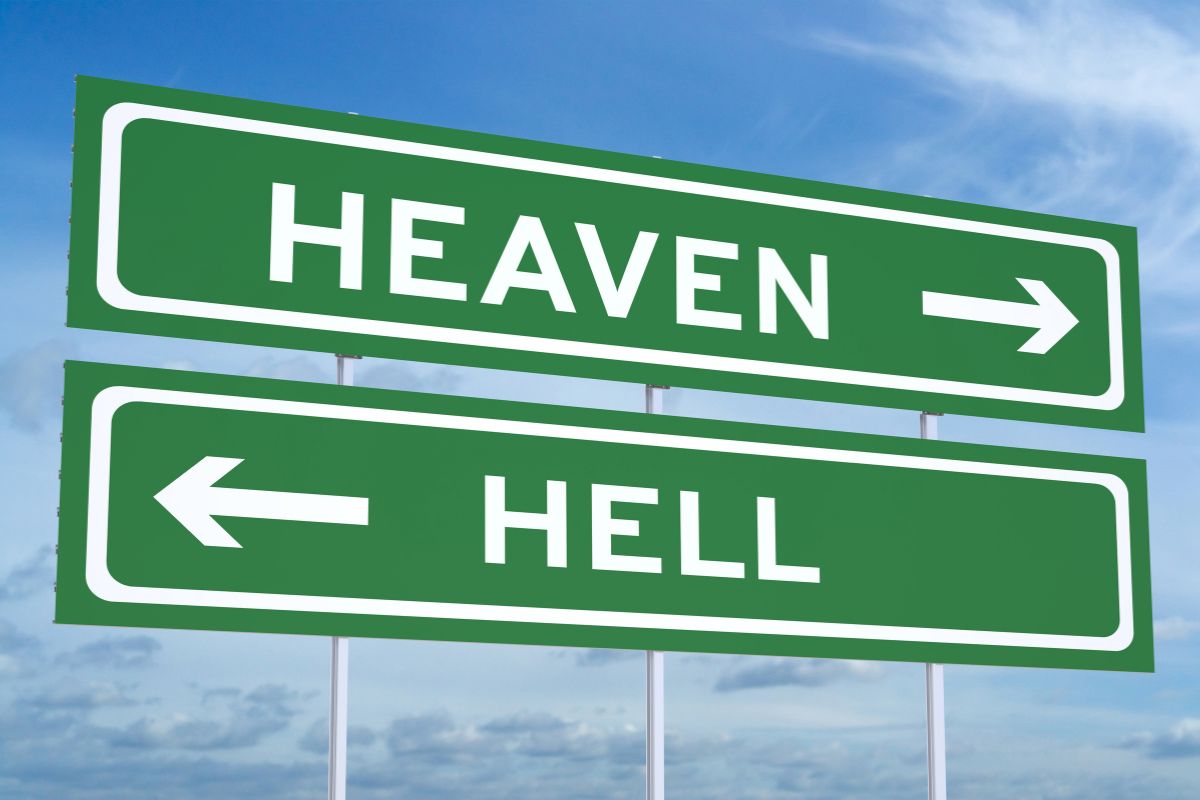
But what about everyone else? It does not seem that everyone loves God; it does not seem that everyone is predestined. If they are not predestined, then they must in the end be damned for all eternity. Is this what God wants? Did God make some people for heaven and others for hell? It might seem that we do not even a choice in this regard; sure, if we are predestined, we are free to pursue under God the predestined path, but we have no say over being predestined or not.
These questions can give rise to great anxiety, anxiety that seems to have weighed heavily on the past five centuries of history. Am I among the predestined to salvation or not?
In the late 16th century, the patron saint of this Diocese, St. Francis de Sales, underwent a great trial in his youth, being convinced that he was predestined to damnation. He was delivered and gained peace of soul by kneeling before a statue of the Blessed Virgin, praying the “Memorare”, consecrating himself to her and making a vow of chastity. Notice, he did not gain certainty of his predestination or salvation, he just stopped worrying about it, gained peace of soul, and began acting like he was indeed loved by God. From there he came to believe in the primacy of God’s love.
Contrariwise, about 70 years earlier, a young Catholic priest, suffering grave doubt about the state of his soul, seeking certainty, came to believe that if he believed hard enough, without any doubts, that he was forgiven by God, that he was among the saved, regardless of his actions, regardless of his sins, then indeed, he was forgiven and would be saved. The name of that priest was Martin Luther and, seeking to resolve his own personal crisis of doubt, seeking a certainty that is not granted to us in this life, he overturned the Church and the world. He also opened the door for John Calvin, another so-called “reformer” who set forth the horrific doctrine of double predestination, some few predestined to heaven, most predestined to hell.
This quest for absolute certainty would eventually resolve to the solution that is so common today: no one is lost, God who is love, predestines everyone to heaven, regardless of how they live on earth. That is a view that certainly makes this life to become very unserious; it finally does not matter what we do, we are all going to heaven – whee!
All these matters show us that what a person thinks and believes can be of great consequence, even in this life, both for himself and for others.
So, how are we to avoid falling off the precipice? Entrusting ourselves to the Blessed Virgin, after the example of St. Francis de Sales, seems like a good start. Putting our trust in God’s love is a second step. Acting as though we are indeed among those predestined to love God, for whom all things work for the good, by diligently doing all that we can to follow the path to heaven taught by Jesus Christ is another step. Those whom he predestined he also called; those he called he also justified; those he justified he also glorified. We must accept the call and live out the justification so as to attain the predestined glorification.
As for those who are not counted among the predestined? We must believe that God designates no one for hell. Those who do not love God have freely chosen to reject his love; if they persevere on this path to the end, they will indeed suffer eternal damnation. That was their free choice. God gave them all they needed for their salvation. Beyond that our mind must bow before the mystery of freedom capable of rejecting God’s love.
The wise son of Sirach taught: Great is the might of the Lord; he is glorified by the humble. Seek not what is too difficult for you, nor investigate what is beyond your power. (Sirach 3:20-21) To understand why some are saved and others not is a mystery beyond human comprehension, truly beyond our power. St Thomas a Kempis, writing of the mystery of the Holy Eucharist wrote, “He who scrutinizes majesty will be overwhelmed by its glory.” (Imitation of Christ, Bk IV.18) Even more could this be said of the mystery of predestination: we should bow before the greatness of God and gladly accept and embrace his merciful gift. Then we can be consoled by those wonderful words, All things work for good for those who love God.
Then we will begin to grasp also that the secure possession of the heavenly mountain peak that we are given to glimpse in today’s 2nd reading awaits those who persevere on the path, whom God fashions according to the image of his Son. Those who realize that the mountain peak of divine wisdom is the pearl of great price and the treasure hidden in the field, will then be ready to give everything they have and follow that rugged path, the way of the Cross, that leads to the top.
Seek a Deeper Connection with God and Join Lay Cistercians of South Florida
Lay Cistercians of South Florida, is a community of lay people who seeks to have a deeper connection with God by living a life inspired by the monks and nuns through Lay Monasticism. Learn more about what is a Lay Cistercian on our website. Anyone who aspires to do the same as us, and is a confirmed Catholic is welcome to join us! We meet every second Saturday of the month at Emmanuel Catholic Church in Delray Beach, Florida.

This Content Has Been Reviewed For Accuracy
This content has undergone comprehensive fact-checking by our dedicated team of experts. Discover additional information about the rigorous editorial standards we adhere to on our website.