The Mysteries of the Kingdom of Heaven – Sermon by Father Levine
Fr. Joseph Levine; Holy Family Catholic Church and Missions, Burns, Oregon; July 12, 2026
May the Lord grant to us eyes that see, ears that hear, and hearts that understand, that we might be truly converted to him and so come to know the mysteries of his kingdom. These are the mysteries that are hidden from the wise and learned of this world but revealed to the childlike (cf. Mt 11:25); these are the mysteries that, once planted in the human heart as in good soil, bear fruit for the glory of God, the salvation of souls, and eternal life. For eyes to see beyond what merely appears to the senses, for ears to hear a message that surpasses human thought, an understanding heart is necessary.
If the soil of our soul is choked by the thorns of worldly cares, we might receive the word, but it will not bear fruit; if our soul is like the rocky soil, occupied by bad habits to which we are attached, no fruit will last; if our soil is like the path, trodden continually by human feet, packed hard, then we will not even hear the word of God, even though it sounds upon our ears.
Now, it might seem strange, but the greatest danger for someone who regularly attends Mass, says prayers, and reads the Bible, might be becoming like the hard-trodden path. The good habit – and these are good habits that we should cultivate – so long as it is just a habit, a mere routine, and not accompanied by continual reflection, can become an obstacle to the fulfillment of the very purpose of the habitual activities. Instead of turning over the soil, these very activities, instead, become like feet, treading down the path.
A child – and we should not blame the child for this – often learns his prayers and can repeat readily the “Our Father” and the “Hail Mary” but never stops to think about the meaning of the words he is saying. He was told to learn the prayers, so he obediently learns the words, but goes no further, unless his parents lead him. Reflection should come with maturity, but it seems that many people never really stop to think about what it is they are doing.
Consider these words of St. Paul, describing how Christ came to be crucified: Those who live in Jerusalem and their rulers, because they did not recognize him nor understand the utterance of the prophets which are read every sabbath, fulfilled these by condemning him – Christ. (Acts 13:27) Now, some of these surely failed to reflect and ponder on what they heard. Others were fixed in their own well-worn paths of human thought; they were, we would say, very opinionated. None of them was like the Blessed Virgin, who kept all these things, pondering them in her heart. (Lk 2:18) The Immaculate Heart of Mary is truly the good soil that receives the word of God and yields a hundredfold fruit; indeed, she even gave birth to the very Word made flesh.
Whether the obstacle to the word of God is the hardness of the path, the shallowness of the soil, or the thorns, there is a solution, but a difficult one. It is called suffering. Through the suffering that God allows in our life, he would break up the hard-trodden path, remove the rocks from the soil, and tear out the thorns of worldly care; through the suffering that he allows in our life, God would lead us to reflection, to ponder the meaning of his word, to seek understanding from him.
Suffering thwarts our own plans, puts a roadblock in front of our self-will.
Our own will is a great good, but also a great peril that we carry within ourselves; to insist on having things “my way”, because it is “mine” is the highroad to hell. When, in indifferent matters, we learn gladly to please another rather than ourselves and when in difficult matters, we learn to choose what is best, what pleases God, rather than what pleases ourselves, then we are entering upon the narrow path that leads to life (cf. Mt 7:13-14); then we are following the example of Jesus Christ who, at the Last Supper, gladly gave us the sacrament of his Body and Blood, even though he knew how ungrateful we would be and how often we would abuse his trust.
Finally, though, suffering confronts us with a question: either life is meaningless and cruel, or there is something deeper, something hidden from our eyes, something that can even give meaning to suffering.
Either we will discover something that will enable us to say with St. Paul, I consider that the sufferings of this present time are as nothing compared to the glory to be revealed for us – then we will have hope, or suffering will lead to despair.
The “death with dignity” movement answers the reality of human suffering with despair. While masked in a mantle of “kindness” and “compassion”, behind the mask is a view that sees no meaning in suffering, unless it can be outweighed by present and manifest benefits. We are surrounded by despair, devoid of the light of eternity.
When our soul is broken open by suffering, we must not listen to the demonic voice of despair but allow the word of God to enter. Despair wounds but cannot heal; despair kills but cannot bring to life. Of God it is written, The Lord kills and brings to life; he brings down to the netherworld and raises up. (1 Sam 2:6) The word of the Lord always brings hope; what is raised up is greater than what is lost; he keeps the best wine for last. (Cf. Jn 2:10)
Job suffered immensely. In the midst of his suffering, he questioned God, directing his questions to God himself. In the end, he received a mysterious answer because God revealed himself through his word. That led Job to say, I had heard of thee with the hearing of the ear, but now my eye sees thee; therefore I despise myself, and repent in dust and ashes. (Job 42:5-6)
Job saw God as present and real, but he did not yet see him as he is, the promise that can be fulfilled only in the next life. (cf. Ex 33:20; 1 Jn 3:2) Yet the vision of living faith is the down-payment on the fulfillment of the promise. The dust and ashes of humility and contrition are the good soil that receives the word of God and so prepares us to receive the fulfillment.
Job suffered immensely, but his sufferings could not compare with those of Jesus Christ on the Cross, who, through his death and resurrection, revealed the glory of the Son of God and the glory to be given to those who, in him, become children of God.
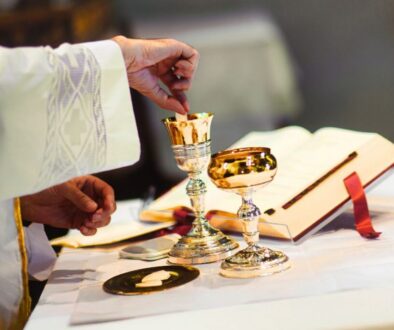
Turning to the 1st reading, the word of God that came down from heaven is, in the first place, Jesus Christ himself. He is the very Word that was in the beginning with God; the one Word in which God said everything there is to say, in which God spoke his very self; the one Word in eternity through which the eternal God created all things; the one Word that is God from God, equal to God, and one God with God; he is at once spoken as a Word and begotten as a Son. (cf. Jn 1:1-3,18) He is the Word who became flesh and dwelt among us. (cf. Jn 1:14) He is the Word that fulfilled the purpose for which he was sent by giving his life on the Cross, laying down his life of his own accord for his sheep, and taking his life up again by his own power. (cf. Jn 10:18) As the Sower, he spoke many words during the course of his earthly life. Among these are found: This is my Body; this is the chalice of my Blood. By these words, he would give himself, the very Word, to us; he would plant himself in our hearts that we might bear fruit to the glory of God, the salvation of souls, and eternal life.
Jesus Christ has fulfilled God’s purpose, doing the will of his Father, making atonement for our sins, winning for us the life of grace. He would continue to fulfill his purpose now by sending the word of his Gospel into our hearts, watering the soil of our hearts with his grace, transforming our lives from within, making us like himself, in his death and in his life, so that, having borne abundant fruit, we might return with him to heaven.
Seek a Deeper Connection with God and Join Lay Cistercians of South Florida
Lay Cistercians of South Florida, is a community of lay people who seeks to have a deeper connection with God by living a life inspired by the monks and nuns through Lay Monasticism. Learn more about what is a Lay Cistercian on our website. Anyone who aspires to do the same as us, and is a confirmed Catholic is welcome to join us! We meet every second Saturday of the month at Emmanuel Catholic Church in Delray Beach, Florida.

This Content Has Been Reviewed For Accuracy
This content has undergone comprehensive fact-checking by our dedicated team of experts. Discover additional information about the rigorous editorial standards we adhere to on our website.