What God Has Made Known To Us – Sermon by Father Levine
Fr. Joseph Levine; Holy Family Catholic Church and Missions, Burns, Oregon; May 31, 2026
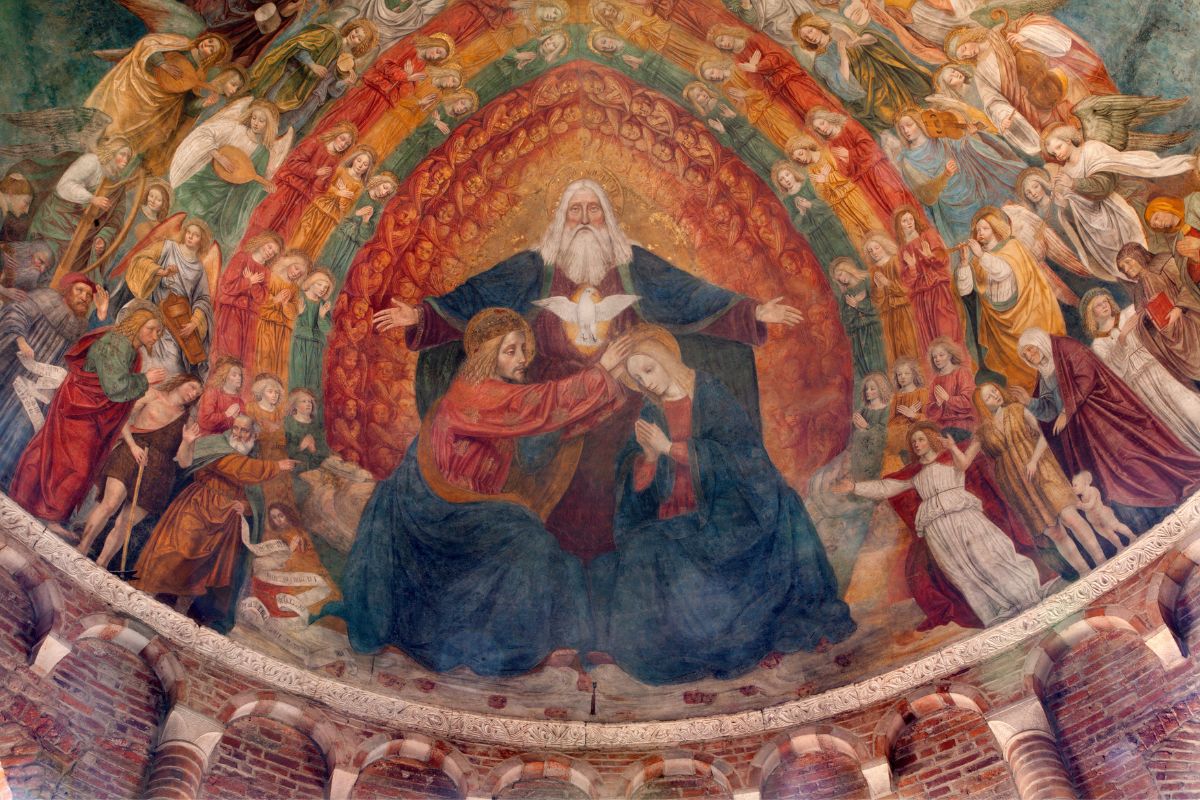
The mystery of the Holy Trinity: three divine persons in one God; one God in three divine persons, the Father, and the Son, and the Holy Spirit. This is the infinite mystery that baffles our finite minds. This is the hidden mystery of God, the creator of the universe, that he made known to us through Jesus Christ, the 2nd person of the Trinity, the Son of God made man. This is truly the great secret, the great mystery that lies at the origin of the universe; it has been given to us to know this mystery through faith; this is truly a great gift, but our minds might be so baffled by the mystery that we wonder what is so special about it, or we might be so accustomed to hearing of the Holy Trinity that we take it for granted.
Let us consider briefly the condition, even in this world, of those who live in ignorance of the Holy Trinity. This will necessarily be very general and schematic.
First, there are those plunged in the darkness of atheistic materialism, who see the world and human life as nothing more than the product of blind, random, material forces or “laws”. For them, finally, there is no ultimate responsibility, no accountability, only raw power, the ability to manipulate and control material, including human material, including themselves. Indeed, the more powerful among them pursue a path of “transhumanism” or “posthumanism” whereby they would use advanced technology to “perfect” or even “transform” humanity, including the humanity of others, willing or unwilling, in their own images, pursuing their own fantasy.
Then there are all the many manifold forms of paganism or polytheism that, while they think there is more to reality than what meets the eye, in the last analysis, they do not recognize any distinction between the divine and the universe, between Creator and creature. As a result, their religiosity will move between two poles: dealing with the so-called “gods” so as to achieve in some way their personal agendas or a path of radical self-denial that seeks reabsorption into the primal unity.
Next, we move to Islam, that recognizes One Creator God, absolute and supreme, together with his so-called “prophet”, who announces the will of God to which everyone must submit. As far as I can tell, Islam is a religion of power. God is, in their eyes, first of all supreme and absolute power. If he is called “merciful and compassionate,” that is because he does not crush those who submit to him but grants them a pleasurable reward in the next life. Muslims most definitely do not recognize God as “Father” but would regard such talk as blasphemy. Communion with God himself is out of the question. While they believe in a final judgment, they do not seem to have a great sense of personal responsibility other than obeying or disobeying the will of God made known through the Koran.
Next, we come to Judaism, and here we are dealing with our close kin, for Christians and Jews both take their origin from the religion of the Old Testament. The Jews are descended from Abraham according to the flesh; Christians are children of Abraham according to the faith. (cf. Gal 3:7)
Yet, Judaism today is shaped by its ancestral rejection of Jesus Christ and the preaching of the Apostles and also by the destruction of the Jerusalem Temple that came a few decades later in 70AD. They possess the rich heritage of the Old Testament; they are still beloved by God and have a providential role to play in his plan of salvation; they possess a deep sense of personal responsibility in terms of fidelity to the covenant and a keen sense of justice, as defined by the commandments.
Nevertheless, instead of recognizing Jesus Christ as the “suffering servant” who redeems mankind for eternal life, they see their own people as the “suffering servant” who “redeems the world”, this world. The words of St. Paul still apply: Being ignorant of the righteousness that comes from God, and seeking to establish their own, they did not submit to God’s righteousness. (Rm 10:3)
“The New Testament lies hidden in the Old, and the Old Testament is unveiled in the New.” (CCC 129) Today’s 1st reading gives us an example of what lies hidden in the Old Testament, read by the Jews, but unknown to them.
God proclaims to Moses the name “Lord”, one Lord, (cf. Dt 6:4), and then he calls out: The Lord, the Lord, a merciful and gracious God, slow to anger and rich in kindness and fidelity.
The title “Lord” is a circumlocution out of reverence for the holy name revealed to Moses on Mt. Sinai, a name that reveals God as “He who is”, the one who has full, complete, and perfect existence from himself, dependent on nothing outside himself, the source of existence for everything else, upon which the whole created world, visible and invisible, is utterly dependent at every moment. When Jesus speaking to the Jewish crowd in Jerusalem said, Before Abraham was, I am, he was effectively applying that divine name to himself. For that reason, the crowd picked up stones to put him to death for blasphemy, but Jesus hid himself and departed. (Jn 8:58-59; cf. Jn 10:33)
Proclaiming his name to Moses, God doubles the name “Lord”. Apparently, this is mere emphasis, but in the light of the New Testament, the second pronunciation of the Holy Name speaks of the perfect image of the first. St. Paul writes of Christ that he is the image of the invisible God. (Col 1:15) He is the image, as a son is the image of his father, in this case the perfect image of God, the Father; he is thus the Son, “born of the Father before all ages, God from God, Light from Light, True God from True God, begotten not made, consubstantial with the Father.”
The love of God, merciful and gracious, slow to anger and rich in kindness and fidelity, finds its supreme manifestation in the gift of his only Son, who became man, who died on the Cross, who rose again from the dead, for our salvation. Yet it is only in the Holy Spirit that we can recognize and receive this gift, saying, Jesus is Lord! (1 Cor 12:3)
Jesus said of the Holy Spirit: He will glorify me, for he will take from what is mine and declare it to you. (Jn 16:14)
The Son of God is born of the Father as his perfect image; since the Holy Spirit is also fully and equally God, he too is perfectly like the Father, but he proceeds from the Father and the Son not as “image”, but as the perfect living and substantial “breath” of their mutual love. The Son is born as the Word and Wisdom of God, the supreme manifestation of Truth. The Holy Spirit proceeds as Divine Love; in him, the truth, God is love, is most manifest. The Holy Spirit is a merciful and gracious God, slow to anger and rich in kindness and fidelity (1 Jn 4:16)
God so loved the world that he gave his only Son. Because the incarnation of the Son of God is a gift of God’s love, we say that he is conceived by the Holy Spirit, who is God’s love in person.
In revealing his inner mystery, God also reveals to the fullest our greatest dignity as persons created in his image and called to communion with him. This is a great gift and a great responsibility, for which we are accountable to God; perhaps we would prefer not to be so accountable; perhaps we would prefer God would not take us so seriously. Yet, to refuse the responsibility, to deny the accountability, is both to refuse the gift and to deny our own personhood.
In our opening prayer, we called upon “God, our Father, who by sending into the world the Word of truth and the Spirit of sanctification made known to the human race [his] wondrous mystery.” The Word of truth is the Word that breathes love, and the Spirit of sanctification is the love that manifests truth; he is the Spirit of truth, who guides us to all truth. (Jn 16:13)
The Son and Word of God, who, having become man, died for our salvation, rose from the dead, and is now seated at the right hand of the Father, has given the Holy Spirit to his Church, the Spirit of sanctification, who works in the souls of the faithful, forming in them the image of Jesus Christ, the Son of God.
This is the gift of the new covenant in the Blood of Christ. Through this covenant we live in the Church, “a people made one with the unity of the Father, the Son and the Holy Spirit” (Lumen Gentium 4); the Church, which “in Christ is like a sacrament or as a sign and instrument both of a very closely knit union with God and of the unity of the whole human race.” (LG 1)
God established the Old Covenant with one people, chosen from among all the peoples of the earth, the people of Israel according to the flesh. He chose them in view of the New Covenant in the Blood of Christ. In Christ and through his Church, that Covenant has now been extended to every tribe and tongue, people and nation. (cf. Rev 5:9) Already, in the Church, we share the life of the grace, life in the Holy Spirit.
All this is so that where Jesus is, in the bosom of the Father, we might also be so as to see the divine glory that he has from the Father from before the foundation of the world. (Jn 17:24) Because he shares the divine glory with the Father, he breathes forth with the Father the glory of divine love, the Holy Spirit. Jesus has made known the Father’s name to us that the love of the Holy Spirit, that he shares with the Father, might be in us, and that in that love we might behold the glory of God. (Jn 17:26)
By revealing to us his inner mystery, the mystery of the Holy Trinity, God has made known to us the mystery of communion of men in God, a communion of life, of wisdom, and of love. This is altogether unheard of anywhere else in the history of mankind; this is altogether inconceivable and unimaginable, except that God has made it known to us.
St. John wrote, That which we have seen and heard we proclaim also to you, so that you may have communion with us; and our communion is with the Father and with his Son Jesus Christ. (1 Jn 1:3) Where two are named, the third is present there because the Holy Trinity is one and inseparable.
Seek a Deeper Connection with God and Join Lay Cistercians of South Florida
Lay Cistercians of South Florida, is a community of lay people who seeks to have a deeper connection with God by living a life inspired by the monks and nuns through Lay Monasticism. Learn more about what is a Lay Cistercian on our website. Anyone who aspires to do the same as us, and is a confirmed Catholic is welcome to join us! We meet every second Saturday of the month at Emmanuel Catholic Church in Delray Beach, Florida.

This Content Has Been Reviewed For Accuracy
This content has undergone comprehensive fact-checking by our dedicated team of experts. Discover additional information about the rigorous editorial standards we adhere to on our website.